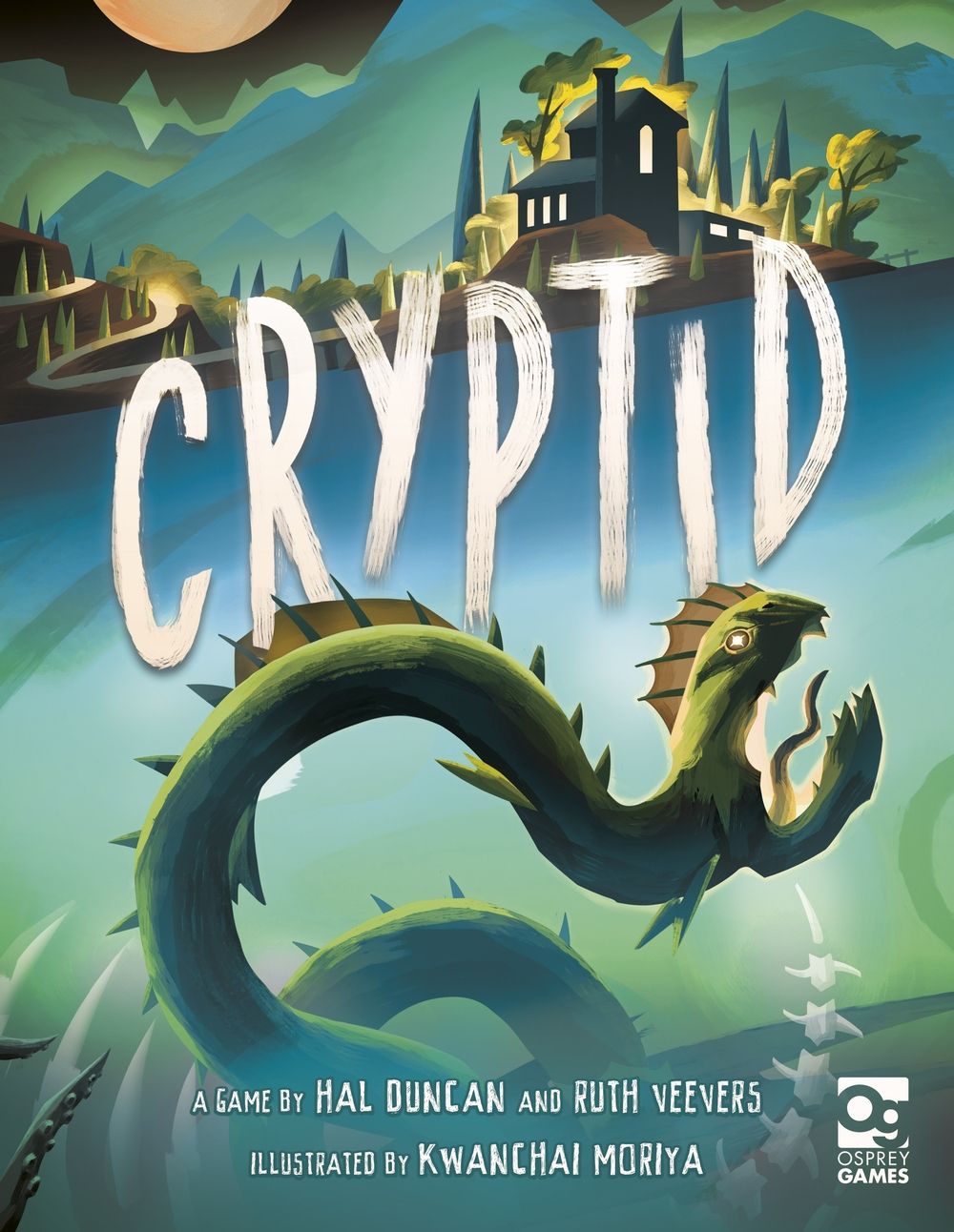
How to Play Cryptid
Osprey Games, 17wanzy (Yihu BG), Doit Games · Board game · 2018What do you want to do now
Ask anything about Cryptid: rules, setup, components, complexity, price, or whether it fits your group.
Video: How to Play
Start here, then follow the written guide
Step by step
Game Objective
Prepare for a cryptozoological adventure! In Cryptid, you and your fellow cryptozoologists are searching for the habitat of a mysterious creature. But beware: ambition has corrupted your hearts, and the glory of discovery is too valuable a prize to share. Your goal is to be the first to use all the clues to locate the single space on the map where the cryptid hides, and thus win the game!
Setup
Let's set up the table for the cryptid hunt! Follow these steps:
- Choose Game Mode: Decide whether you will play in normal mode (ideal for beginners) or advanced mode. In advanced mode, some clues can be negative ("the habitat is not here") and all four structures of each type are used (instead of just three in normal mode).
- Assemble the Map: Shuffle the cards for the chosen game mode and draw one. The front of the card will show the positions and orientations of the six numbered map tiles. Assemble the map accordingly, ensuring that the numbers on the tiles and the dots on the edges match the card.
- Position the Structures: The same card will indicate where to place the Standing Stones (octagons) and Abandoned Shacks (triangles) on the map. In normal mode, only three structures of each type are used; in advanced, all four.
- Distribute Markers: Choose a starting player (whoever assembled the map is a good suggestion). Each player receives a set of Player Markers (cubes and discs) of one color.
- Assign Clues: Flip the setup card to its back. It will indicate which Clue Books should be used for the game, based on the number of players. Each player, in turn order, takes one of the corresponding books. The number on the card's row and the book's column indicates which clue you should consult. Keep your clue secret!
- Initial Sharing: The starting player places a cube on a space on the board that cannot be the habitat, according to their clue. Clockwise, each player does the same, until everyone has placed two cubes. Remember: you cannot place a marker on a space that already contains a cube.
- First Turn: The starting player takes the first turn.
The Game Turn
On your turn, you can perform one of two possible actions: Ask or Search. After your action (unless you have found the habitat), the turn passes to the player to your left.
Core Rules for All Actions:
- You must be honest when placing your markers on the map.
- Markers (cubes and discs) are never removed from the board, unless a mistake has occurred.
- You can never interact (ask, search, or place markers) with a space that already contains another player's marker.
- If you are forced to place a cube (either by an ask or a search), you must also place one of your own cubes somewhere on the board that cannot be the habitat according to your clue.
- If one of your markers is already in a space, you cannot add more markers to that same space.
Possible Actions:
1. Ask
To Ask, follow these steps:
- Place the Pawn on any space on the map. You can even choose a space you know is not the habitat to throw others off!
- Ask any other player: "Can the creature be here?"
- The questioned player must answer honestly, according to their clue, and place one of their markers on the space:
- If the space can be the habitat for them, they place a disc of their color. (Discs can be stacked).
- If the space cannot be the habitat for them, they place a cube of their color. (Only one cube per space).
- If the questioned player placed a cube, you (the active player) must also place one of your own cubes on a different space that cannot be the habitat, according to your clue.
- The turn passes to the player to your left.
2. Search
To Search, follow these steps:
- Place the Pawn on a space on the map that can be the habitat according to your own clue.
- Declare that you are "Searching" that space.
- Immediately, place one of your own discs on that space. If you already have a disc there, place a disc on another space that can be the habitat according to your clue and that does not yet contain one of your discs.
- Clockwise, ask each other player if, according to their clues, the creature can be in that space.
- Each player responds by placing a cube or a disc on the space, unless they already have a disc of their color there.
- End of Search:
- If any player places a cube, the search ends immediately. No one else needs to respond. You (the active player) must then place one of your own cubes on another space that cannot be the habitat according to your clue. The turn passes to the player to your left.
- If no one places a cube (i.e., all players placed discs or already had discs there), you have correctly identified the habitat and won the game! Congratulations, cryptozoologist!
End of Game and Scoring
The game ends immediately when a player performs a Search and all other players confirm that the searched space can be the habitat according to their clues (i.e., no one places a cube). That player is declared the winner!
There is no scoring in Cryptid; it's a race to be the first to find the habitat.
Tips for Winning
To become a Cryptid master, consider these tips:
- Be Strategically Honest: You must be honest when placing your markers, but you can be cunning. If your clue is "the habitat is not a mountain," and you need to place a cube, placing a cube on a different mountain can lead others to think that is your clue, diverting attention.
- Use Paper and Pencil: Don't underestimate the power of taking notes! Recording the information you get from other players (especially where they place cubes and discs) is crucial for deducing their clues and refining your own search.
- Understand the Clues: Familiarize yourself with all possible clue types. Knowing how clues work (distances, terrain types, structures, animal territories) and how they manifest on the board will help you interpret other players' actions and plan your own questions and searches. Remember that "within X spaces" includes the element's own space.
More videos
More rules explanations from the community


Rules manual
Official PDF file
Frequently Asked Questions
Quick answers about the rules