
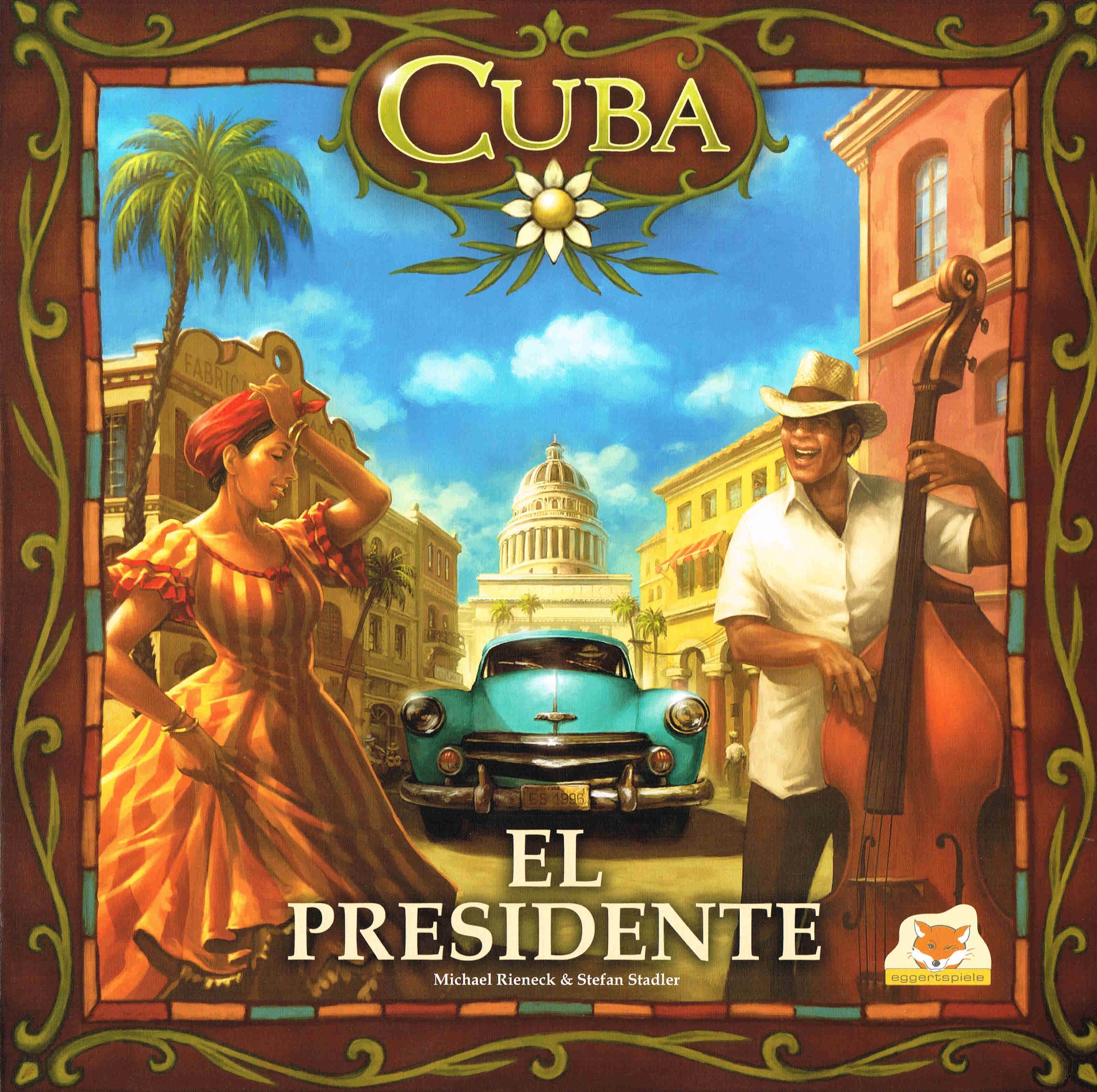
How to Play Cuba: El Presidente
eggertspiele, Filosofia Éditions, The Game Master BV · Board game · 2009What do you want to do now
Ask anything about Cuba: El Presidente: rules, setup, components, complexity, price, or whether it fits your group.
Video: How to Play
Start here, then follow the written guide
Step by step
Objective of the Game
The adventure in Cuba continues with the El Presidente expansion. This expansion introduces several Cubans and a president, offering new tactical possibilities. While new ships, acts, and buildings are optionally available, the core objective and gameplay remain essentially the same as the basic Cuba game. Players are trying to achieve victory, presumably through accumulating victory points, though the specific conditions for winning are not detailed in this context.
Preparation (Setup)
First, set up the basic game of Cuba. Then, follow these steps for the El Presidente expansion:
- Gameboard: Place the new game board so it touches the upper edge of the "Cuba" game board, creating 4 complete spaces for the bills above the Capitol.
- Car: Put the president's car in front of the first space on the "Avenida del Presidente" (President Boulevard).
- Ships: Shuffle the 6 new ship cards into the existing ship card pile.
- Buildings: Place the 5 new building tiles, along with the buildings from the basic game, face up to the right of the game board. If you prefer to play with the original number of buildings, you can replace any 5 buildings from the basic game with the new ones.
- Cubans: Shuffle the 6 new Cuban cards and randomly distribute them face up on the 6 big spaces of the new game board, placing 1 card on each space. Adjust for fewer than 5 players:
- Players can choose which Cuban cards to replace.
- The female dancer must be included in all games.
- 5 players: All Cuban cards are used.
- 4 players: Replace 1 Cuban with 1 donkey card.
- 3 players: Replace 2 Cubans with 2 donkey cards.
- 2 players: Replace 1 Cuban with 1 donkey card.
- Statute cards: Players agree on the number of rounds they want to play. There are 2 new acts per type of act, allowing the game to be played for 8 rounds.
- For 8 rounds, shuffle the new acts into their respective stacks.
- If playing fewer than 8 rounds, remove the appropriate number of cards from each statute card stack before starting. Players determine which cards to remove, or they are removed randomly. The new acts include 2 tax acts, 2 duty acts, 2 subsidy acts, and 2 other acts.
Flow of the Game
Overview of the Action Phase
During their turn in the action phase, a player can choose a Cuban card from the game board instead of a character card from their hand. After choosing, the player immediately performs the action indicated on the chosen card. Each player has one more turn in total (five turns) during the action phase than in the basic game. The exception is a two-player game, where each player will play a card six times, as each player selects 2 Cuban cards.
Playing the Cuban Cards
- Sometime during the round, each player must take 1 Cuban (except in a two-player game).
- No player may take a donkey.
- Each Cuban may be used only once per round.
- When a player chooses to take a Cuban, they remove the card from the layout, put it in their play area (on the table near them), and immediately perform the action. After that, they put the card aside until the next round.
- A player may never use a Cuban in the same turn that they use a hand card (worker, tradeswoman, etc.), but only instead of it.
- Each player is free to decide in which turn they will play a Cuban.
End of the Action Phase
At the end of the action phase, there is always one Cuban card left. The president rides in his car to this remaining Cuban, thereby triggering a specific event. The Cuban itself is no longer important, but the space it occupies is, as each space shows a symbol for an event.
- The car moves along the 6 spaces of the "Avenida del Presidente" (President Boulevard).
- The president never drives to a donkey.
- The car must always move at the end of an action phase. If a card is left on the same space as in the previous round, the car "moves" to the same space, and the event is repeated.
The Events
Some events are effective immediately, some later, and others do not become effective until the next round.
- Space 1 Event: In the next round, each player sends 2 (not 1) of their characters (hand cards) to parliament. This means each player has one less action in the next round. In the respective parliament phase, each player has the total number of votes for both of their characters sent to parliament.
- Space 2 Event: All current bills for this round are passed automatically. The next parliament phase is omitted since voting is not necessary. If the church owner has used the church for his veto, all 3 remaining bills are passed.
- Space 3 Event: Every player who plays their foreman during the next action phase may move their worker at the same time. This allows everyone to move their worker twice – with the worker (as usual) and with the foreman. This is particularly advantageous for using buildings.
- Space 4 Event: Each player may immediately pay 1 peso and overbuild one of their own buildings. Beginning with the starting player, each player may take a building from the layout and build it on top of an already existing building on their plantation board. To pay the building costs for the new building, the player only has to pay the difference in resources. Overbuilt buildings do not give any additional victory points in the final scoring and have no influence on taxes or subsidies.
- Space 5 Event: The leading player immediately loses 2 victory points. If two or more players are tied for the lead, each of them loses 2 victory points.
- Space 6 Event: Beginning with the starting player, each player, in turn, may take a piece of any one kind of merchandise (citrus fruit, sugar cane, tobacco, rum, or cigars) from the market.
- They may take merchandise only from the market, not from the stock.
- Players take the chosen pieces from the market from right to left, meaning always the cheapest tobacco, rum, etc., first.
- When a player chooses a product, they may store it immediately; they need not put it in the lot first.
- If, on a player’s turn to take something, nothing is left, they get nothing.
From One Round to Another
- Car: The car remains at its new location until the president drives at the end of the next action phase. This is important for spaces 1 and 3, as those events take effect later.
- Cuban cards: At the beginning of each round, reshuffle all Cuban cards and distribute them anew on the 6 spaces (as during the set-up).
- Final round: In the final round, the events of spaces 1, 3, and 4 do not have any effect on the game.
Actions and How to Play
Players choose a Cuban card from the game board instead of a character card from their hand and immediately perform the indicated action.
The Cuban's Actions
- The Dancer: Gives a player the right to be the starting player. When a player chooses the dancer, they immediately become the new starting player and move the starting player card to their play area. The starting player rule of the basic game is not used with El Presidente. If nobody chooses the dancer, the starting player passes the card to their left neighbor at the end of the action phase.
- The Musician: Gives a player money. When a player chooses the musician, they immediately take 2 pesos.
- The Day Laborer: Stores products. When a player chooses the day laborer, they may immediately store all their products (citrus fruit, sugar cane, and tobacco). This does not apply to products they get later.
- The Harbor Master: Changes ship positions. When a player chooses the harbor master, they may immediately exchange 2 neighboring ships in the harbor with one another. This does not apply to a ship at sea. The harbor master can exchange the ship on position 2 in the harbor with either of the two other neighboring ships (position 1 or 3). The player may forego an exchange.
- The Lawyer: Uses a building. When a player chooses the lawyer, they may immediately use one of their own buildings once. First, they must pay 1 peso. The worker's position is irrelevant.
- The Revolutionary: Gives a player 1 victory point. When a player chooses the revolutionary, they immediately score 1 victory point.
New Buildings and Their Actions
- Casino: Building costs: 1 stone, 1 water + 1 wood. If a player uses their casino with the foreman, they either pay 5 pesos to get 2 victory points, or vice versa (give up 2 victory points to get 5 pesos). This feature can be used twice per round.
- Customs Office: Building costs: 1 wood. If a player uses their customs office with the foreman, they can load any one piece of merchandise from the general stock onto any one ship in the harbor. They do not get victory points for it; it just blocks the loading spot. Alternatively, the owner of the customs office may also take off any one piece of merchandise from a ship of their choice in the harbor and put it in the general stock, vacating a loading spot. Again, no victory points are gained for this. This feature can be used once per round.
- Beach Café: Building costs: 1 stone + 1 wood. The beach café has a special status. It can be used anytime to do a second action with one of your cards, even without a foreman. The owner of the beach café may use the alternative features of their tradeswoman, their architect, and their mayor, even if they have already been used by another player (marked "occupied").
- Statue: Building costs: 1 water + 5 stone. During the game, the statue is not of any concrete use. At the end of the game, however, it gives its owner 1 additional victory point per building, meaning 3 instead of 2 victory points. This also applies to the statue itself and the warehouse printed on the plantation board. The foreman has to activate it in the final round for the statue to take effect.
- Newspaper Publishing House: Building costs: 2 stone + 2 wood. When a player uses their newspaper publishing house with the foreman, they get the press tile. They immediately put it on one of the 4 current bills. If this marked bill does not pass in the following parliament phase, the owner of the newspaper publishing house earns 1 victory point and 1 peso. This also applies if it belongs to the player who passes the bills (and selects 2 other bills).
New Acts
There are 2 new acts per type of act:
- Tax Acts:
- One act requires 6 pesos tax.
- The other act requires 1 peso for every 10 earned victory points.
- Duty Acts:
- One act requires, as duty, pesos as high as the current tax.
- The other act requires, as duty, any one product and any one resource.
- Subsidy Acts:
- One act gives 1 victory point for each unit of rum and/or cigars that a player owns.
- The other act gives the non-leading players advantages. Players get victory points according to their position on the victory point track: position 1 gives 1 victory point, position 2 gives 2 victory points, position 3 gives 3 victory points, etc. If several players are in the same position, they get the same number of victory points; however, they occupy one place each (as in a horse race).
- Other Acts:
- Export Act: When a player supplies a ship, they get 2 victory points for each piece of merchandise supplied, regardless of the position of the ship in the harbor.
- Control Act: The alternative features of tradeswoman, architect, and mayor do not apply; this also affects the use of the beach café.
End of Game and Scoring
The game ends after a number of rounds agreed upon by the players at the beginning of the game (up to 8 rounds with the new statute cards). The specific criteria for final scoring and victory are not detailed in the provided context, beyond the Statue giving additional victory points at the end of the game (1 additional victory point per building, totaling 3 instead of 2 victory points for the statue itself and the warehouse, if activated by the foreman in the final round).
Tips for Winning
- Early Decisions for More Choices: When a player makes an early decision regarding which Cuban card to choose, they have more options available to them.
- Influence on Events: If some Cubans have already been chosen, players have fewer choices left, but they gain more influence over which event the president will trigger next.
- Preventing Events: When a player chooses a Cuban card, they automatically prevent the event of the respective space from being triggered by the president. This can be a powerful tactical consideration.
Rules manual
Official PDF file
Frequently Asked Questions
Quick answers about the rules
