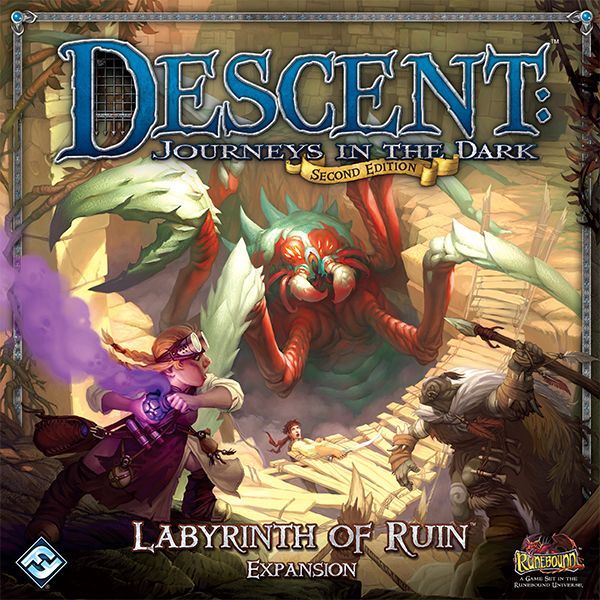
How to Play Descent: Journeys in the Dark (Second Edition) – Labyrinth of Ruin
Fantasy Flight Games, ADC Blackfire Entertainment, Arclight Games · Board game · 2013What do you want to do now
Ask anything about Descent: Journeys in the Dark (Second Edition) – Labyrinth of Ruin: rules, setup, components, complexity, price, or whether it fits your group.
Step by step
Game Objective
In Descent: Journeys in the Dark (Second Edition) - Labyrinth of Ruin, players are transported to the ruins of Sudanya, an ancient city full of dangers and mysteries on the borders of Terrinoth. The heroes must face horrible creatures, but they will count on powerful allies to guide them through the twisted labyrinth of the deserted and ruined city.
The main objective is to complete a new epic campaign, "The Labyrinth of Ruin," which unfolds through a series of quests. The heroes seek to unravel the secrets of the forgotten city. The campaign culminates in a Final quest that will determine the grand winner of the campaign.
Preparation (Setup)
Before starting the game, all players must agree on which expansion to include. When using the Labyrinth of Ruin expansion, all of its components must be used, unless otherwise indicated. This means that players will have access to new heroes, classes, items, travel events, monsters, and Overlord cards.
The Expansion Setup involves the following steps:
- Incorporate New Cards:
- Add all Shop Item and Travel Event cards from this expansion to their respective decks.
- Take the new Class, Condition, Overlord, and Monster cards and add them to the available card pool. They function in the same way as similar cards from the base game.
- Separate Campaign Cards:
- Set aside the Lieutenant, Relic, Ally, and Ally Skill cards from this expansion. They are only used when the "Labyrinth of Ruin" campaign is played.
- Incorporate Other Components:
- Add the green power die, Hero tokens, monster and hero figures, all markers, and map tiles from this expansion to their respective supplies.
If using multiple expansions, mix the corresponding components. For example, the Item cards from this expansion should be mixed with the Item cards from the base game and any other expansions in use.
The "Labyrinth of Ruin" campaign uses a new campaign map. Heroes always begin their journey at Pylia Camp and must follow a continuous path to the chosen quest location on the map.
Game Flow
The "Labyrinth of Ruin" campaign follows many of the rules of the base game's "The Shadow Rune" campaign, but with some specific changes. Players will play a total of nine quests during the campaign.
Campaign Structure
- Introductory Quest: The campaign begins with the "Ruinous Whispers" quest.
- Act I:
- After completing the introductory quest, the quest winner chooses the next Act I quest. Available quests are indicated by arrows on the campaign log. For example, after "Ruinous Whispers," one can choose between "Gathering Foretold" or "Honor Among Thieves."
- After completing an Act I quest, the winner chooses between the two available quests listed below it on the campaign log, connected by an arrow.
- Two Act I quests, "Fury of the Tempest" and "Back from the Dead," are always available, regardless of the choice after the introductory quest.
- After completing three Act I quests, the Interlude must be chosen as the next quest.
- Interlude:
- The Interlude is a special quest that marks the transition from Act I to Act II.
- There are two different Interlude quests, and the one to be played is chosen by the winner of the last Act I quest.
- The Interlude is considered an Act I quest.
- Act II:
- After completing the Interlude, the campaign shifts to Act II. The Act II steps listed in the basic game rulebook must be resolved.
- The winner of the Interlude chooses which Act II quest will be played first.
- After each Act II quest, the winner chooses the next Act II quest. Players are free to choose any Act II quest that has not yet been played.
- After completing three Act II quests, it is time for the Finale.
- Finale:
- The campaign ends with an exciting quest known as the Finale.
- There are two different Finale quests: "A Glimmer of Hope" (if the heroes won "Tipping the Scales" during Act II) or "Endless Night" (otherwise).
- The Finale quest is considered an Act II quest.
Ally Activation
During a quest where hero players control an ally, they can activate it once each turn before the Overlord's turn. The ally must be activated before or after a hero has completed their turn, but not during a hero's turn. After activating the ally, the Ally card is flipped to indicate that it has already been activated this turn.
Actions and How to Play
This expansion introduces new elements and rules that affect actions and gameplay.
New Power Die
The green power die functions similarly to the red and yellow power dice. Some specific weapons and abilities will utilize this die.
New Classes
Four new classes are added, one for each archetype: Apothecary (Healer), Beastmaster (Warrior), Enchanter (Mage), and Treasure Hunter (Scout). Heroes can choose from these classes during Hero Setup.
- Elixir Tokens (Apothecary):
- The Apothecary class interacts with elixir tokens. When choosing this class, the player places the elixir tokens in a pile near their play area.
- When instructed to gain an elixir token, the player takes one from the supply and places it on their Hero token.
- To discard an elixir token, it is removed from the hero token and returned to the supply.
- Elixir tokens remain on Hero tokens between encounters but are discarded at the end of a quest. The number of elixir tokens is limited only by the supply.
- Any hero with an elixir token can discard it at any time during their turn to recover damage. This ability, "Mix Elixir," allows rolling a red power die and recovering damage equal to the number rolled. A knocked-out hero cannot discard an elixir token.
- Heroes can trade elixir tokens following the base game's trading rules.
- Charm Tokens (Enchanter):
- The Enchanter class interacts with charm tokens. When choosing this class, the player places the charm tokens in a pile near their play area.
- When a monster is charmed by an Enchanter Class card, the hero player places a charm token next to the monster, making it a CHARMED MONSTER. The number of charm tokens on a monster is limited only by the supply.
- A hero attacking a charmed monster can discard one or more charm tokens from the target monster, after rolling dice. For each charm token discarded, the attack deals one additional damage to the monster. This ability is "Weakening Charm."
New Overlord Deck
An alternate deck of 15 basic Overlord cards, identified by the expansion symbol and named "Basic II," can replace the base game's basic deck. At the start of a campaign, the Overlord player chooses which basic deck to use and cannot mix basic cards between decks. Overlord cards may have an additional effect if played on the appropriate hero archetype.
Some Overlord cards are "Quest Reward," with no experience cost, and become available as a reward for specific quests. When the Overlord receives them, they shuffle them into their deck.
New Travel Event Cards
Some new Travel Event cards allow heroes to choose a hero of a specific archetype to keep the card in their play area. If there are no heroes of the listed archetype, the card is discarded. If there are, the card is placed in the hero's play area and can be discarded to trigger its event. Travel Event cards not used at the end of the quest are shuffled back into the deck.
Elevation
Elevation is represented by a red dotted line (elevation lines) that blocks movement but not line of sight. Figures cannot move across an elevation line but can trace line of sight. Spaces separated by an elevation line are still adjacent. When attacking melee across an elevation line, the target adds a black defense die to their defense pool, unless the attack has the Reach keyword.
Large monsters are blocked by elevation lines for movement but can end or interrupt movement in spaces with elevation lines, provided they are empty. A figure with the "Fly" ability can move across elevation lines.
Foliage
Foliage is a new feature, similar to green doors in the Quest Guide. Figures cannot trace line of sight through foliage and cannot attack through it. However, figures can move through them and count spaces through foliage for abilities. Large monsters cannot occupy two spaces separated by foliage.
A figure can perform an open or close door action to remove an adjacent foliage from the map, returning it to the game box. This is considered as a door being opened.
Allies
Allies are new campaign-specific characters in "Labyrinth of Ruin" who can join the heroes. They are represented by ally tokens on the map and are treated as hero figures for abilities, attacks, and Overlord cards. They are friendly figures to heroes and enemies to monsters. Ally cards list their attributes, abilities, characteristics, and attack/defense dice.
- Gaining Allies: Heroes can receive an ally as a reward from certain quests. The corresponding card and token are placed in the heroes' play area and stored between sessions.
- Ally Skills: Heroes can upgrade their allies with ally skills, received as quest rewards. Ally Skill cards function like Class cards, listing talents and special actions.
- Controlling Allies: In certain quests, heroes control an ally. This is specified in the quest setup. If the quest says "Heroes control their allies," they control the ally received in the campaign. Outside the campaign, heroes can choose which ally to control. The ally token must be placed adjacent to a hero at the start of the quest.
- Ally Actions: When activated, an ally can perform two actions, only one of which can be an attack action. Available actions are:
- Move: Move a number of spaces equal to its speed.
- Attack: Attack a monster once per activation.
- Revive a hero: Revive an adjacent knocked-out hero.
- Ally Action: Unique actions listed on Ally cards or Ally Skill cards (marked with a �). If it allows an attack, it counts as the attack action.
- Open or Close a Door: Open or close an adjacent door.
- Special: Unique actions provided by quests, clearly stated "As an action."
- Ally Damage and Defeat: Allies can suffer damage and conditions. When defeated, the ally token is removed from the map, and it is out of play for the rest of the encounter. Allies recover all damage at the end of the encounter.
The Sunstone Token
The Sunstone is a powerful relic. In addition to its card, it is represented by a sunstone token. When a hero is equipped with the "Sunstone" relic, they place the sunstone token on their hero token. If the hero is defeated, the token is placed in their space and the Relic card next to it.
As an action, a hero or monster can pick up the sunstone token. If it is a hero, the token goes to their Hero token and they receive the Relic card. If it is a monster, the token is placed at the base of the monster. If the monster carrying the Sunstone is defeated, the token is placed in the monster's space.
If a monster is carrying the sunstone token at the end of any encounter, the token is returned to the game box and the Overlord receives the "Sun's Fury" Relic card. Any lieutenant can use the "Sun's Fury" relic in addition to any other relic, but it does not drop the sunstone token when defeated, an exception to normal relic rules.
End of Game and Scoring
The game ends with the Final quest of the "Labyrinth of Ruin" campaign.
- After completing three Act II quests, players resolve the campaign phase normally and then the heroes travel to the Final quest.
- The Final quest is chosen based on a previous event:
- If the heroes won "Tipping the Scales" during Act II, the final quest is "A Glimmer of Hope."
- Otherwise, the final quest is "Endless Night."
Rules manual
Official PDF file
Frequently Asked Questions
Quick answers about the rules
What is the objective of Descent: Journeys in the Dark (Second Edition) – Labyrinth of Ruin?
How do you set up Descent: Journeys in the Dark (Second Edition) – Labyrinth of Ruin?
How do you play Descent: Journeys in the Dark (Second Edition) – Labyrinth of Ruin?
How does Descent: Journeys in the Dark (Second Edition) – Labyrinth of Ruin end, and how do you score?
Expansion for
Published additional content