How to Play Evolution: Flight
North Star Games, LLC, Rightgames RBG SIA · Board game · 2015What do you want to do now
Ask anything about Evolution: Flight: rules, setup, components, complexity, price, or whether it fits your group.
Step by step
Objective of the Game
In Evolution, players adapt their Species with Traits to survive in an ever-changing ecosystem. You're trying to ensure your Species survive and thrive, while others might disappear forever. The game ends after the round where the Trait Card deck needs to be reshuffled during the Deal Cards Phase. At the end of the game, scoring considers how much Food has been eaten, the Population of surviving Species, and the number of Traits on your surviving Species. The player with the most points wins!
Preparation (Setup)
- Put the Watering Hole in the middle of the table.
- Place the Cliff next to the Watering Hole.
- Put the Species Boards and Wooden Markers within easy reach.
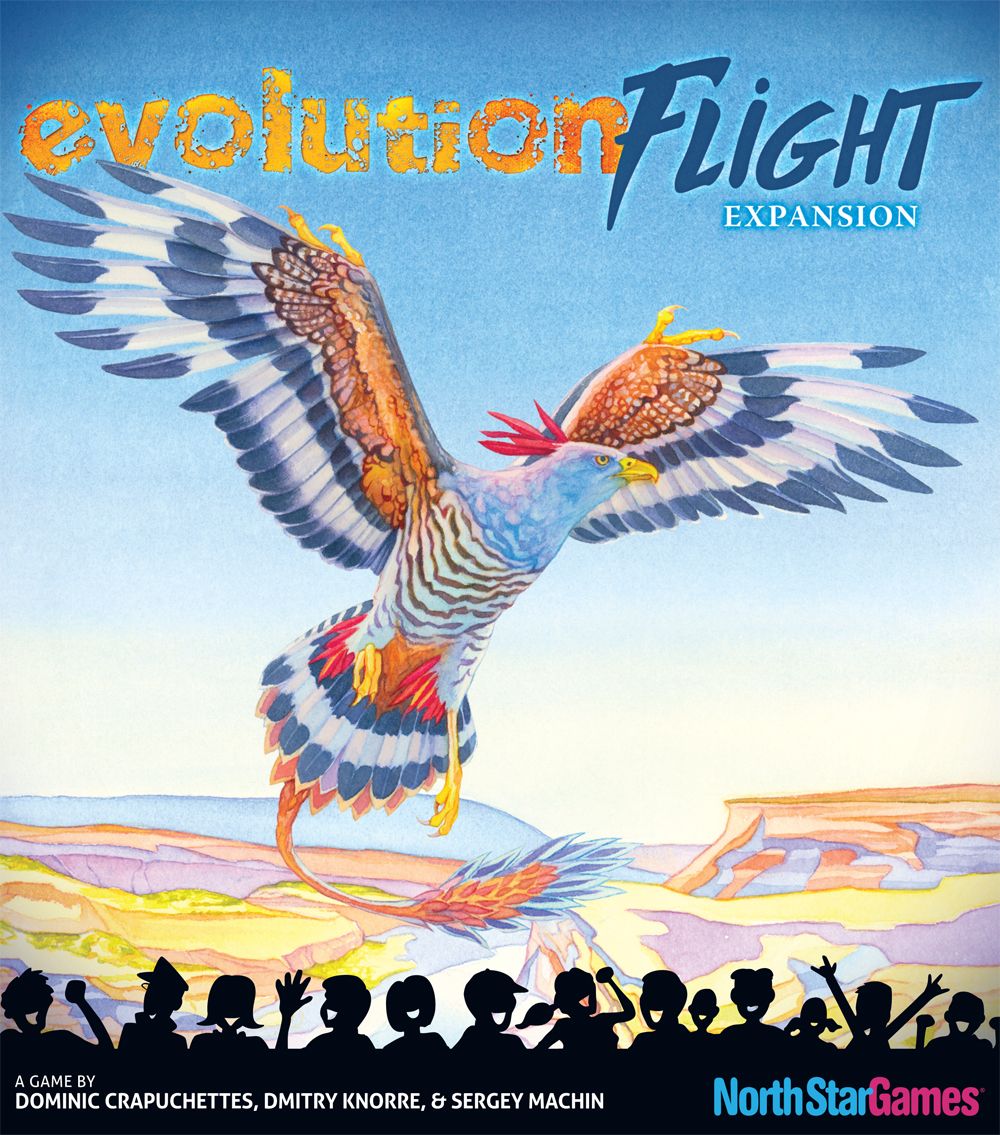
- Place the Avian Species Boards and 12 Flight Trait Cards next to the Species Boards.
- Put the Food Tokens to one side to form the Food Bank. Food Tokens are unlimited, so if you run out, substitute other counters in.
- Give each player one Food Token Bag.
- Shuffle the Trait Card deck and place it face down on the table. Also shuffle into this deck the Trait Cards and Event cards from Flight if using this expansion.
- Remove 40 cards from the deck, and place them to one side to form a Reserve. When the main deck is exhausted, use the Reserve for the last round instead of reshuffling.
- Randomly determine the first player, and give them the First Player Marker (dinosaur).
Fluxo do Jogo
The game has a variable number of rounds. Rounds are played until the End Game condition is met. Each round consists of four phases:
Phase 1: Deal Cards (and Species)
- Place a Species Board in front of any player who has no Species at all. This is all players in the first round.
- Set the Population and Body Size of any Species added in this way to 1.
- Deal 3 cards plus 1 additional card for each Species a player owns to each player (e.g., four cards each on the first turn).
- If the draw deck is depleted during this phase, the Reserve deck is used, and this round is the last round.
Phase 2: Select card for Food
Each player secretly chooses one of the Trait Cards they have in their hand, based on how much Plant Food they wish to add to the Watering Hole (bottom right number in leaf). Each player places a Trait Card face down in the Watering Hole (these are now known as Food Cards, and are revealed during Phase 4: Feeding).
Phase 3: Play cards
Starting with the first player and proceeding clockwise, each player has the opportunity to play as many Trait Cards from their hand as they wish (or they may save them for future rounds). The Trait Cards may be played for any of the following three effects, in any order and any combination:
- Play a Trait – The player places a Trait Card face down next to one of their Species. A Species may not have any duplicate Traits. A Species may not have more than three Traits at a time. If you wish to add a Trait to a Species with three Traits already, discard a Trait and replace it.
- Create a New Land Species – A player may discard a Card face up to get a new Species. He places a new Species Board in front of him and adds Wooden Markers, setting Population and Species Size to 1. The new Species can be added to the left or right of the Species Board row, but not between two pre-existing Species.
- Create a new Avian species – A player may discard 2 cards to create an Avian species. The player takes an Avian Species Board, places it in front of him and sets population and body size to zero. He also takes an avian trait card and places it above the avian species board.
- Increase Body Size or Population – A player may discard a Trait Card face up to increase either the Population or Body Size of a Species by 1. Move a Wooden Marker accordingly. A Species cannot have a Body Size or Population greater than 6.
- Discard a Trait – Players may discard Trait(s) without replacing them.
- Play an Event – If a player has an Event card (Seed Dispersal or Dive Bomb), the Event card may be discarded to the discard pile for an immediate effect.
Once a player has spent as many Trait Cards as they want, play passes to the next player clockwise, and he plays cards in the same way, and so forth until each player has played their cards. Then, the Trait Cards played are simultaneously revealed.
Phase 4: Feeding
Cards with a leafy border have effects that may trigger BEFORE the Food Cards are revealed. If a player has multiple Traits that trigger at this point, he can choose what order to trigger them in. If there is any conflict in resolution of leafy border cards, resolution proceeds clockwise from the first player, and each player resolves all their leafy border effects before the next begins.
Feeding occurs in three steps:
- Reveal Food Cards: The first player reveals the Food Cards and totals their Food value. The first player adds that much Food to the Watering Hole from the Food Bank (if a positive value), or removes Food from the Watering Hole and returns it to the Food Bank (if it is a negative value). The revealed Food Cards are placed on the discard pile. Also place food on the Cliff equal to the number of players.
- Feeding Species: Beginning with the first player and continuing clockwise, each player must feed a hungry Species. A Species is hungry if it has less Food than its Population. A Species can never eat more Food than its Population. When a Species takes Food, it is placed in the Food Track on the board of the Species that is eating, starting from the 1 position. Any Food eaten is worth 1 point per Food Token at the end of the game.
- Feeding non-Carnivores – Take one plant Food from the Watering Hole, and place it on the Species you are feeding. Some Traits (e.g. Foraging) may modify the amount of Food taken from the Watering Hole, but a Species can never take more Food than it has Population. Non-Carnivores normally eat plant Food, but they can also eat meat Food with Traits such as Scavenger and Co-operation. An avian species can take food from the watering hole or the cliff, but not both at the same feeding (e.g. when using Co-operation or Foraging). Cooperation triggers as normal. An avian species must take food equal to its body size before it can feed its population, and this upkeep food is placed on the bottom of the avian species board.
- Feeding Carnivores – Carnivores can never eat Plant Food, even using Traits such as Long Neck or Co-operation. They feed by attacking other Species. A Species must attack if it is hungry, even if it means attacking a Species with Horns, or another Species belonging to the same player. A player may attack any Species, including their own. Carnivores can continue to feed (attack) after the Watering Hole runs out of plant Food. An attack can be made if:
- The Carnivore’s Body Size is larger than the Body Size of the Species being attacked, AND
- The Carnivore has the necessary Traits to overcome the attacked Species’ defensive Traits.
- Reduce the Population of the attacked Species by 1. If this reduces the Population below the amount of Food already consumed, the attacked player puts the excess Food in their Food Token Bag. If the Population is reduced to zero, the Species becomes Extinct.
- The attacking player takes meat Food from the Food Bank equal to the Body Size of the attacked Species and places it on the attacking Carnivore’s Species Board.
- End of feeding – Feeding ends when all Species have eaten Food equal to their Population size, or when all hungry Species are no longer able to eat.
- If a Species did not manage to eat as much Food as its Population, reduce its Population to the same level as the Food eaten. If the Species failed to eat any Food, it becomes Extinct.
- Each player places all Food eaten by their Species in their Food Token Bag.
- Upkeep food for avian species is returned to the Food Bank, and not added to the player’s Food Token Bag.
- Any plant Food remaining on the Watering Hole stays in place.
- Pass the start player marker to the left.
Ações e Como Jogar
Consulte o manual para detalhes sobre esta seção.
Fim de Jogo e Pontuação
The game ends after the round where the Trait Card deck needs to be reshuffled during the Deal Cards Phase. If the main deck is exhausted during Phase 1: Deal Cards, then add the reserve deck to the main deck, and the game ends at the end of the current round. If the main deck is exhausted for any other reason, play one more full round, and then the game ends. End of game scoring is then conducted as follows:
- Each Food in a player’s Food Token bag is worth one point.
- Each surviving Species is worth points equal to its Population.
- Each Trait card on a surviving Species is worth one point.
Add up the points, and the player with the most points wins! If there is a tie, the player with the most Trait Cards is the winner, with Population points as the second tie breaker.
Dicas para Vencer
- Consider the colors on cards: Red Traits help Carnivores, White Traits help protect Species from Carnivores, Green Traits relate to getting Food, and Yellow Traits relate to Population or other effects.
- When playing with promo cards, select 1-3 sets of Traits and substitute them for an equal number of promo cards. Remember to remove and add Traits in matched pairs (e.g., if removing Warning Call, also remove Ambush). Do NOT just shuffle in promo cards.
- Pay attention to Avian species' upkeep food. An avian species must eat food equal to its Body Size before it can feed its population, and this upkeep food is placed on the bottom of the avian species board. This upkeep food is returned to the Food Bank at the end of feeding and not added to your Food Token Bag.
Rules manual
Official PDF file
Frequently Asked Questions
Quick answers about the rules
What is the objective of Evolution: Flight?
How do you set up Evolution: Flight?
How do you play Evolution: Flight?
How does Evolution: Flight end, and how do you score?
What are some tips for winning Evolution: Flight?
Expansion for
Published additional content