
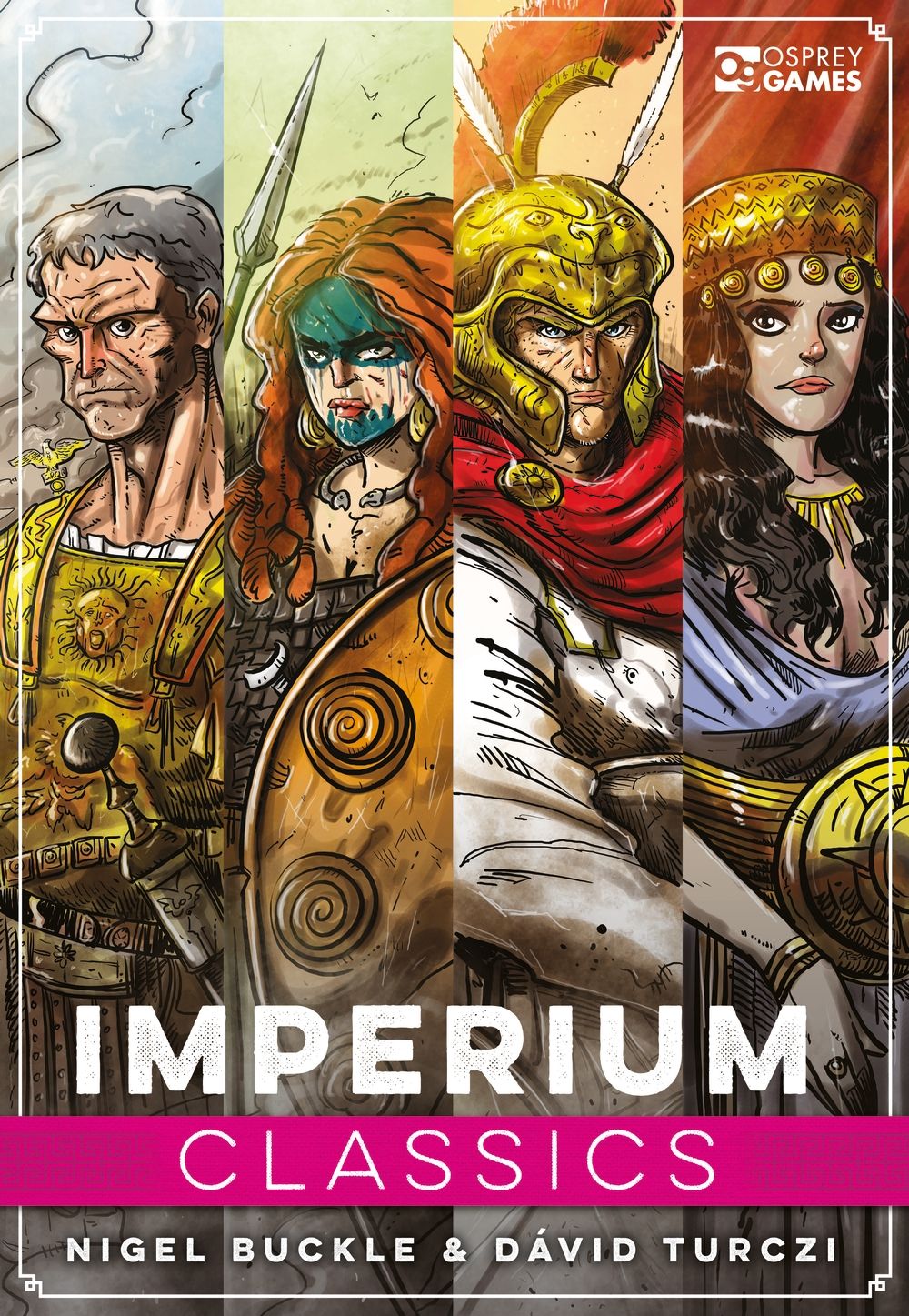
How to Play Imperium: Classics
Osprey Games, Banana Games, Board Game Rookie · Board game · 2021What do you want to do now
Ask anything about Imperium: Classics: rules, setup, components, complexity, price, or whether it fits your group.
Video: How to Play
Start here, then follow the written guide
Step by step
Game Objective
In Imperium: Classics, you take control of a historical nation, seeking to expand your territory, advance culturally, and become an empire. The game ends when a player triggers scoring or collapse, with the winner being whoever accumulates the most victory points (VP) or, in the case of collapse, whoever has the fewest unrest cards.
Preparation (Setup)
- Each player chooses a nation (e.g., Romans, Carthaginians) and organizes their cards as indicated by the bottom left corner.
- Position the power card in the center of the play area. Nations like Arthurians and Utopians have specific additional cards.
- Shuffle the nation cards and form the nation deck, placing the ascension card (or equivalent) at the bottom.
- Set up the market with revealed cards from the regions, uncivilized, civilized, and main piles, placing an unrest card under each, except those with a ★ icon.
- Distribute starting tokens: 3 ▲, 2 ●, 1 ■, 5 ◆, and 3 ✓ (Utopians receive only 3 ◆).
Game Flow
Each round consists of turns in clockwise order, starting with the player to the left of the solstice card. On your turn, choose one of the options:
- Activate: Perform up to 3 actions and use up to 5 exhaustible abilities.
- Innovate: Discard your hand and promote a card from the market (regions, uncivilized, civilized, or fame).
- Revolutionize: Return cards from your hand to the unrest pile.
After your choice, perform cleanup: add 1 ✓ to the market, refresh your tokens, optionally discard cards, and draw up to 5 cards.
Actions and How to Play
During Activate, you can:
- Perform actions: Spend 1 ◆ to play a card from your hand, resolve its effect, and discard it (unless it is fixed).
- Use exhaustible abilities: Spend 1 ✓ to activate effects of cards in play or from your power card.
Cards have keywords like acquire (take cards from the market), promote (add cards to your hand), and solstice (effects resolved at the end of the round).
End of Game and Scoring
The game ends if:
- The main pile runs out.
- A player develops their last development card.
- The King of Kings card is revealed.
- Specific nation conditions (e.g., Vikings discarding Harald Hardrada).
In scoring, count:
- 1 VP for each ◆.
- Card points (fixed, conditional, or variable VPs, up to 10 per card).
In collapse (empty unrest pile), the winner is whoever has the fewest unrest cards.
Tips for Winning
- Resource management: Prioritize cards that generate ◆ and ✓ to maintain actions and development.
- Adapt to your nation: Romans focus on rapid expansion; Carthaginians on trade; Utopians on advancing their journey.
- Control unrest: Unrest cards can be detrimental in collapse. Discard them or use effects to remove them.
More videos
More rules explanations from the community
In English
-
 Imperium - Tutorial & Playthrough
-
 Game in a Nutshell - Imperium Classics & Legends (how to play)
-
 Box of Delights Presents ... IMPERIUM
-
 Peaky Boardgamer Episode #99 - Imperium : Classics - Full rules explanation (English)
-
 One Minute Overview of Imperium Classics and Legends
-
 Game in a Nutshell - Imperium Classics SOLO (how to play)
-
 How to Solo - Imperium: Classics
-
 Imperium: Classics - Playthrough
-
 Imperium Classics: How to Play Solo
-
 Rules teach and playthrough featuring Lord of the Board
-
 Imperium Classics HOW TO PLAY + PLAYTHROUGH
Rules manual
Official PDF file
Frequently Asked Questions
Quick answers about the rules
