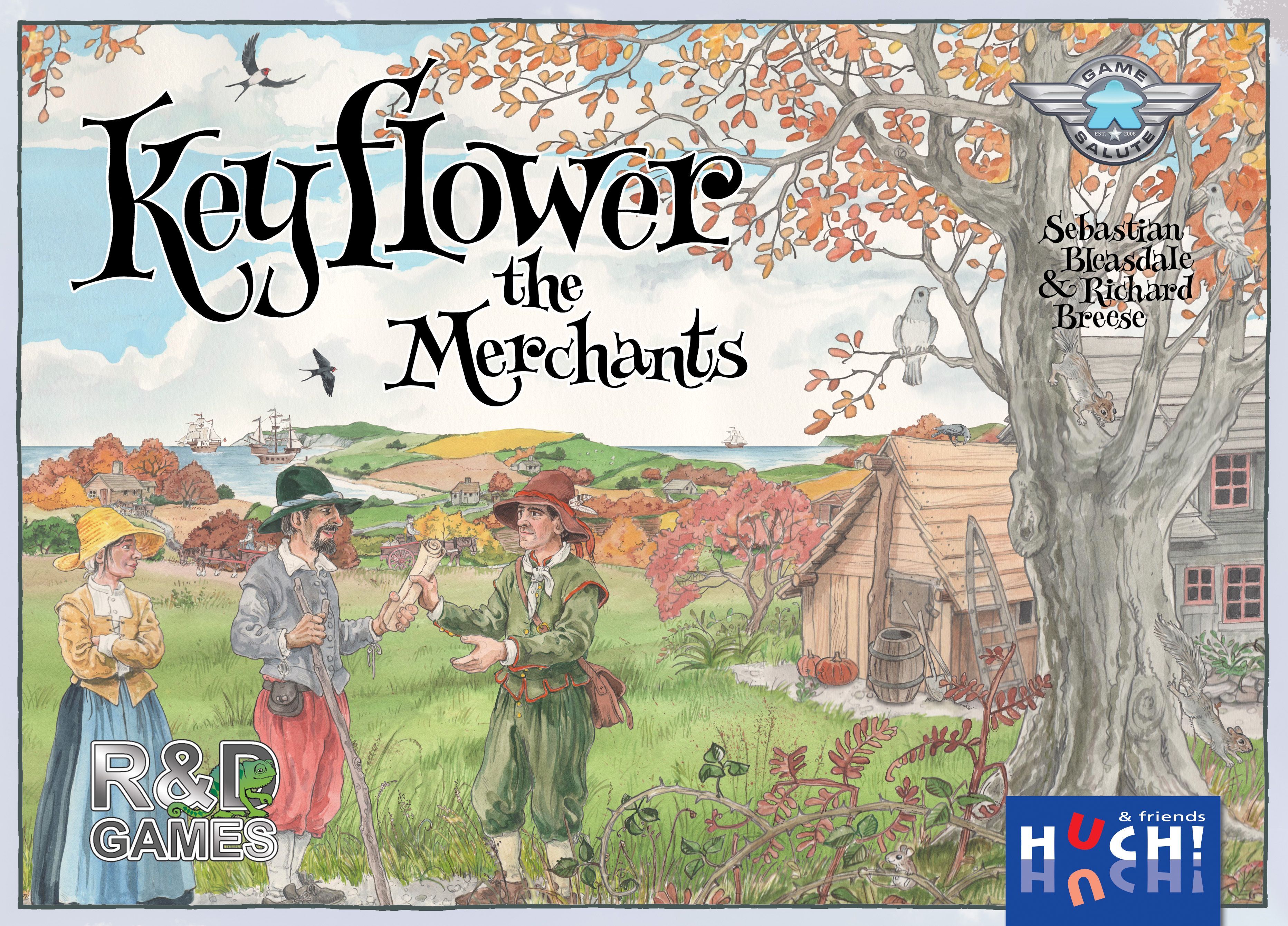
How to Play Keyflower: The Merchants
R&D Games, Czacha Games, Ediciones MasQueOca · Board game · 2014What do you want to do now
Ask anything about Keyflower: The Merchants: rules, setup, components, complexity, price, or whether it fits your group.
Step by step
Objective of the Game
In Keyflower – The Merchants, players continue to develop their unique villages over four seasons. You aim to build the most prosperous village by constructing extensions and cabins, securing lucrative contracts, and managing the new combinations of items arriving on incoming boats. The player with the most points at the end of the game is the winner.
Setup
Follow the standard Keyflower setup rules, with the following modifications:
- Boat Tiles: Take each set of boats with the same name and choose one boat at random from each set. The number of boats used depends on the number of players. Note that these new boats may carry cabins, gold, face-down contracts, or green workers.
- Cabins: Place the cabins by the side of the playing area.
- Contracts: Turn all contract tiles face-down (plain side visible). Divide them into three approximately equal piles and place them by the side of the playing area. Turn the top tile from each pile face-up so that three contracts are visible.
- Extensions: Place the extensions by the side of the playing area.
- Village Tiles: Add the new spring, summer, and autumn village tiles to the corresponding season's tiles from the base game. Mix the three new winter village tiles with the existing winter tiles. The number of winter tiles per player increases as follows: 4 tiles each for 2-3 players, 3 tiles each for 5 players, and the standard amounts for 4 and 6 players.
- Merchant's Variant: For your first game, it is suggested to play Variant A, which ensures all new tiles are used.
Game Flow
The game progresses through four seasons: Spring, Summer, Autumn, and Winter. Each season consists of a bidding phase where players compete for village tiles and boats.
At the end of each season (except Winter), the following end of season procedures occur:
- Players retrieve workers from losing bids.
- Discard village tiles that were not bid for.
- Starting with the start player, players claim their won village tiles in clockwise order. Workers from winning bids are placed in the bag. Workers on successfully bid-for tiles are placed behind the player's screen.
- Players collect workers from their village and place them behind their screen.
- Deal with turn order tiles and boats. Workers, skill tiles, and contracts are placed behind the player's screen. Resources and cabins are placed on the player's home tile.
- If a player owns boat 1 or boat 6, they collect them and potentially allocate animals to a field.
- Breeding: Except in Winter, if two or more animals of the same kind (and no other kind) are in a field, they may breed, adding one more animal of that type to the field.
- Players expand their villages with won village tiles.
- Replace the three face-up contracts from the face-down piles.
Actions and How to Play
During a turn, players participate in bidding to acquire village tiles or boats. A player may add more workers to an existing bid to create or maintain a winning bid. Green workers cannot substitute for other colors.
Acquiring Extensions
Extensions allow a tile to be upgraded for a second time. To obtain an extension, you must place workers on a tile that already has an upgrade symbol (such as home tiles or transport tiles) or use a cabin.
- An extension must be played on an already upgraded tile in your own village.
- Only one extension can be played per tile.
- You must pay the cost indicated on the extension (which may include resources, skill tiles, or workers).
- If an extension requires resources, they must be moved onto the target village tile before construction.
- Once placed, only workers of the same color as the extension can be placed on that tile.
Obtaining Contracts
Contracts can be obtained from boats (placed face-down) or from specific village tiles (assayer, bookkeeper, or merchant).
- When using a village tile, you may choose one of the three face-up contracts or a face-down contract from the piles.
- Exchange: At any time during your turn, you may perform a "free" action to exchange a contract for one of its "specific" items (not the white "any" symbols). If exchanged for a resource, it goes to the home tile; if for a worker or skill tile, it goes behind your screen.
Using Cabins
Cabins are placed on the home tile and act as an extra upgrade symbol. They do not affect transport ability but can double the upgrade ability of certain boats.
End of Game and Scoring
The game ends after the Winter season. Players score points based on the following criteria:
- Autumn Scoring Tiles: Score resources placed on the barn, blacksmith, stone yard, and timber yard.
- Sheep: Score sheep placed in the sheep shelter.
- Fields: Score fields containing animals (1 pt for sheep, 2 pts for pigs, 3 pts for cows).
- Special Boat Effects: Flipper (upgrade a tile) or Flipper II (add an extension).
- Village & Boat Tiles: Score fixed points as indicated on the tiles.
- Extensions: Score based on the fixed point value of the upgraded tile.
- Contracts: Each completed contract is worth 7 points (or 10 points if you own White Wind II).
- Winter Tiles: Score remaining winter tiles.
- Boat Tiles: Score remaining boat tiles.
- Turn Order: Score 1 point for each adjacent turn order tile.
- Gold: Score 1 point for each gold resource.
- Utilize the Merchant's Variant: For your first game, use Variant A to ensure you interact with all the new Keyflower – The Merchants tiles.
- Strategic Contract Exchange: Remember that exchanging a contract for a specific item is a free action that does not count as a turn, allowing you to optimize your village mid-game.
The player with the most points wins. In a tie, the player who chose their boat tile first in Winter wins.
Tips for Victory
Rules manual
Official PDF file
Frequently Asked Questions
Quick answers about the rules