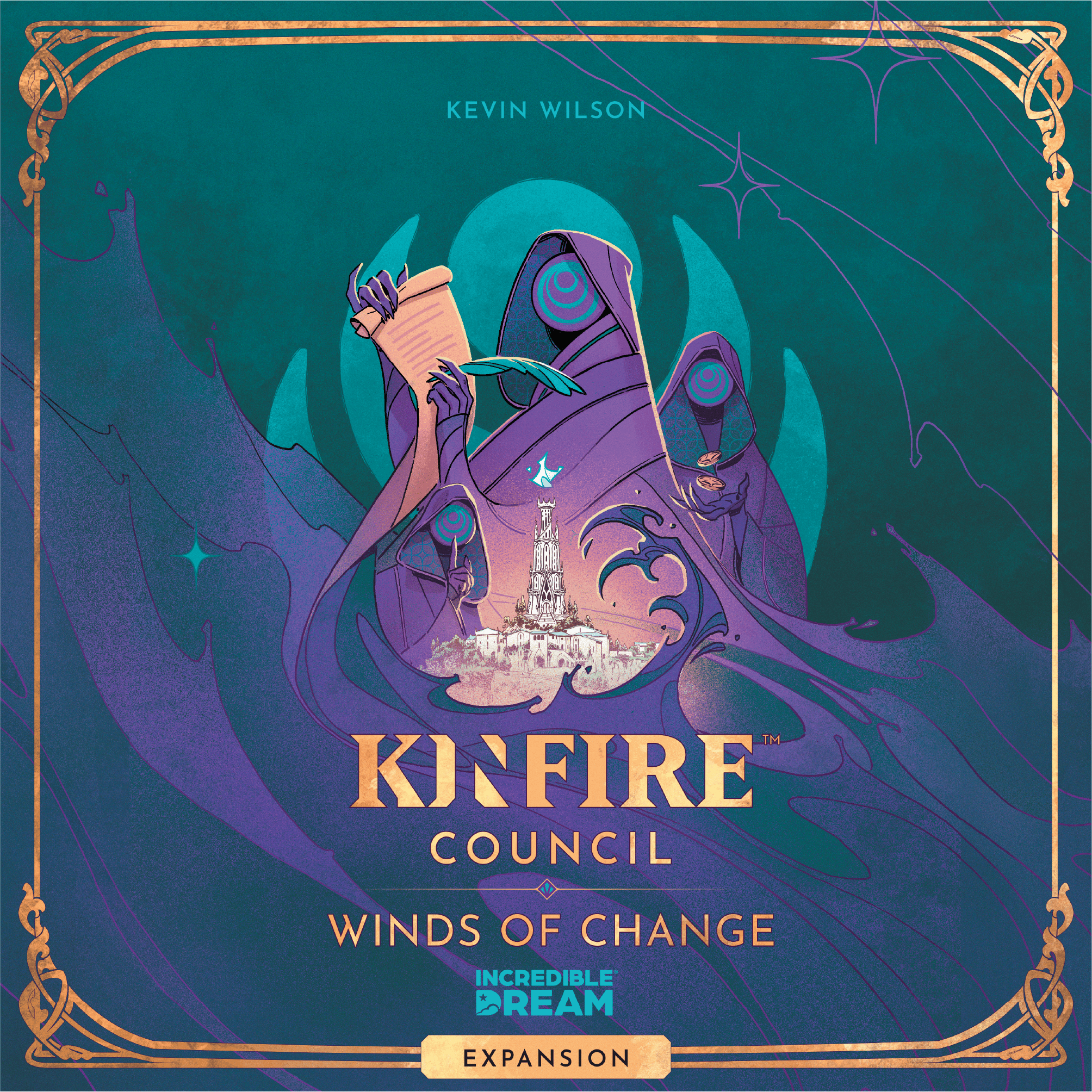
How to Play Kinfire Council: Winds of Change
Incredible Dream Studios · Board game · 2025What do you want to do now
Ask anything about Kinfire Council: Winds of Change: rules, setup, components, complexity, price, or whether it fits your group.
Video: How to Play
Start here, then follow the written guide
Step by step
Objective of the Game
The city of Din’Lux is entering a new era, with the rediscovery of kinfire creation bringing hope despite the ravages of the Starless Nights. The City Council has launched an initiative to rebuild and rejuvenate the city. However, criminal forces will rise to profit, and the Cult of Altan will spread its shadowy influence to sabotage the Council. In Kinfire Council: Winds of Change, players take on the role of Councilors working to restore the city. In cooperative mode, Councilors must work together to defeat the Cult of Altan. In solo mode, a single player pits themselves against the Cult.
In cooperative play, if every Councilor has more V (Victory Points) than the Cult at the end of the game, they are victorious. If the Cult ties or beats even a single Councilor's V, the entire group loses. In solo mode, if you have more V than the Cult at the end of the game, you win. If the Cult ties or beats your score, you lose.
Preparation (Setup)
General Setup
- Lighthouse Site sheets: Shuffle the new Lighthouse Site sheets with your other Lighthouse Site sheets. Then, discard down to 5 Lighthouse Site sheets, returning the discarded sheets to the box without looking at them.
- Favor tokens (F): Place the favor tokens (F) in a pile next to the other resource tokens.
- Shady Dealer/Black Market tile: Replace the original Shady Dealer tile with the new one.
- Research and Threat cards: Shuffle the new research and threat cards into their respective decks.
- Decree cards: Set aside the 18 Rezoning laws from the 21 new decree cards. Shuffle the other 3 new decrees into the decree deck permanently. At the start of each game, randomly shuffle 4 Rezoning laws into the decree deck. At the end of the game, remove these 4 Rezoning laws and return them to the deck of Rezoning laws.
- Special Threat and Threatened District tiles: Place these tiles near the special threat tiles from the base game. They are only used if their respective threat cards come into play.
- Rezoned District tiles: Place these tiles near the play area where players can reach them.
First Game with Winds of Change
- Draw 3 cultists from the bag. For each numbered cultist drawn, swap the standard district tile corresponding to that cultist with its rezoned district tile. These swaps are permanent across game sessions.
Cooperative Play Mode Setup
- Perform setup as usual, with the following additions:
- Cult Decree cards: Shuffle the Cult Decree cards into a deck and place it facedown near the docket.
- Hidden threats: Depending on the desired challenge level, draw additional hidden threats:
- Normal - 3 Hidden threats
- Intermediate - 5 Hidden threats
- Hard - 7 Hidden threats
- Extreme - 9 Hidden threats
Solo Play Mode Setup
- Follow the rules and setup for cooperative play mode, with these exceptions:
- Choose two Councilor/Seeker combos and control both as a team. Each Councilor receives their Seeker and 3 workers.
- Choose one of the Councilors’ score tokens to track your score. Any V gained by the Councilors are tracked with a single score token.
- Note: Only Elias Talltide's 3 workers are trained at the start of the game if Elias is one of the chosen Councilors.
Rezoning Jumpstart Variant
- During setup, you may choose to draw 1 or more cultists from the bag. If a numbered cultist is drawn, swap its corresponding standard district tile with its rezoned district tile. You can decide whether this cultist draw allows rezoned districts to return to their standard district tile or not.
Flow of the Game
Consulte o manual para detalhes sobre esta seção.
Actions and How to Play
Using Favor Tokens (F)
- Favor tokens (F) can be spent in place of a c, f, s, g, or m resource.
- Each time a player spends a favor token, the Cult gains 2 V.
Rezoning Laws and Rezoned Districts
- If a Rezoning law is passed, it swaps one of the standard district tiles with its rezoned district equivalent.
- This swap is permanent, even across multiple game sessions.
- If that Rezoning law is later passed again, the standard district tile is swapped back in.
Cooperative Play Mode Gameplay
- Cult Decrees: Each Sun’s Rise when the docket is prepared, draw 1 Cult Decree and add it to the docket (in addition to the 2 normal decree cards).
- When a Cult Decree is added to the docket, the instant effect listed on the bottom of the card immediately takes effect.
- Cult Decrees have 1 or more v (votes) already cast on them, shown in the upper left corner. To prevent a Cult Decree from passing, Councilors need to cast enough v to at least tie the printed v on the Cult Decree.
- At Night’s Fall, if the Cult Decree has more v than any other decree on the docket, it will pass and take effect. In case of a tie, the Councilor with the Speaker’s Medallion determines which decree passes.
- Players may not use the Sway Vote research card to alter the v printed on a Cult Decree. This card can, however, be used to change v that have been added to a Cult Decree by game effects.
- Cult Influence (d): Councilors cannot gain Cult influence (d). Instead, this icon allows them to remove 1 trouble token from any threat card in play.
- Cult V (X): Instead of causing the Cult to gain the indicated V, this icon causes the Cult to lose the indicated V.
- Councilors cannot become the Cult conspirator.
Solo Play Mode Gameplay
- Alternate taking turns with the two Councilors.
- Resources, research cards, arrested cultists, and thwarted threats gained go into a shared pool for both Councilors.
- Sentries, influence, and Councilor abilities may only be used by the appropriate Councilor. For example, Elias Talltide may only train his 3 workers at the start of the game.
End of Game and Scoring
Cooperative Play Mode
- At the end of the game, if every Councilor has more V than the Cult, they are victorious.
- If the Cult ties or beats even a single Councilor, the entire group loses the game.
Solo Play Mode
- At the end of the game, if you have more V than the Cult, you win the game.
- If the Cult has tied or beaten your score, then you lose the game.
Tips for Winning
- Strategic Favor Token Use: While Favor tokens (F) are a versatile resource, remember that each time one is spent, the Cult gains 2 V. Use them wisely, weighing the immediate benefit against the long-term cost to the Council's victory.
- Cooperative Cult Decree Management: In cooperative play, prioritize preventing Cult Decrees from passing. Councilors must coordinate their votes to at least tie the Cult's pre-cast votes, as a passing Cult Decree can have significant negative impacts.
- Leverage Rezoning Laws: Passing Rezoning laws permanently alters the city map, which can change your version of Din’Lux over time. Consider which district swaps would be most beneficial for your strategy, and remember that passing the law again can revert the change.
Rules manual
Official PDF file
Frequently Asked Questions
Quick answers about the rules
What is the objective of Kinfire Council: Winds of Change?
How do you set up Kinfire Council: Winds of Change?
How do you play Kinfire Council: Winds of Change?
How does Kinfire Council: Winds of Change end, and how do you score?
What are some tips for winning Kinfire Council: Winds of Change?
Expansion for
Published additional content