
How to Play Menara: Rituals & Ruins
Zoch Verlag · Board game · 2019What do you want to do now
Ask anything about Menara: Rituals & Ruins: rules, setup, components, complexity, price, or whether it fits your group.
Step by step
Objective of the Game
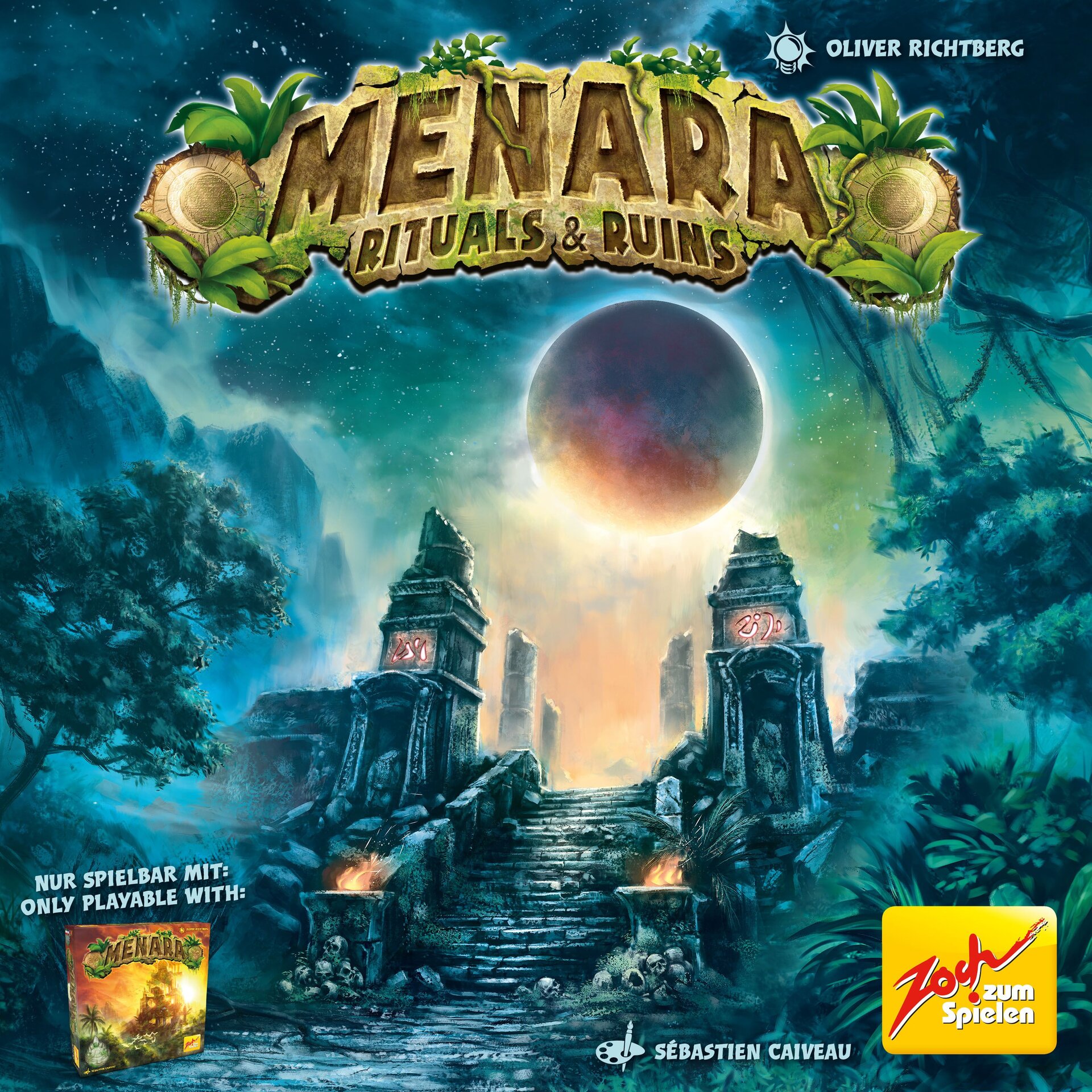
In Menara: Rituals & Ruins, players are challenged to build the temple even higher and make it shine in the twilight of a solar eclipse. The game expands upon the basic game by introducing new columns, temple floors, and construction plans, along with new components like Tears of the Gods (crystal tokens), Ritual cards, and Fate cards. The ultimate goal is to preserve the spiritual balance of the temple, which, if playing with Tears of the Gods, means placing all 12 Tear tokens in the temple before the game ends.
Preparation (Setup)
To set up Menara: Rituals & Ruins, always include all materials from the basic game. Use the larger cloth bag provided in Rituals & Ruins. The basic game materials include:
- 35 Construction Plan cards (9 easy, 12 medium, 14 difficult)
- 18 Temple floors
- 1 camp
- 5 level cards
- 76 columns (30 yellow, 20 red, 12 black, 8 white, 6 blue)
Next, decide which additional materials from Rituals & Ruins you want to use for your expanded game:
- Temple floors: Add the desired number of new Temple floors. These new floors are distinguished by a symbol on both their light and dark sides.
- Construction Plan cards and columns: Depending on the chosen Temple floors, add the corresponding new Construction Plan cards and columns as listed in the table on page 10 of the manual. Shuffle each individual category (easy, medium, difficult) of new Construction Plan cards, draw the indicated number, and then shuffle them into the respective piles of the same category from the basic game. Throw the additional columns, along with the columns from the basic game, into the bag.
- Golden columns: Decide whether to include the two golden columns. If so, place them next to the camp.
- Tears of the Gods: Decide whether to include the Tears of the Gods. If so, place the 6 blue and 6 red Tear tokens next to the camp.
- Ritual cards: Decide whether to include the Ritual cards. If so, shuffle the 13 Ritual cards thoroughly, draw one, and lay it face up next to the camp. This card's rule is in effect for the entire game. Put the remaining Ritual cards back into the box.
- Fate cards: Decide whether to include the Fate cards. If so, shuffle them thoroughly and place them as a face-down pile next to the camp. Before starting, remove cards for any Temple floors from Rituals & Ruins that you are not including in the game, and adjust the quantities of columns and Construction Plan cards accordingly. Draw the top three Fate cards. If "The Thorn Moon" or "The Crescents of the Sun" are drawn, shuffle them back and draw replacements. Then, pick out the Temple floors from the quarry indicated on the three drawn cards and use them to form the temple base. You can choose to use either the light or dark side of these Temple floors for the base.
For a first game to become familiar with the expanded game, it is recommended to play with the golden columns and the first four Temple floors from the table (along with their required cards and columns).
Flow of the Game
Consulte o manual para detalhes sobre esta seção.
Ações e Como Jogar
New Components and Their Rules
- The Tears of the Gods: There are 12 Tear tokens (6 blue, 6 red). Your objective is to place all 12 in the temple before the game ends to preserve spiritual balance.
- Acquiring a Tear Token: Before drawing a Construction Plan card, you may throw any column from your supply back into the bag. Then, choose a blue or red Tear token and place it in front of you. You can acquire multiple Tear tokens on your turn by throwing one column into the bag for each token.
- Placing a Tear Token: Tear tokens can only be placed on spots on Temple floors that show a magically glowing mark of the same color. Only one Tear token may be placed on each magical mark. On your turn, you may place any number of Tear tokens you have acquired, regardless of when you acquired them. You can place a Tear token even if you cannot fulfill the Construction Plan card you have drawn. If a Tear token falls off its Temple floor during a game turn, it must immediately be put back.
- The Golden Columns: These two columns are shorter than normal columns. You may build a golden column on a base of any color instead of a column from your supply. Golden columns may never carry a Temple floor. Once built, golden columns can never be removed or moved.
- New Construction Plan Cards: All Construction Plan cards from Rituals & Ruins show a specific symbol to distinguish them from the basic game cards.
- COMPLETE 2 DIFFERENT LEVELS: Keep placing columns, one after another, on two Temple floors until all bases of these floors are occupied. After completing the first Temple floor, immediately add a new Temple floor to the tower. Only then may you place columns on the second Temple floor (which can be the just-placed one). After that, add another Temple floor.
- BUILD 2 OR 3 COLUMNS ON DIFFERENT TEMPLE FLOORS: Place two or three columns on different Temple floors.
- BUILD 2 OR 3 COLUMNS OF DIFFERENT COLORS: Place two or three columns in different colors on color-matching bases.
- BUILD 2 OR 3 COLUMNS OF THE SAME COLOR: Place two or three columns of the same color on color-matching bases.
- BUILD 1 OR 2 BLACK COLUMNS: Place one or two black columns on black bases.
New Temple Floors and Their Building Rules
All Temple floors of Rituals & Ruins have a symbol on both their light and dark sides. For most, building rules are the same for both sides; only a few have different rules.
- THE DOUBLE AX: Both sides: Always build on two connected bases (twin bases) on the same game turn. If only one suitable column is available, you cannot build. If the task "Move columns up" is used, the "twin" of the moved column remains in place. You can only build on an emptied single base when its twin base has also been emptied.
- THE WHEEL OF THE THREE TRUTHS: Both sides: Rules are the same as for "The Bridge of Dangers".
- THE WEDGE MOON:
- Light side: You may build columns only in number sequence (starting with "1"). If "Move columns up" vacates bases, new columns must be built on vacated bases with lower numbers first. If two bases have "2" and two have "3", choose which "2"-base and (subsequently) which "3"-base to build on first.
- Dark side: Columns on these colored bases move, following the same rules as for "The Bridge of Dangers".
- THE CRESCENTS OF THE SUN: Both sides: For the ruin base in the middle, the rules of "The Thorn Moon" apply. For other bases, normal building rules of the basic game apply.
- THE RING OF BALANCE: Both sides: Rules are the same as for "The Wedge Moon".
- THE THORN MOON: When building this Temple floor, no column underneath it may protrude into its openings. Both sides: You may not put any further Temple floor on top of this one; it has ruin bases only. When building on it, place the column slightly tilted in the opening. This can also be a golden column. This Temple floor may never be used for extending the temple base. If you cannot add it, move it to the last position of the quarry (or move its Fate card to the bottom of the pile) and add two Construction Plan cards from any discard piles to the row of level cards.
- THE WHEEL OF THE FIVE WINDS: Both sides: You may build on the central white base only when the other bases of this Temple floor are occupied.
- THE BRIDGE OF DANGERS: Both sides: Each column color may be used for building only once. You may build exclusively on the starting base. If occupied, move the column there (along arrows) to the second base without touching it, using only the column you are placing. If the second base is occupied, move that column to the third base, then the first to the second, etc. Golden columns cannot be moved; once placed on the starting base, they block further completion of this Temple floor.
Rituals (Modifying Game Rules)
One Ritual card is drawn at setup and is in force for the entire game.
- THE ENLIGHTENMENT: Add Temple floors to the temple exclusively with the light side facing up. If playing with Tear tokens, light sides have no spots for red Tear tokens, so these 6 will be left over at game end.
- THE CURSE OF THE GODS' TEARS: Play with Tear tokens. Temple floors with magically glowing marks may be completed with columns only after all glowing marks on that floor have been covered with Tear tokens.
- THE GRACE OF THE YELLOW COLUMNS: If you perform the task "Move columns up", you may use only yellow columns for this.
- THE UNHOLY WHITE COLUMNS: When placing or moving a white column, take the top easy Construction Plan card and put it on the discard pile (it is not executed). If the easy pile is depleted, discard a medium card.
- THE DARK: Add Temple floors to the temple exclusively with the dark side facing up. If playing with Tear tokens, dark sides have no spots for blue Tear tokens, so these 6 will be left over at game end.
- THE BAN OF THE BLUE COLUMNS: At the beginning, equip the camp with 3 blue columns and 3 columns of different colors drawn from the bag. No one starts with blue columns. Any blue columns drawn during the game are thrown back into the bag without replacement. Exception: If all camp columns are exchanged (e.g., when a new card is added to the row of level cards) and blue columns are drawn, they remain in the camp and can be used. If not enough non-blue columns are left in the bag when new columns are drawn at the end of a turn, the game ends immediately.
- THE JINXED YELLOW COLUMNS: If you successfully place or move yellow columns on your turn, lay the completed Construction Plan card in front of you, not on the discard pile. You may put it on the discard pile only when you don't place or move any yellow columns on a subsequent turn. If any such cards are in front of you at game end, add them to the row of level cards. A golden column placed on a yellow base also counts as a "jinxed" yellow column.
- THE THIN TIP: From the fourth level on, you may build only one Temple floor per level. "The Thorn Moon" Temple floor cannot be used for this ritual; remove it from the quarry (and its Fate card if playing with them).
- THE SLIGHT EARTHQUAKE: If you draw an easy Construction Plan card, remove all non-golden freestanding columns from completed Temple floors (before execution) and throw them back into the bag. (A column is freestanding if its upper end doesn't touch any Temple floor.) This can split twin columns.
- THE GLOWING RED COLUMNS: If you build a red column into the tower, you may not have direct body contact with it. Use an object (e.g., pullover sleeve, handkerchief) to avoid skin contact. This rule does not apply when drawing red columns from the bag, exchanging them with camp columns, or handling them in your supply.
- THE FLOATING QUARRY: When adding a new Temple floor, draw the top three Temple floors from the quarry (or Fate cards from the pile). Choose one, and return the other two without changing their order. If you choose the second or third Temple floor, you may only build it as the top level of the temple. If playing with Fate cards, you cannot choose "Merciful Fate".
- THE NARROW BASE: Use the three smallest Temple floors to form the temple base, turning the side with fewer bases upwards. If playing with Fate cards, remove the cards of these 3 Temple floors from the pile before the game starts.
Fate (Using Fate Cards)
Fate cards show all types of Temple floors in the game. After setup, remove cards for any Temple floors not included. Shuffle the remaining cards and place them face-down next to the camp.
- THE BALANCE OF FATE: If you draw an easy Construction Plan card and fulfill it, place it in front of you. On your next turn, you must draw a difficult Construction Plan card. If you fulfill it, discard both cards. If not, the difficult card is added to the row of level cards, and the easy one remains in front of you. On your next turn, draw another difficult card. If no difficult cards are left, draw a medium one. If only easy cards are left, this ritual rule is omitted, and any easy card in front of you is discarded.
You can choose from three fate levels:
- MERCIFUL FATE: Lay three Fate cards face up next to the pile. When building a new Temple floor, choose among the three shown. Pick the chosen Temple floor from the quarry. Discard the used Fate card and add a new one face up. Cannot be chosen if playing with "The Floating Quarry" ritual.
- BEARABLE FATE: Lay one Fate card face up next to the pile. When building a new Temple floor, use the Temple floor depicted on this card (from the quarry). Discard the Fate card and lay out a new one face up.
- TOUGH FATE: Do not lay out any Fate cards. Only when building a new Temple floor do you draw the top card from the pile of Fate cards and use the depicted Temple floor (from the quarry). Discard the Fate card.
Fim de Jogo e Pontuação
Consulte o manual para detalhes sobre esta seção.
Dicas para Vencer
- Consider carefully when to use a golden column. While it can save the current game, it can also be disruptive since you may not move it or put a Temple floor on it.
- Don't be afraid of continuing to build upwards. Sometimes, not building beyond the required minimum number of levels creates more complications in the temple than you think.
- It can occasionally be useful to build a Temple floor on only two columns. Also, sometimes it makes sense to build in such a way that a column carries two Temple floors (these may never overlap, however).
Rules manual
Official PDF file
Frequently Asked Questions
Quick answers about the rules
