6.2
rating
Ludopedia
5.8
rating
BGG
Our Verdict
RECOMMENDED
A fast-paced urban logistics challenge perfect for route-building enthusiasts.
Highlights
- Agile route strategy
- Ever-changing modular board
- High player interaction
- Quick and dynamic
Keep in mind
- Requires spatial reasoning
- Can be highly competitive
Rules manual not indexed yet
Upload the PDF rulebook to ask questions about this game with AI.
About the game
What you do in a play session
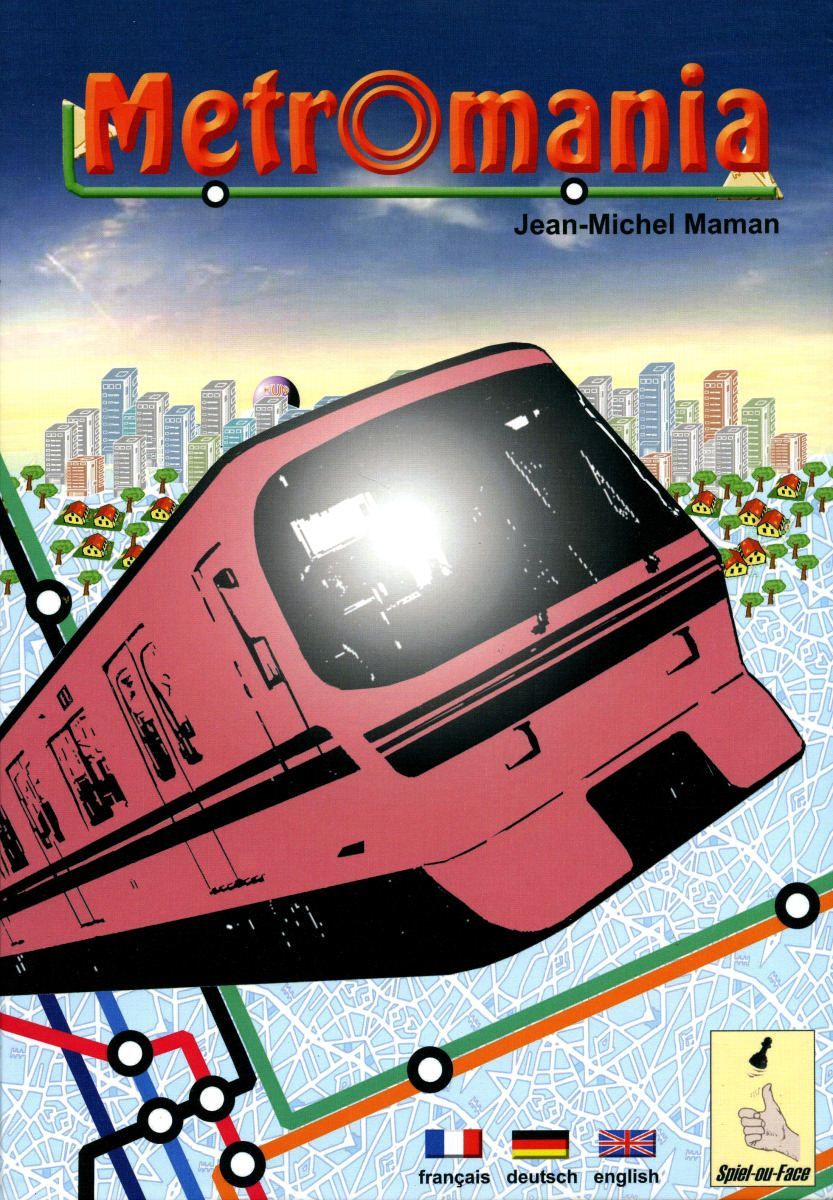
If you enjoy planning routes and want to feel the chaos of an expanding metropolis, Metromania is the game for you! Here, the goal is clear: you take on the role of an urban planner responsible for tracing subway lines that connect vital points of the city. Each player must build two distinct lines, trying to link residential, commercial, and industrial zones as efficiently as possible. But don't think it's just about drawing a path; things get serious during the trip-test phase!
The dynamics are super fluid: on each turn, you place three line markers on the board. The detail that changes everything is that the board is modular and the line pieces have a triangular shape, which requires sharp spatial reasoning so you don't run out of options. If your line crosses with an opponent's, a station is built at that intersection, creating an interconnected network. This makes the game extremely interactive, as you'll have to decide whether to help complete a route or block your neighbor's path to secure your victory.
The real trick happens during the construction phase, when players define where the trips start and end. Since the rules prevent the same player from choosing both points, you'll have to read the game and anticipate your opponents' moves to avoid being caught off guard. In the end, speed is everything: whoever manages to connect the key points (drawn at the start of the game) with the shortest travel time earns the highest score. Those who fail to connect their specific points end up losing precious points. It's a fast-paced strategy game with high interaction and a completely new map setup every single time.
The dynamics are super fluid: on each turn, you place three line markers on the board. The detail that changes everything is that the board is modular and the line pieces have a triangular shape, which requires sharp spatial reasoning so you don't run out of options. If your line crosses with an opponent's, a station is built at that intersection, creating an interconnected network. This makes the game extremely interactive, as you'll have to decide whether to help complete a route or block your neighbor's path to secure your victory.
The real trick happens during the construction phase, when players define where the trips start and end. Since the rules prevent the same player from choosing both points, you'll have to read the game and anticipate your opponents' moves to avoid being caught off guard. In the end, speed is everything: whoever manages to connect the key points (drawn at the start of the game) with the shortest travel time earns the highest score. Those who fail to connect their specific points end up losing precious points. It's a fast-paced strategy game with high interaction and a completely new map setup every single time.
Gallery
Box and component photos
Tap any photo to open fullscreen. Photos submitted by the community or publisher.
Rules videos
Learn by watching before you open the box
In English

Best player count
BGG community vote
2
REC
3
BEST
4
REC
Soundtrack
Ambience suggested by Melodice
Loading playlist...
Where to Buy
Prices monitored daily
Finding best prices...
Prices unavailable at this time.
Price history — last 6 months (lowest new offer)
Alert enabled!
Join the BoardGamesBot deals group
Get the best board game deals every day — without message spam.
Join the WhatsApp groupGame details
Mechanics, categories, families and credits
Mechanics
Categories
Families
Publisher
Spiel-ou-Face
Designer
Jean-Michel Maman
Artist
(Uncredited)
Community
Data from BoardGameGeek
Frequently Asked Questions
Quick answers before you buy
How long does a game last?
The game is quite dynamic, taking about 45 minutes.
How many players is it for?
It works great with 2 to 4 players.
What is the complexity level?
It's a medium-complexity game, ideal for those familiar with route-building mechanics.
Is there a lot of interaction?
Yes! You'll be fighting for space and can block your opponents' routes.
Does the board change every time?
Absolutely! The board is modular and the connection points are drawn, ensuring variety.
Other Games You'll Like
Based on mechanics and theme