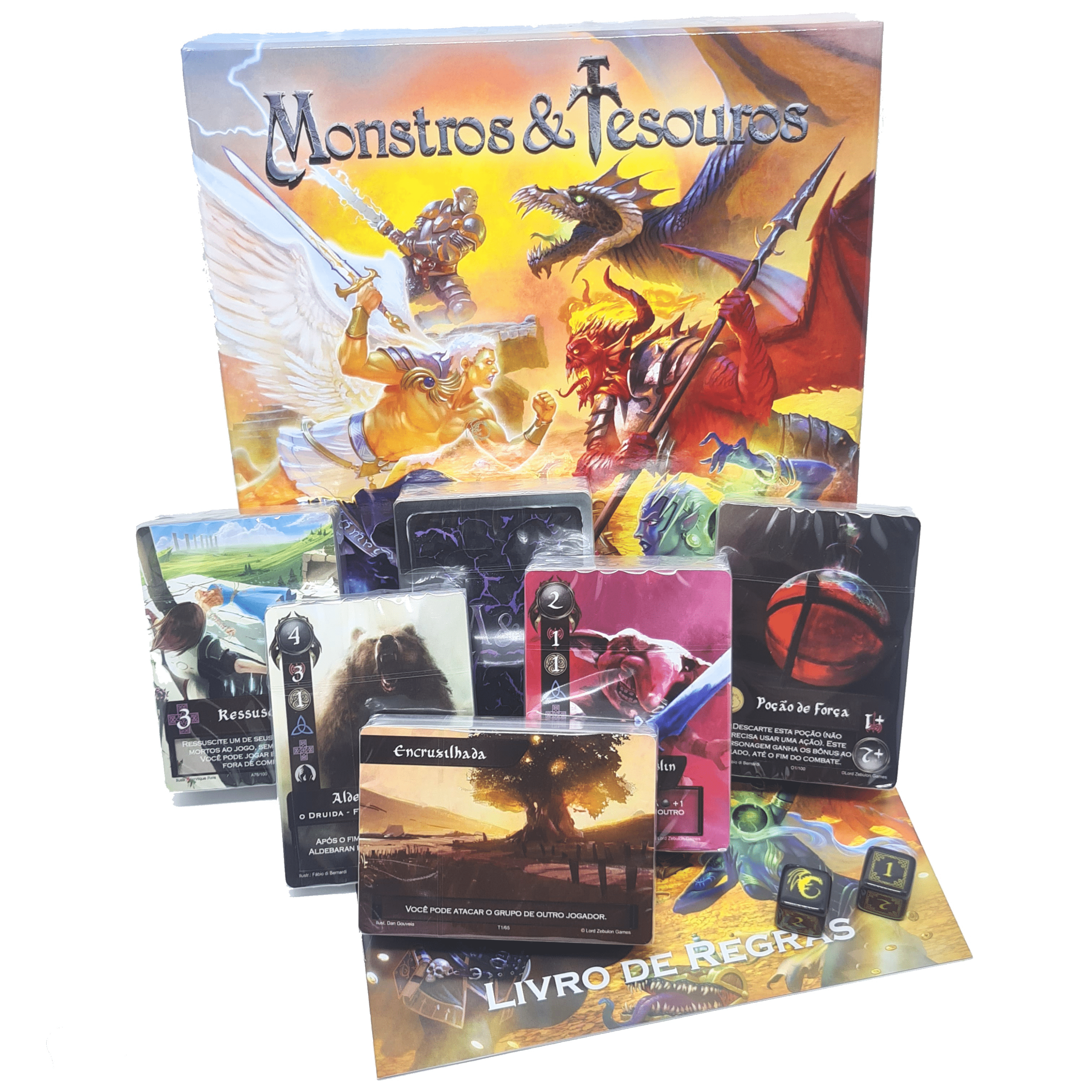
Monstros & Tesouros — How to Play
Lord Zebulon Games · Board game · 2021What do you want to do now
Ask anything about Monstros & Tesouros: rules, setup, components, complexity, price, or whether it fits your group.
Step by step
Game Objective
In Monsters & Treasures – XP, players take on the role of heroes who explore terrains, face monsters, and collect treasures. The main goal is to conquer terrains and defeat bosses to accumulate treasure points and experience. Victory is achieved when the team fulfills the specific victory condition of the game mode (for example, defeating the final boss in a dungeon or conquering a certain number of terrains in adventure mode).
Setup
- Board and terrains: Place the terrain stack (red) in the center of the table. If playing Dungeon Mode, set up the dungeon tracks as described in Part 2.
- Monsters: Shuffle all monster cards (red) into a single deck. If using Dungeon Mode, remove the boss from the deck and place it on the “Final Encounter” terrain card.
- Treasures: Shuffle all treasure cards (yellow) into a deck. If desired, you may split the deck into two for easier handling.
- Action cards: Shuffle all action cards (blue) into a deck. Remove the cards indicated in the replacement list (A3, A4, …, A99) if you wish to use the balanced 120-card deck.
- AI cards: Place the Artificial Intelligence card stack (gray) in an accessible location. These will be used only in combat.
- Heroes: Each player chooses or randomly receives two heroes (or one, depending on the mode). Place the heroes on the table, along with their familiars and mounts (if any).
- Tokens and markers: Provide heart, power, escape, death state, and coin tokens (if using the coins and cities mode), as well as any tavern house or city markers.
- Specialization cards: Keep the specialization cards separate; they can be acquired during the game.
Game Flow
- Exploration: On each turn, the active player reveals the top card of a terrain or a dungeon path. If the card is a trap, resolve it immediately. If it is a normal terrain, the player can decide whether or not to enter (in adventure mode, they may use a stealth check).
- Combat: When a terrain reveals monsters, combat begins. Each character (hero, familiar, mount) and each monster receives an action maneuver (action cards). Monsters use AI cards to determine their actions.
- Action Phase: Each character performs an action (or reaction if applicable). Reactions are played before the action that triggers them and do not consume the character's action.
- Maintenance Phase: After all actions, resolve escape (if any), apply healing in terrains that allow it, and heroes may draw cards up to their hand limit.
- End of Turn: The next player takes the initiative. In cooperative modes, initiative can be decided by a die roll or by turn order.
Actions and How to Play
- Non-attribute actions: Can be used by any character. Ex.: “Combine Forces,” “Destroy,” “Buy.”
- Dual-attribute actions: Require the character to possess the minimum level in both indicated attributes. If a character has only one suitable attribute, they cannot use the action.
- Reactions: Do not consume the character's action. Each character can use only one reaction per round. Triggers are explicitly stated in the card text (ex.: “When an enemy uses an Attack or Defense action…”).
- Mounts: When a character mounts a mount, they and the mount are considered a single character. The mount can use action cards from the rider's hand or its own ability. Mounts cannot draw cards or take treasures.
- Mount treasures: These are equipped when the character mounts the mount. The mount's power bonus is applied to the mounted character.
- Trap treasures: Installing a trap activates it during combat. It remains until the end of combat or when explicitly stated that it is discarded.
- Equip: When a character has “Equip = X” in the text box, they must search for a compatible treasure in the treasure pile and attach it to the character.
- Specializations: A hero can acquire a specialization by paying its cost. The card adds an extra text box to the hero and remains in play as long as the hero is alive.
End Game and Scoring
The game ends when the victory condition of the game mode is met:
- Adventure Mode: When the team conquers the required number of terrains or defeats the final boss.
- Dungeon Mode: When the dungeon boss is defeated.
- Solo Mode: When the hero reaches the specified victory condition (for example, reaching the end of a path).
To count points:
- Treasure points: Each treasure revealed or won in combat grants treasure points equivalent to its value. In modes with coins, points are converted into coins according to the coins and cities rule.
- Experience: Each defeated monster grants experience equal to its level. Bosses and dungeon monsters grant additional experience according to the boss rule.
- Hearts: When a character receives a death effect, remove two hearts. If the character runs out of hearts, they die.
The winner is the player or team that accumulates the most treasure points at the end of the game. In the event of a tie, the team with the most experience wins.
Tips for Winning
- Use Strategic Reactions: Reactions can cancel enemy actions before they cause damage. Plan to use reactions when a monster launches an attack or defense action that can be negated.
- Combine Mounts and Treasures: Mounting a mount with a high power bonus and equipping an attack treasure can turn your character into a dominant threat, reducing the number of monsters that need to be faced.
- Manage Hearts: Keep enough hearts on key characters. If a hero is close to losing hearts, use healing treasures or seek the tavern/city to recover hearts before entering combat.
Rules manual
Official PDF file