
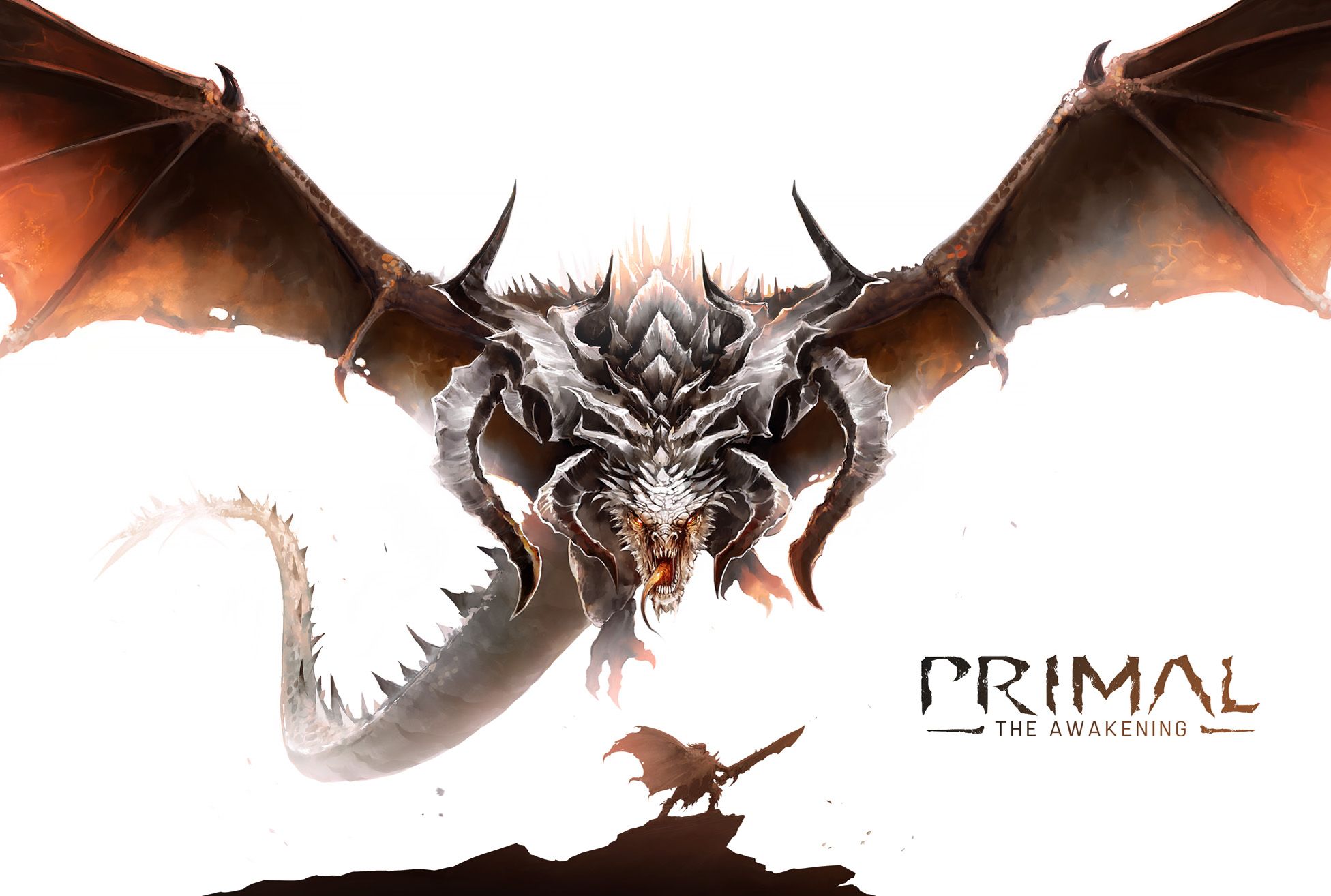
How to Play Primal: The Awakening
Reggie Games, CrowD Games, HIT Games · Board game · 2024What do you want to do now
Ask anything about Primal: The Awakening: rules, setup, components, complexity, price, or whether it fits your group.
Video: How to Play
Start here, then follow the written guide
Step by step
Game Objective
In Primal: The Awakening, players are hunters in an epic fantasy world, struggling to survive in an untamed wilderness. The main objective in each scenario is to defeat the corresponding monster, reducing its health to 0. Players can play standalone scenarios in Expedition mode or multiple scenarios connected by a story in Campaign mode. The game is cooperative for 1-4 players.
Setup
To set up the Prologue scenario, follow these steps:
- Place the combat board in the center of the table.
- Place the monster miniature in the center of the combat board, with the front sector being the bottom one.
- Place the hunter miniatures in the front sector.
- Place the terrain tokens as shown in the image: Brush, Cyricae, Baethanis.
- Place the round marker on the first space of the round track.
- Keep all tokens indicated in the General Components list (Stamina, Struggle, Strain, Damage, Bonus Damage, Counter, Threatened, Trigger, First Player, Round, Aggro, Fire Terrain, Brush Terrain, Cyricae Terrain, Baethanis Terrain, KO, Stun, Blind, Deplete, Vulnerable, Confused, Bonus 1/3 Damage) near the board.
- Set up the monster area:
- Place the monster board near the combat board.
- Place the health marker on 10 on the health track on the monster board.
- Shuffle the behavior cards to form the behavior deck and place it near the monster board.
- Place stance card I and its associated danger and objective cards below the monster board. Use stance cards I, II, and III that display the 0 (aggression level) symbol in the top left corner, and behavior cards with the , or aggression icons (total of 9 cards). Use danger and objective cards with the aggression icon.
- Shuffle the base attrition cards to form the attrition deck and place it near the monster board.
- Each player performs the following steps:
- Place their hunter board in front of them on the table.
- Place their starting equipment and potion cards on their hunter board in the spaces corresponding to their icons. Each hunter starts with a 24-card starting deck of action cards (identified with the ID "S"), an associated mastery card, a level 1 base weapon, base armor, base helmet, and 1 Alemore potion card.
- Shuffle their action deck and place it to the left of their hunter board.
- Place the mastery card associated with their action deck face down (with the unfocused side up) to the right of their hunter board.
- Determine the aggro player: Assign the aggro token to one of the players.
- Each player draws 5 cards from their action deck to form their starting hand.
- Take the first 3 cards from the behavior deck and place them face down in the three behavior spaces on the monster board.
Game Flow
The game is played in a series of rounds. A scenario consists of 10 rounds. A round consists of the following steps, which must be resolved in order:
STEP 1: CONSUME
- Each player can resolve the Consume ability on one of their cards (any ability text that begins with the keyword Consume). Players resolve these abilities in any order they wish. Each player can resolve only 1 Consume ability per round.
STEP 2: MONSTER MAINTENANCE
Resolve the following steps in order:
- Behavior Update (skip this phase in round 1): Look at the behavior cards in play. Discard the behavior card with the lowest update value and replace it with the first card from the behavior deck. If more than one behavior card has the lowest update value, discard all tied behavior cards with the lowest update value and replace them.
- Struggle: The monster gains 1 struggle (i.e., 1 struggle per player). Each time the monster gains struggle, place that number of struggle tokens on the monster board. If the total amount of accumulated struggle is equal to or greater than 3 (i.e., 3 per player), immediately resolve the Trigger:
- All players immediately suffer monster damage (the damage value indicated on the current stance).
- Remove struggle tokens until the monster has 1 per player.
STEP 3: PLAYER TURNS
- At the beginning of this step, the player with the aggro token becomes the first player and receives the first player token. Players play in clockwise order, starting with the first player. The player taking their turn is called the active player.
- The monster reacts dynamically to player actions, based on its behavior cards in play.
STEP 4: END OF ROUND
- When all players have taken their turns, all "At the end of the round" effects are triggered. Then, the round ends: Advance the round marker by 1 along the round track and start a new round from step 1.
Actions and How to Play
A player's turn is divided into the following phases, resolved in this order: Movement Phase, Action Phase, Attrition Phase, and finally, End of Turn.
Movement Phase
- You choose whether to move or remain in your current sector on the board.
- If you move: Pay
 (1 stamina) to place your hunter miniature in a sector adjacent to your current sector. You can only move once during your Movement Phase.
 - If you don't move: You become threatened and take a threatened token (if you don't already have one). If you are already threatened, keep the token and trigger any effects that activate when you become threatened.
- If you move: Pay
- To pay a stamina cost, discard cards from your hand. Each discarded card generates 1 stamina for each icon in the bottom left corner.
- To remove the threatened status, move on the board. When moving, immediately discard the threatened token.
Action Phase
During this phase, you can perform any of the following actions, in any order. Each action (except Revive) can be performed as many times as desired:
- Play an action card from your hand:
- You can play up to 5 action cards from your hand, resolving them one at a time. The sequence of cards you play from left to right is called your sequence.
- To play an action card, you must first pay its stamina cost.
- Attack Cards (
 ): Deal damage to the monster equal to your weapon damage. They can only be played if you are in a sector on one of the monster's exposed sides, indicated in the exposure diagram of the current stance card.
 - Maneuver Cards (
 ): Remove 1 struggle token from the monster board.
 - Dodge Cards (
 ) and Parry Cards (
 ): Have no additional effect when played in your sequence, only resolve their ability text. The number of defensive cards played is important to avoid attrition damage.
 - Aggro Cards (
 ): When you play an aggro card, immediately take the aggro token. The monster will turn to face your sector at the end of your turn.
 - Triggered Abilities: Playing a card in your sequence can trigger multiple abilities from other cards in play (equipment, mastery, or other action cards in your sequence). The player decides the order of resolution.
- Assist: During another player's Action Phase, before or after any action, you can support the active player by discarding a card with the keyword Assist from your hand. If you do, the active player draws 1 card. Each player can assist only once per turn.
- Activate an ability that begins with the keyword Action.
- Revive (only once per turn): If you are in a sector with another player who is KO'd, you can pay (2 stamina) to revive that player. Flip that player's KO token to the black side. If the black side is already visible, discard the token and the player stands up.
- Focus your Mastery: To focus your mastery, you must collect the same number of counters as the card's focus value. You place counters on your mastery card by triggering the card's focus ability. Once you have accumulated the number of counters equal to the focus value, discard these counters and flip the card to the focused side, unlocking the mastery ability for the rest of the game.
Attrition Phase
- The active player must perform an attrition check:
- Reveal the first card from the attrition deck.
- Suffer attrition damage (equal to the monster's damage value on the current stance card), unless you have a number of defensive cards ( or ) in your sequence equal to or greater than the revealed attrition value.
- Discard the revealed attrition card.
- If you are threatened, reveal two attrition cards instead of one and use the attrition value that would result in the worst outcome to avoid attrition damage.
End of Turn
Follow the steps below:
- Discard your sequence: Discard all cards from your sequence in the order they were played.
- Replenish your hand: Draw cards from your deck until you reach your hand size limit (which is 5 by default). If you empty your deck, shuffle your discard pile to form a new deck, then draw the remaining cards. If you have more cards in hand than the limit, discard down to the limit.
- Monster rotation: Turn the monster to face the aggro player (the player with the aggro token).
Damage and Wounds
- When you deal damage to the monster, place that number of damage tokens on the current stance card.
- If the total damage the monster has suffered is equal to or greater than the resistance value of the current stance card, inflict a wound:
- Reduce the monster's health by 1.
- Remove an amount of damage tokens equal to the resistance value.
- When the monster's health reaches the progression value indicated on the stance card, the current stance is completed and the monster advances to the next:
- Remove the current stance card from the game.
- Reveal the next stance card (I, II, and III).
- Remove any danger and objective cards in play that correspond to the completed stance and reveal any cards associated with the next one.
- When you empty your deck, you suffer fatigue damage equal to your weapon level.
Suffering Damage and Being Knocked Out (KO'd)
- Each time you suffer damage, place that number of damage tokens on your hunter board.
- When your total damage suffered reaches or exceeds your health value (sum of hit points from your equipped armor and helmet), you are knocked out (KO'd).
- If you are the active player, your turn ends immediately.
- Remove all damage tokens and any other tokens from your hunter board.
- Discard your entire hand of cards and any cards in your sequence.
- Add a wound card to your discard pile, then shuffle your discard pile to form a new deck.
- Choose your armor or helmet card that is not depleted and place a depletion token on that card.
- Lay your miniature on the board to indicate that your
More videos
More rules explanations from the community
In English
-
 Primal: The Awakening Combat Details!
-
 Primal: The Awakening | Solo Board Game Tutorial and Playthrough | Prologue
-
 Primal: The Awakening - How To Play (Prototype)
-
 Primal: The Awakening - Tutorial & Playthrough
-
 Primal: The Awakening | The Valley of Blood Prologue | Rules Overview & Part 1
-
 Primal: The Awakening HOW TO PLAY. Rules explanation and sample turns based on the prototype.
-
 Primal: The Awakening | How To Setup | Expedition Mode
-
 Primal: The Awakening | The Valley of Blood Prologue | Setup
-
 Primal: The Awakening - New expansion! Crystal Biome and Ozew
-
 Painting Up This Fire Breathing Wyvern - Vyraxen of Primal The Awakening
-
 Primal: The Awakening + Biome Expansion | The Game Haus
Rules manual
Official PDF file
Frequently Asked Questions
Quick answers about the rules
What is the objective of Primal: The Awakening?
How do you set up Primal: The Awakening?
How do you play Primal: The Awakening?
Other Games You'll Like
Based on mechanics and theme
 Monster Hunter World: The Board Game – Wildspire Waste
 Monster Hunter World: The Board Game
 Sword & Sorcery: Ancient Chronicles
 Cthulhu: Death May Die – Fear of the Unknown
 Ascension Tactics: Miniatures Deckbuilding Game
 Adventure Tactics: Domianne's Tower
 Sentinels of the Multiverse: Definitive Edition
 Middara: Unintentional Malum – Act 1
