
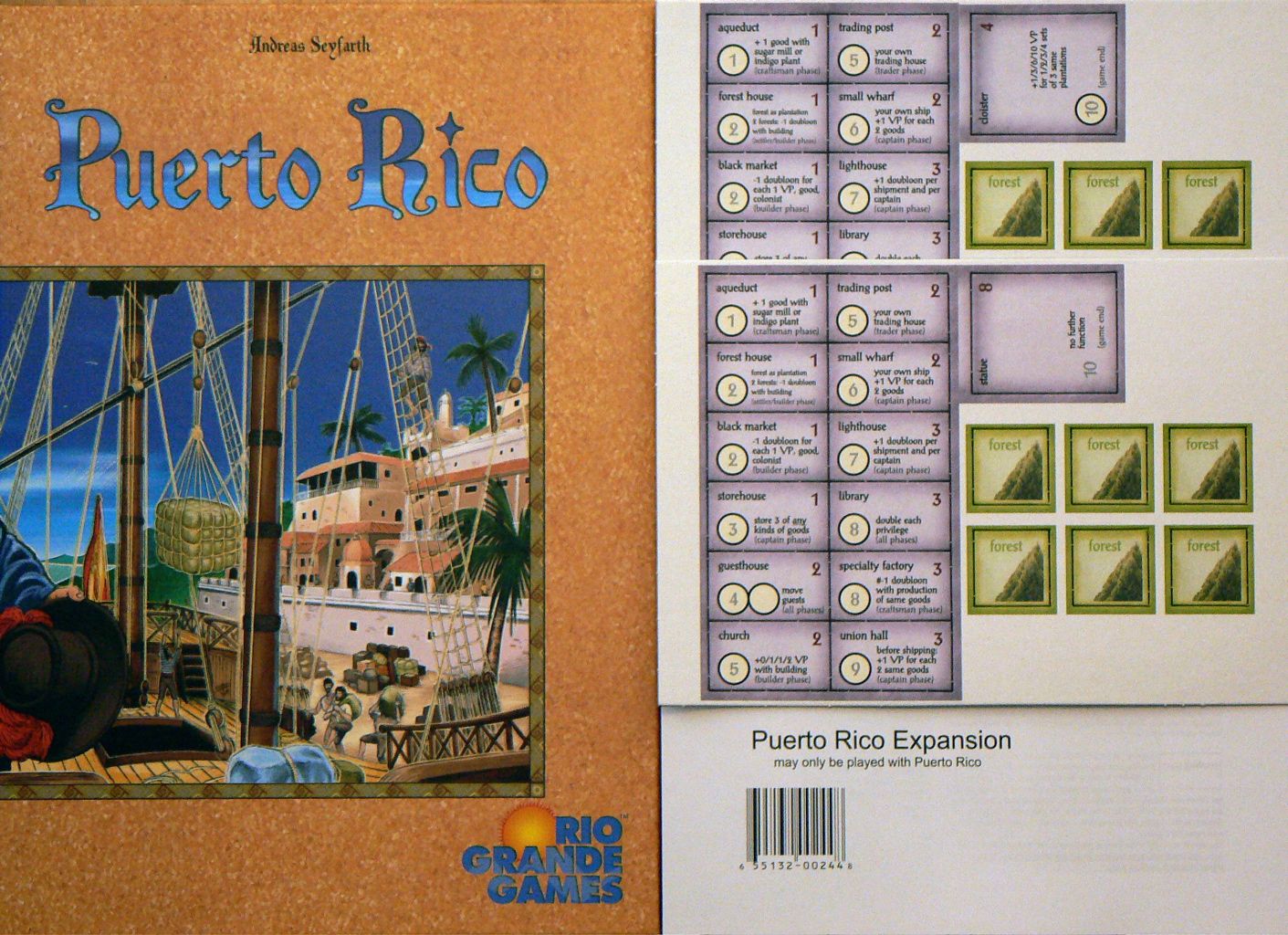
How to Play Puerto Rico: Expansion I – New Buildings
alea, bhv Software, Lacerta · Board game · 2004What do you want to do now
Ask anything about Puerto Rico: Expansion I – New Buildings: rules, setup, components, complexity, price, or whether it fits your group.
Step by step
Game Objective
The game is played over several rounds. In each round, players choose one of seven different roles to initiate an action that all players can perform. The goal is to manage these roles and their associated actions, along with special privileges, to achieve the greatest prosperity and respect. The winner is the player who accumulates the most victory points (VPs) at the end of the game.
Preparation (Setup)
To play "Puerto Rico: Expansion I - New Buildings," follow the basic game setup steps with the following exceptions:
- Place all production buildings on the game board as in the basic game.
- Lay out the 55 beige buildings (2 of each of the 12 small buildings and 5 large buildings from the basic game, plus 2 of each of the 12 small buildings and 2 large buildings from the expansion) next to the game board.
- The starting player chooses 1 building from all available beige buildings and places it on the game board in an appropriate space (the building's cost must match!).
- If the starting player chooses a small building, they place the second building of the same type on top of the one they just placed: small buildings are placed in pairs (except in two-player games).
- Players continue placing buildings clockwise until the spaces for all 12 small buildings and all 5 large beige buildings are filled.
- The 26 unchosen beige buildings (2 of each of the 12 small buildings and 2 large buildings) are returned to the box – they will not be used in the game.
- For buildings costing 2, 5, and 8 doubloons, players will choose two different ones from the four available for each cost.
- The game is then played as in the basic game.
Game Flow
The game is played over several rounds (about 15). Each round is played in the same way:
- The player with the governor card starts. They take one of the role cards, place it face up next to their player board, and perform the action allowed by the role card.
- Then, their neighbor to the left performs the action allowed by that role card, and so on around the table, clockwise, until each player has performed that action once.
- Afterward, the neighbor to the left of the governor takes their turn: they take one of the remaining role cards, place it face up next to their player board, and perform the action allowed by the role card.
- Then, their neighbor to the left performs the action allowed by that role card, and so on around the table, clockwise, until each player has performed that action once.
- This continues until all players have taken a role card and all players have performed the actions allowed by the chosen role cards.
- Then, a doubloon is placed on each of the three role cards that were not chosen by a player during the round.
- The used role cards are then placed back on the table next to the unused cards.
- The neighbor to the left of the player with the governor card takes the governor card, becoming the governor for the next round. They start the round, and the game continues as before.
Basic rules for all role cards:
- If a card has one or more doubloons on it, the player who takes it also takes the doubloons, in addition to the privilege and action associated with the card.
- The action associated with a role card is always performed first by the player who took the card, followed by the others in clockwise order.
- A player must always take a role card when it is their turn, but may choose not to use the action or privilege of the card they chose. The other players, of course, perform the card's action.
- The action of a role card is optional (exception: captain). A player may choose not to use or be unable to use the action on their turn.
- A role card remains in front of the player who took it until the end of the round. It cannot be taken by another player in the same round.
Actions and How to Play
Each role grants the player who chooses it a special privilege and a specific action that can be performed by each player, in clockwise order, starting with the player who chose the role (exception: prospector).
The Settler (Settler Phase)
- Action: Each player takes and places a plantation tile.
- Privilege: The settler may take and place a quarry, instead of a plantation.
- The player who chooses this role may take a quarry as their privilege or one of the face-up plantation tiles and place it on any empty island space on their player board.
- Then, each other player, in clockwise order, may take one of the face-up plantation tiles (not a quarry! - exception: construction hut) and place it on any empty island space on their player board.
- Finally, the settler player places the unchosen face-up plantation tiles into a plantation discard pile and draws new plantation tiles from the face-down piles, placing them face up next to the quarry pile. They draw one more than the number of players.
- When a player has filled all 12 island spaces on their player board, they cannot take any more tiles in settler phases for the rest of the game.
- When there are no more quarries in the quarry pile, the settler cannot use their privilege, and the owner of the construction hut cannot use this special function.
The Mayor (Mayor Phase)
- Action: Each player takes and places a settler on their turn.
- Privilege: The mayor may take an additional settler.
- The tiles (plantation, quarry, or building) have 1 to 3 circles. A player may place a settler on each circle on the tiles on their player board. If there is at least one settler on a tile, it is considered occupied. Only occupied tiles can use their functions; unoccupied tiles never work!
- The player who chooses this role may first take a settler from the settler supply (not from the settler ship!) as their privilege.
- Then, players take settlers from the settler ship one at a time, starting with the mayor. Players continue to take one settler at a time, in clockwise order, until none are left on the settler ship.
- A player may place their new settler(s), along with all settlers they acquired in previous rounds, on any empty circles on the tiles on their player board. Thus, a player may move a settler placed on a circle or on their compass rose in a previous round.
- If a player cannot place all their settlers, they may "store" them on their compass rose on their player board. The settlers remain there until a later mayor phase, when they can be placed on empty circles on the player's tiles.
- As their last task, the mayor places new settlers on the settler ship to be used in the next mayor phase. For each empty circle on the buildings on all players' player boards (empty circles on plantations and quarries do not count!), the mayor takes a settler from the settler supply and places it on the settler ship. However, as a minimum, the mayor must always place at least as many settlers on the ship as the number of players in the game.
- No player may choose to place settlers on their compass rose if they have empty circles available on their player board. All empty circles must be filled, if possible. Settlers can only be placed on the circles during the mayor phase.
The Builder (Builder Phase)
- Action: Each player may build a building.
- Privilege: The builder pays 1 doubloon less.
- The player who chooses this role may immediately build a building for one doubloon less than the normal cost as their privilege. They pay the money to the bank, take the building from the supply, and place it on any empty space in the city on their player board. When placing a large building, the player needs two adjacent empty spaces.
- Then, the other players, in clockwise order from the builder, may similarly build one building each (at normal cost).
- No player may build more than one building per round.
- Each occupied quarry a player owns can reduce the cost of building a building by 1 doubloon. The limit for such reductions is shown on the game board: players building buildings in the first column can reduce their cost by a maximum of 1 doubloon (1 occupied quarry), in the second column by 2 doubloons (2 occupied quarries), in the third column by 3 doubloons (3 occupied quarries), and in the fourth column by 4 doubloons (4 occupied quarries).
- The builder's privilege reduction is in addition to the quarry reduction, but the cost of a building cannot be reduced below 0 doubloons.
- It is not possible to build on more than 12 city spaces. A player who has no empty city spaces cannot build any more buildings.
The Craftsman (Craftsman Phase)
- Action: All players take goods from the supply.
- Privilege: The craftsman takes one extra good.
- The player who chooses this role takes goods from the supply according to their production capacity and places them on the compass rose on their player board. Thus, the compass rose holds a player's money, goods, and extra settlers.
- Then, the other players take goods from the supply according to their abilities, in clockwise order from the craftsman.
- As their last task, the craftsman takes an additional good (of those they can produce) from the supply as their privilege.
- If the type of good a player produces is exhausted in the supply, they take nothing.
- If the craftsman does not produce goods, they do not receive an extra good (privilege).
The Trader (Trader Phase)
- Action: Each player may sell a maximum of one good.
- Privilege: The trader receives 1 extra doubloon on their sale.
- The player who chooses this role may immediately sell a good to the trading house. They place the sold good on any empty space in the trading house and take from the bank the price associated with the good they sold (0-4 doubloons) plus 1 doubloon as their privilege.
- Then, in clockwise order from the trader, each other player may sell a good to the trading house for the price shown, provided there is space for it in the trading house.
- The trading phase ends when all players have had a turn to sell or when the trading house is full.
- Selling rules:
- The trading house has space for only four goods. When it is full, no other player can sell goods in this trading phase.
- The trading house only buys different types of goods (exception: office).
- As their last task, the trader empties the trading house if it is full with four goods, placing them in their separate supply piles. If there are fewer than four goods in the trading house, they remain there. It will be harder to sell goods in the next trading phase, because of the types of goods already present and the fewer available spaces.
- If the trader does not sell, they do not receive the extra doubloon (privilege).
- A player may sell corn to the trading house even if they do not earn money for it.
The Captain (Captain Phase)
- Action: Players must load goods onto the cargo ships.
- Privilege: The captain receives 1 extra VP.
- The captain is responsible for shipping goods to the old world. This means the captain is the first to load goods onto the cargo ships. Then, the other players follow, in clockwise order from the captain.
- In the captain phase, each player may have multiple turns to load goods onto the cargo ships. When it is a player's turn to load goods onto a cargo ship, they must
Rules manual
Official PDF file
Frequently Asked Questions
Quick answers about the rules
What is the objective of Puerto Rico: Expansion I – New Buildings?
How do you set up Puerto Rico: Expansion I – New Buildings?
How do you play Puerto Rico: Expansion I – New Buildings?
Expansion for
Published additional content

