
How to Play Red7
Asmadi Games, 999 Games, Albi · Board game · 2014What do you want to do now
Ask anything about Red7: rules, setup, components, complexity, price, or whether it fits your group.
Video: How to Play
Start here, then follow the written guide
Step by step
Game Objective
In Red7, the objective is to be the last player remaining in the round, beating the other players on all your turns. Each of the seven colors in the game represents a different way to win, and players must choose the best card from their hand to play and, if necessary, change the game rules. A round lasts only a few minutes, and the last player remaining wins the round.
Setup
- The deck of 49 cards, numbered 1 to 7 in seven rainbow colors (Red, Orange, Yellow, Green, Blue, Indigo, and Violet), is shuffled.
- Each player receives a hand of 7 cards.
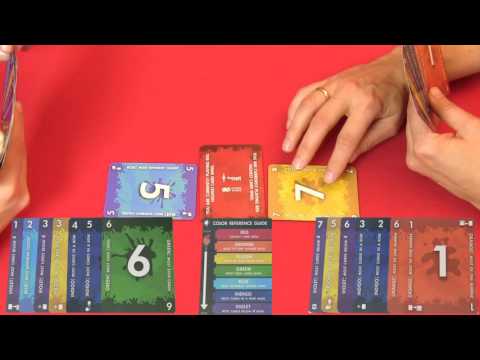
- Then, each player receives one more card face up. This is the player's starting Palette card, which is the area where the player will place their cards during the game. All cards in the Palette must be visible and in front of each player.
- The Canvas, which is a pile in the center of the table, is started with the "Playing with Red" card.
- The top card of the Canvas pile determines the rule in effect for the round.
- The player with the highest card in their Palette is currently the winner.
- The player to the left of the current winner starts the game.
Gameplay Flow
The game progresses in turns. On their turn, a player must choose one of four possible actions. If a player is not winning the game at the end of their turn, they lose and are out of the round. The last player remaining wins the round.
Actions and How to Play
On your turn, you must choose one of the following actions:
- Play a card face up from your hand into your Palette.
- Play a card from your hand onto the Canvas to change the game to the rule of the color of the played card. You must be winning the new game after this action.
- Play a card from your hand into your Palette and then play a card from your hand onto the Canvas. You must be winning the game after this action.
- Do nothing and lose. You can do this intentionally when playing Advanced Red7 to limit an opponent's points. If your hand is empty, this is your only possible action.
You are winning a game if your Palette contains more cards that satisfy the current game rule than any other player. In case of a tie, look at the highest card that meets the rule for each tied player, checking its value and, if necessary, its color. If you have no cards (for the Green and Violet rules) that meet the rule, you are not winning. If you have no cards in your hand at the start of your turn, you lose, as you will be unable to do anything to be winning by the end of the turn.
The rule in effect is determined by the color of the card on top of the Canvas:
- RED: HIGHEST CARD
- ORANGE: MOST OF THE SAME NUMBER
- YELLOW: MOST OF THE SAME COLOR
- GREEN: MOST EVEN NUMBERS
- BLUE: MOST DIFFERENT COLORS
- INDIGO: MOST NUMBERS IN SEQUENCE
- VIOLET: MOST NUMBERS BELOW 4
Icon Effects (OPTIONAL): The four odd-numbered cards (1, 3, 5, 7) have icons in their corners that represent an additional effect when played into the Palette. These effects are recommended for experienced players and can be used with Basic Red7 or Advanced Red7. When you play a 1, 3, 5, or 7 into your Palette, you must perform that card's action, if conditions allow:
- 7: Choose a card from your Palette and then play it onto the Canvas or place it face down on top of the deck. If you choose to play it onto the Canvas, you must be winning afterward.
- 5: Play one more card from your hand into your Palette. You can still play one more card onto the Canvas afterward.
- 3: Draw a card from the deck. (You can play a 3 to try to draw a card you can play onto the Canvas to stay in the game.)
- 1: Choose a card from another player's Palette and place it face down on top of the deck. You cannot choose a player with fewer cards in their Palette than you. (You cannot use a 1 to take another player's card if you are not going to stay in the game afterward.)
Advanced Red7: When you play a card onto the Canvas, if the number of that card is greater than the total number of cards in your Palette, you may draw an additional card from the deck (unless it is empty).
End of Game and Scoring
A round ends when only one player remains. This player wins the round. The player who wins a round takes all the cards from their Palette that satisfy the current rule and places them under their reference card. For example, if they won with the Blue card rule, by having the most cards of different colors in their Palette, they take the highest card of each color from their Palette and place them under their reference card. The next hand is dealt without those cards, as they are now in their score pile. Cards are worth their face value in points.
The game ends if there are not enough cards to deal a new hand to each player. The player with the highest score wins the game.
The POINTS TO WIN the game are:
- 2 PLAYERS: 40 POINTS
- 3 PLAYERS: 35 POINTS
- 4 PLAYERS: 30 POINTS
Tips for Winning
- When comparing two cards, compare the value first, then the color. A 7 is always higher than a 6, but a Red 6 is higher than an Orange 6, and so on by the order of colors in the spectrum (Red, Orange, Yellow, Green, Blue, Indigo, and Violet).
- If you have no cards in your hand at the start of your turn, you lose, as you will be unable to do anything to be winning by the end of the turn.
More videos
More rules explanations from the community







Rules manual
Official PDF file
Frequently Asked Questions
Quick answers about the rules