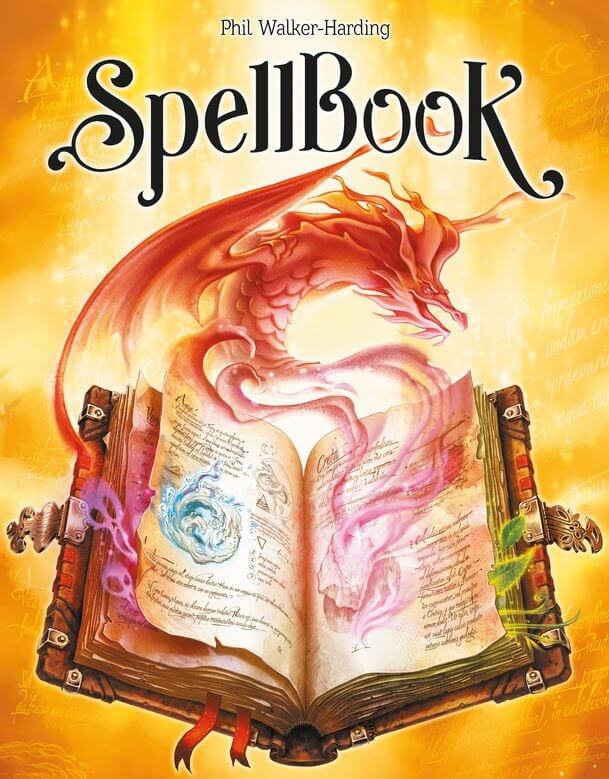
How to Play Spellbook
(Self-Published) · Board gameWhat do you want to do now
Ask anything about Spellbook: rules, setup, components, complexity, price, or whether it fits your group.
Step by step
Goal of the Game
In SpellBook, players take on the roles of wizards gathering to participate in the Great Annual Rite. The goal is to fill your Spellbooks with new Spells, using Matter to do so. Wizards can also store power in their Familiars to gain points. The competition ends when any player's Spellbook or Familiar is filled, and the wizard with the most points wins.
Setup
To prepare the game, follow these steps:
- Place the Altar piece and the Vortex Bag in the center of the table. Mix all Matters into the Bag.
- Draw 5 Matters randomly from the Bag and place them in the empty spaces of the Altar. Prepare the discard pile next to it.
- Randomly choose who will be the First Player and give them the First Player token.
- Each player receives a Familiar board, a Player Aid card, and the Spell deck corresponding to their Familiar icon (each deck has 21 cards divided into three sets of 7).
- Each player draws 2 Matters from the Bag and places them in front of them, forming their starting reserve.
Game Settings
- First Game: To learn the game, it is recommended to use the set of 7 Spell cards with the Familiar symbol in front of you.
- Classic Game: Each player must have 1 Spell of each of the 7 colors. For each color, the First Player shuffles the 3 cards of that color and draws one randomly. The other players take the same card. The other 2 cards of that color are discarded.
Game Flow
The game is divided into turns, where each player completes their Day before passing the turn to the next player in clockwise order. A Day consists of 3 phases:
- Morning: Phase where players can perform a primary action.
- Midday: Phase where players can perform a primary action.
- Night: Phase where players can perform a primary action.
Important: Players are limited to a single action per phase. Performing an action is optional and any phase can be skipped. At the end of each player's Day, they must refill the Altar before passing the turn.
Refilling the Altar
At the end of the Day, the player refills the Altar according to the rules:
- If there are fewer than 5 Matters in the Altar: Draw from the Bag until 5 spaces are occupied.
- If there are between 5 and 9 Matters in the Altar: Draw 1 Matter from the Bag and place it in an unoccupied space.
- If there are 10 or more Matters in the Altar: Discard all Matters from the Altar, draw 5 Matters from the Bag, and place them in the Altar.
Actions and How to Play
Available actions depend on the phase of the Day and the Spells learned.
Primary Actions (Start of the Game)
- Morning:
- Take 1 Matter: Choose 1 Matter from the Altar and add it to your reserve.
- Draw 2 Matters: Draw 2 Matters from the Bag and add them to your reserve.
- Midday:
- Store 1 Matter: Take 1 Matter from your reserve and place it in the first available space on your Familiar board.
- Night:
- Learn 1 Spell: Spend Matters from your reserve of the same color as the desired Spell. One Matter is placed on the card to indicate the level (3, 4, or 5) and the others are discarded.
Note: It is possible to use 3 Matters of the same rune as a wild Matter to help reach the required color.
- Learn 1 Spell: Spend Matters from your reserve of the same color as the desired Spell. One Matter is placed on the card to indicate the level (3, 4, or 5) and the others are discarded.
Spell Actions
When learning a Spell that has an Action Symbol, a new action option is unlocked for the player the following day. If the Spell has a Phase Symbol (Morning, Midday, or Night), the player can choose to use the effect of the learned level or any lower level.
- Instant Effects (Lightning Symbol): Applied immediately upon learning the Spell.
- Permanent Effects: Applied whenever the conditions are met during the player's Day.
Important Reserve and Matter Rules
- Reserve Limit: Each player's reserve has a maximum limit of 9 Matters.
- Wild Matter: When learning a Spell, you can spend 3 Matters of the same rune to create a wild Matter of the color you need.
End of Game and Scoring
The game ends when a player completes their 7th Spell or when their Familiar board is completely filled.
Scoring
After the end of the game, all players calculate their points:
- Spell Points: Receive the number of points indicated on the Spell card, according to the level at which it was learned.
- Familiar Points: Receive the number of points indicated by the lowest visible value on your Familiar board.
Tie-breaking Criteria
- The player who learned the most Spells wins.
- If a tie persists, the player with the most Matters in their reserve wins.
- In case of a persistent tie, the players share the victory.
Tips for Winning
- Reserve Management: Pay attention to the 9 Matter limit in your reserve so as not to lose valuable resources.
- Level Strategy: Remember that higher levels of a Spell do not necessarily provide more resources, but offer more usage options or higher scoring.
Rules manual
Official PDF file
Frequently Asked Questions
Quick answers about the rules