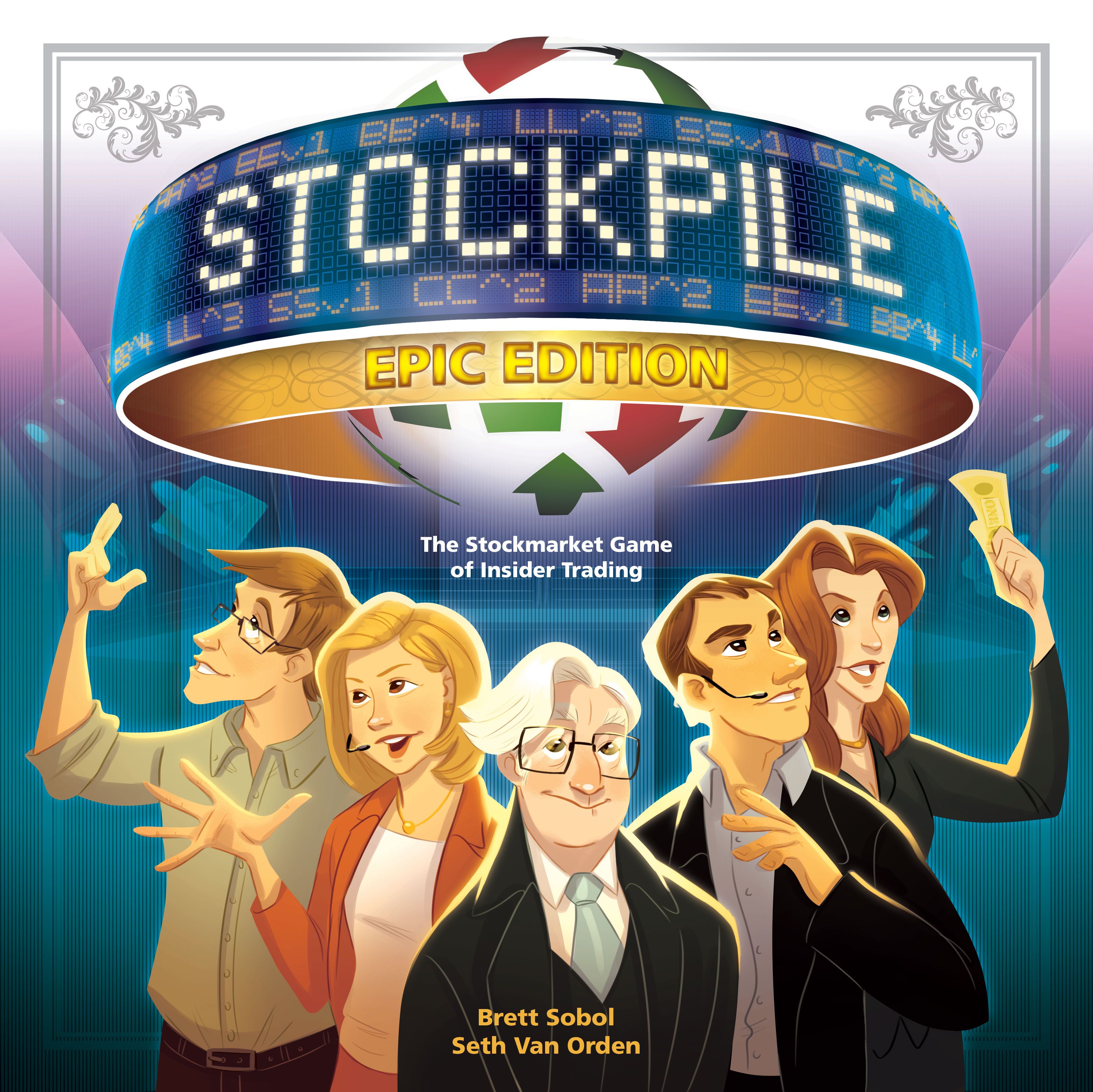
How to Play Stockpile: Epic Edition
Nauvoo Games, Arrakis Games · Board game · 2019What do you want to do now
Ask anything about Stockpile: Epic Edition: rules, setup, components, complexity, price, or whether it fits your group.
Step by step
Game Objective
In Stockpile, you are a private investor with the goal of accumulating the greatest fortune. The game is a fast-paced economic game of corporate investment, insider information, and market manipulation. The player with the most money at the end of the game wins.
Setup
- Give each player an Auction Meeple, a Player Board, and $20,000 in Money Cards (three $5K and five $1K). Place the remaining Money Cards near the board.
- Place the Turn Marker on the calendar space on the game board that corresponds to the number of players.
- Place a Stock Marker on the starting values of each stock, indicated by the dark circles.
- Shuffle and place the Company Cards and Forecast Cards near the board in separate piles. For the base game, use only one of each of the following Forecast Cards: +4, +2, +1, $$, -2, -3. The others can be left in the box.
- Take one of each of the six different Stock Cards from the Market Deck and give one to each player. Each player places this stock face down in the Stock Portfolio space of their Player Board. Place any remaining cards back into the Market Deck, shuffle it, and place it face down near the board.
- The game begins with the player who paid the most for their last meal. Give them the First Player Token.
Setup with Expansion Modules:
- Promissory Notes: Place the Promissory Note Cards next to the Money Cards.
- Commodities & Taxes: The Commodity Cards are combined with the Tax Cards to create the new deck called the Trade Deck. Place the Trade Deck near the Market Deck.
- Forecast Dice: Replace the 6 base game Forecast Cards with the 22 Forecast Cards from this expansion. Place them in piles near the game board. Place the Annual Forecast Board and the Forecast Dice near the game board.
- Investment Strategies: Shuffle all Investment Strategy Cards and deal (3 + the number of players) cards to each player. Each player must then discard 2 Investment Strategy Cards and remove them from the game, along with any other unused ones.
- Investors: Give two Investor Cards to each player. Each player chooses one investor and removes the other from the game. A player's starting money is determined by the chosen Investor Card, instead of the normal $20,000.
Game Flow
Stockpile is played for a few rounds, depending on the number of players. The game begins with the player who has the First Player Token and proceeds clockwise. At the end of each round, pass the First Player Token to the next player to the left.
Each round consists of six phases:
- Information Phase
- Supply Phase
- Demand Phase
- Action Phase
- Selling Phase
- Movement Phase
The Turn Marker shows the number of rounds remaining in the game.
1. Information Phase
During the Information Phase, each player receives a Company Card and a Forecast Card. These cards, when linked, indicate the movement of a stock's value, which happens at the end of the round during the Movement Phase.
- Give one Company Card and one Forecast Card to each player. Players must look at their cards and keep them face down. They provide insider information.
- Place one Company Card and one Forecast Card face up on the board. The value change of this stock is public information.
- Combine the remaining Company Cards with the Forecast Cards and place each pair in different face-down piles near the board. These cards will be used at the end of the round during the Movement Phase.
2. Supply Phase
In the Supply Phase, players place cards into Stockpiles. These cards can be company stocks, trading fees, or action cards. The Stockpiles are the market's supply and are bid on in the Demand Phase.
- Flip one card from the Market Deck face up to begin building each Stockpile. The Stockpiles are built below the calculators at the bottom of the board. The number of Stockpiles in each game is equal to the number of players.
- Deal two cards from the Market Deck to each player. Players must keep these cards separate from others obtained earlier in the game.
- In turn order, each player places their two cards into any Stockpiles in the game. One card is placed face up and the other is placed face down. Cards can be placed in the same Stockpile or in different Stockpiles.
3. Demand Phase
It is in the Demand Phase that players acquire a Stockpile created in the Supply Phase. The Bid Track represents the demand or the amount to be paid in money for the corresponding Stockpile at the end of this phase.
- In turn order, each player places their Auction Meeple on an available number on any Bid Track of their choice, including those tracks where someone has already bid, as long as the new bid is higher than the previous one. A player cannot bid higher than their current money amount.
- If a player has their bid surpassed by another player, the surpassed player takes their Meeple and can place a new bid on their next turn. The new bid only happens after all players have had a chance to bid. The new bid can be placed on the same Bid Track or on a different Bid Track. The maximum bid is $25,000. You cannot bid less than or equal to another player on the same Bid Track.
- The auction continues until all Bid Tracks have an Auction Meeple on them.
- Players pay the bank the value of their bid, take their Meeple, and all cards in the Stockpile they purchased. A player may end up winning a Stockpile with a $0 bid.
- If a player's Stockpile had a Trading Fee Card, the player pays the bank the indicated amount. When paid, Trading Fees are placed face up in the discard pile. If players do not have money to pay for the trading fee, they must keep the card, placing it face up in front of them, and pay it as soon as they have enough money.
- Place the other obtained cards face down in the Stock Portfolio section of the Player Board. Stock Cards obtained during the game must be kept hidden from other players.
4. Action Phase
In this phase, players manipulate the market using Action Cards.
- In turn order, players use all Action Cards obtained in the previous Demand Phase, placing them face up in the discard pile after their effect.
- Stock Boom! – for each Stock Boom, the player chooses a stock and moves its value two points up.
- Stock Bust! – for each Stock Bust, the player chooses a stock and moves its value two points down.
Action Cards must be played in the same round they were acquired.
5. Selling Phase
The Selling Phase gives players an opportunity to sell any stocks they currently own. They must use the knowledge gained in the Information Phase to know which stocks to sell.
- In turn order, players can sell any number of stocks they have obtained, placing them face up in the discard pile and gaining money from the bank equal to the value of the stocks for each stock sold.
6. Movement Phase
In the Movement Phase, the value of stocks varies according to the Company Cards and Forecast Cards that were linked in the Information Phase.
- In turn order, players reveal their Company Cards and Forecast Cards and move the stock values accordingly.
- Move the remaining stocks according to the face-up and face-down pairs of Company Cards and Forecast Cards that are on and near the board. All stocks will be affected in every round.
- The Forecast Card showing "$$" means a company pays dividends. The stock value does not change. Instead, each player immediately receives $2,000 for each stock of this company they have in their Stock Portfolio. A player will receive double dividends for stocks in their Split Portfolio. The player must reveal the stocks for which they want to receive dividends.
Stock Split
If a stock's value is to increase by more than 10, the stock splits. A stock split effectively doubles your shares of that company. When a stock splits, all players with shares of that company in their portfolio reveal them and move them, face down, to their Split Portfolio. If the value increase causes it to land exactly on the Stock Split space, then the stock's value returns to 6. If the stock's increase would move the value beyond the Stock Split space, return the stock's value to 6 and continue to increase that stock's value. Any new stock acquired after the stock split goes into the player's normal Stock Portfolio. If a player already has any stock in their Split Portfolio and that stock splits again later in the game, that player receives $10,000 in Money Cards for each stock of that company they have in their Split Portfolio. The stock remains in the Split Portfolio.
Bankruptcy
If a stock's value is to decrease below space 1 in a turn, that company immediately goes bankrupt. All players discard all shares of that company they own, including those in their Split Portfolio. Return the value of that company's shares to the starting value of 5.
End of Round
The round ends after the Movement Phase. If the Turn Marker is not yet on the rightmost space of the calendar, move it one space to the right. Pass the First Player Token to the left and start a new round. If the Turn Marker is already on the rightmost space of the calendar, the game is over. Proceed to the End of Game.
Actions and How to Play
Refer to the manual for details on this section.
End of Game and Scoring
The game ends at the end of the last Movement Phase. Any remaining cards in the Market Deck will not be used in the game.
- All players reveal all shares they own of each company and determine the majority shareholders. A majority shareholder is the player with the most shares of a company. Shares in a Split Portfolio count double when determining majority shareholders. The majority shareholders of each company receive a $10,000 bonus. If there is a tie, all tied players receive $5,000.
- Each player then sells their shares at the current price of each share. Shares in players' Split Portfolios are worth double.
- Sum each player's Money Cards. The player with the most money, and therefore the greatest fortune, wins the game.
Scoring with Expansion Modules:
- Promissory Notes: Players exchange their Promissory Note Cards for money from the bank equal to the full price they paid for them during the game.
- Commodities & Taxes: Commodity Cards and Tax Cards are only evaluated at the end of the game. Commodities give money according to the different types (see Figure 16 in the manual). Commodities of the same type can also be valuable, starting a new set with each duplicate Commodity. Tax Cards are evaluated according to how many cards the player took (see Figure 17 in the manual).
Tips for Winning
- Utilize the insider information obtained in the Information Phase to make strategic decisions during the Demand and Selling Phases, anticipating stock price movements.
- Buy Promissory Notes early to profit more from interest each round, but be careful not to overspend and run out of money to buy valuable Stockpiles later.
- Pay attention to stock splits, as they double your shares of that company and can generate significant cash bonuses if the stock splits again.
Rules manual
Official PDF file
Frequently Asked Questions
Quick answers about the rules
What is the objective of Stockpile: Epic Edition?
How do you set up Stockpile: Epic Edition?
How do you play Stockpile: Epic Edition?
How does Stockpile: Epic Edition end, and how do you score?
What are some tips for winning Stockpile: Epic Edition?
Other Games You'll Like
Based on mechanics and theme