
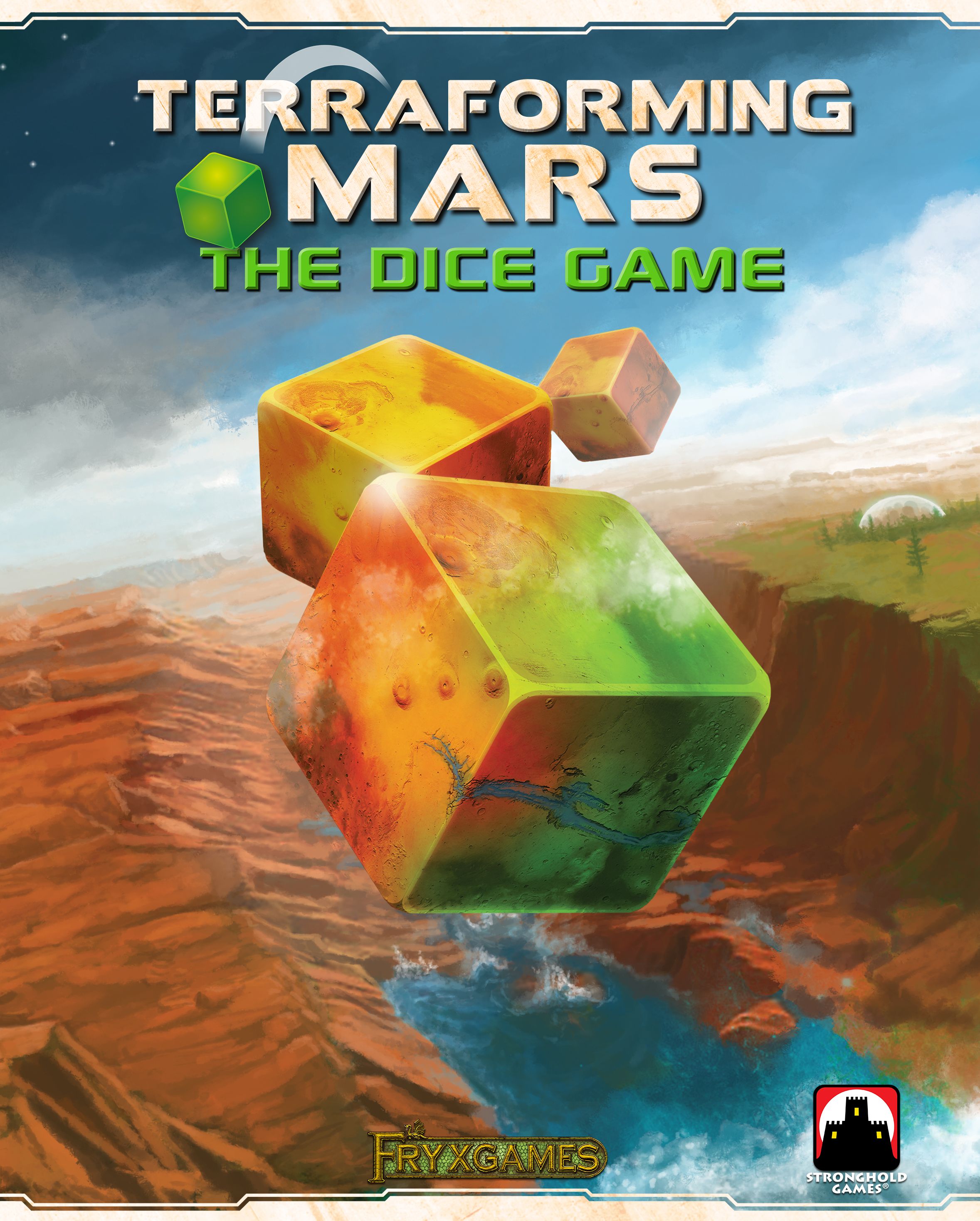
How to Play Terraforming Mars: The Dice Game
FryxGames, Ghenos Games, Intrafin Games · Board game · 2023What do you want to do now
Ask anything about Terraforming Mars: The Dice Game: rules, setup, components, complexity, price, or whether it fits your group.
Video: How to Play
Start here, then follow the written guide
Step by step
Game Objective
In Terraforming Mars: The Dice Game, players take on the role of corporations seeking to terraform Mars, transforming it into a new home for humanity. To do this, they use special dice representing resources to play cards and perform actions.
The main objective is to accumulate the most Victory Points (VPs). Players earn VPs by terraforming Mars (increasing oxygen, temperature, or placing oceans), by placing tiles on the board, playing cards, and by obtaining Awards and Milestones.
The game ends when 2 of the 3 global terraforming parameters (oxygen, temperature, or ocean) are completed. The player with the most VPs at the end of the game wins.
Setup
- Board: Place the board (choose a side) in the center of the table. Place a clear cube on 0% oxygen and another on -32°C temperature. Stack 7 oceans on the ocean symbol on the board. Each player chooses a color and places their corresponding cube at the start of the VP track (0 VP).
- Dice Supply: Place all dice next to the board, within everyone's reach. This is the Dice Supply. Place all wildcard tokens and tiles near the supply.
- Project Deck: Shuffle all project cards, forming a face-down deck next to the board, with a space nearby for a discard pile.
- Bonus Card: Shuffle all bonus cards and randomly draw 4 (for 1 or 2 players), 6 (for 3 players), or 8 cards (for 4 players) without revealing them. Leave them face-down next to the board and return the remaining ones to the box, without looking at them. When players reach the bonus locations on the VP track (5 and 12 VP), they will receive a bonus card.
- Awards: Take 1 die of each color from the dice supply and randomly select 3 of them, roll them, and place them, one in each award space on the board. Players compete to have the majority of these symbols in the cost of their played cards at the end of the game.
- Milestones: Randomly take 3 milestones and place them on the board. Return the rest to the box. The first player to achieve a milestone's objective immediately receives the tile for free. Each milestone is worth 4 VPs at the end of the game.
- Player Order: The player who most recently won a game of Terraforming Mars (any version) is the starting player and begins this game. Play proceeds clockwise.
- Projects and Corporations: Starting Hand: Deal 5 project cards to each player. Shuffle the corporation cards and deal 2 to each player. Each player chooses one of these corporations to be theirs, then all unused ones are returned to the game box.
- Reveal Corporations: In turn order, each player places their chosen corporation face-up in front of them, and receives the starting bonus shown in the red box (in this example, 3 wildcard tokens). Then, each player covers the red box with their color tile.
- Initial Production: Each player receives the production shown in the brown box (in this example, 2 yellow dice and 1 red die). Each player rolls the dice and leaves them in front of them representing their resources. During the game, players may receive more resources by performing a production turn.
- First Player Penalty: The first player must choose 1 of their resources and give it to the last player (skip this step if you are playing alone). Then the first player starts the game.
Game Flow
Players take turns clockwise. This continues throughout the game until 2 of the 3 global parameters have been completed and the game ends.
On your turn, you can choose to produce new resources (production turn) or perform actions (action turn):
Production Turn
- Keep up to 3 of your current resource dice (wildcard tokens are not dice!), returning the rest to the dice supply.
- You may discard any number of cards from your hand.
- If you have fewer than 5 cards in your hand, draw cards until you have 5.
- Produce new resources: receive and roll all dice shown in the brown boxes of your corporation card and your in-play green project cards. If there are not enough dice in the dice supply, you take as many as you can and receive 1 wildcard token (regardless of how many fewer dice you took).
- Return any used blue project cards to their original position. These cards can be used again.
Action Turn
An action turn consists of performing 1 of the support actions and then 1 of the main actions:
Support Action (choose 1)
- Receive and roll 1 die of your choice from the dice supply.
- Pay any resource to change the result of another die to any of its sides.
- Pay any resource to draw 2 cards.
- ...or use a support action on one of your unused blue cards. Then, rotate it to mark it as used.
Main Action (choose 1)
- Play a card from your hand, paying its costs.
- Perform another support action as your main action.
- Pay 3 heat resources to increase the temperature by 1 level.
- Pay 3 water resources to place 1 ocean.
- Pay 4 plant resources to place 1 forest (and increase oxygen by 1 level).
- Pay 3 city resources to place 1 city.
- Pay 3 MegaCredit resources to immediately receive 2 VPs.
- ...or use a main action on one of your unused blue cards. Then, rotate it to mark it as used.
Free Action
Some blue cards have a free action, which can be performed at any time during your turn, before or after your support action or main action, or even at the beginning or end of a production turn. Perform its effect and rotate the card to mark it as used.
Actions and How to Play
Playing a Card
Playing a card is a main action performed on your action turn, so make sure you have performed your support action first! To play a card from your hand, you must pay exactly the resources shown in the upper left corner of the card (the icons must match!). Spent resources return to the dice supply. Wildcard tokens can be paid as any resource. After paying for the card, perform its effects, in any order. If an effect cannot be performed, ignore it.
Card Types
- Green Cards: All green cards have a brown production box in the upper right corner. Nothing happens when playing these cards. Stack them leaving only their cost and the brown production boxes visible. All dice in brown boxes are received and rolled each time you perform a production turn.
- Red Cards: When playing a red card, its effect is performed immediately. Any dice are received and rolled immediately. Stack the red cards together, leaving only their costs visible (they will help you obtain Awards at the end of the game!).
- Blue Cards: When playing a blue card, nothing happens. Just keep the card separate from the others. These cards have an action (support action, main action, or free action) that only you can use. When using the action of a blue card, pay the cost (if any) shown to the left of the arrow and receive the benefit shown to the right of the arrow, then rotate the card to mark it as used. All used blue cards return to their original position during your production turn, and can then be used again.
Terraforming and VPs
- Whenever a player terraforms (places an ocean on the board, increases temperature or oxygen), they receive 2 VPs, immediately moving their color cube on the board's VP track.
- If the oxygen, temperature, and ocean parameters are already complete, you can still terraform them. Nothing happens, but you will receive 1 VP (instead of 2 VPs).
Placing Tiles on the Board
An icon showing an ocean, forest, city, or special tile hexagon means placing the corresponding tile on the board. Only 1 tile can be placed in each area. Place the tile and receive any placement bonuses printed in that area.
- Ocean: Place an ocean in an area reserved for oceans (marked in blue on the board). No other tile can be placed in areas reserved for oceans. Receive 2 VPs, as this counts as a terraforming.
- Forest: Place a forest in an area of the board and receive 1 VP for each adjacent city. Increase oxygen by 1 level and, therefore, receive 2 VPs for terraforming.
- City: Place a city in an area that is not adjacent to another city. Receive 2 VPs for this city and an additional 1 VP for each adjacent forest.
- Special Tiles: Place the brown tile with the corresponding symbol in an area.
Parameter Bonuses
The oxygen and temperature parameters have bonuses along their tracks. The player who moves the marker to one of these levels receives the respective bonus.
Bonus Card
When you reach the bonus levels on the VP track (at 5 and 12 VPs), you receive a bonus card at the end of your turn. Secretly look at all available bonus cards, choose one, and play it immediately at no cost. Then, return the remaining bonus cards to the side of the board, face-down, for the next player to take their turn. Bonus cards work exactly like other green, red, or blue cards, also counting towards Milestones.
Dice and Resources
- There are 5 different colors of dice. Each die has 3 different resources. Each die has 1 common resource (on 3 faces), 1 uncommon resource (2 faces), and 1 rare resource (1 face).
- The die icon ( ) means a die of that color. Receive the die from the dice supply and roll it immediately, making it a specific resource. The face shown up after rolling is your resource, for example a plant ( ).
- A question mark (?) means any resource of that color.
- A white resource with a question mark means any resource of any color.
- A white die icon represents a die of any color.
- Rotate a die! If a die icon has pink arrows around it, this means you can rotate one of your dice to any side you want.
- Wildcard tokens: Wildcard tokens can be spent as any resource of your choice.
- Red borders on resources: If a resource icon has a red border with a minus symbol in front, it means each opponent must lose this resource (if possible).
- Dice not available in the dice supply: If there are not enough dice in the dice supply to perform your production turn, receive as much as you can from your production and 1 wildcard token (no more!). In any other situation, any missing resources or dice are simply lost, without any compensation.
End of Game and Scoring
The game ends when 2 of the 3 global parameters (ocean/temperature/oxygen) are completed. Then all players (including the player who completed the second parameter) take 1 final turn. Note that increasing the third parameter still grants you 2 VPs and you still receive 1 VP for increasing any already completed parameter.
When the last turn is complete, any remaining resources and cards in players' hands are discarded without any effect. Now, score Awards, Milestones, and cards to reach your final score:
- Awards: For each Award, players will count the quantity of the respective icon in the costs of all their played cards. The player with the highest quantity of this icon receives 5 VPs and the second-place player receives 3 VPs. Ties are friendly: if 2 or more players tie for first place, both will receive 5 VPs but there will be no scoring for second place. If 2 or more players tie for second place, both will receive 3 VPs. In a 2-player game, there will be no scoring for second place.
- Milestones: Each Milestone is worth 4 VPs. Milestones are obtained during the game as soon as a player meets their requirements.
- Card VPs: Each player adds all VPs present on all their played cards (VP icons with a red ribbon in the lower right corner).
The player with the highest score is the winner of the game! In case of a tie, the player with the most dice production (count all dice icons in brown boxes on their corporations and green cards) is the winner. If the tie persists, play a new game!
Tips for Winning
- Terraform for VPs: Whenever a player terraforms (places an ocean, increases temperature or oxygen), they receive 2 VPs. Prioritizing terraforming is a consistent way to accumulate points.
- Take advantage of placement bonuses: When placing forests or cities, look for areas adjacent to other tiles to maximize the VPs received. For example, a forest adjacent to a city yields 1 extra VP, and a city adjacent to a forest also yields 1 VP.
More videos
More rules explanations from the community


Rules manual
Official PDF file
Frequently Asked Questions
Quick answers about the rules
