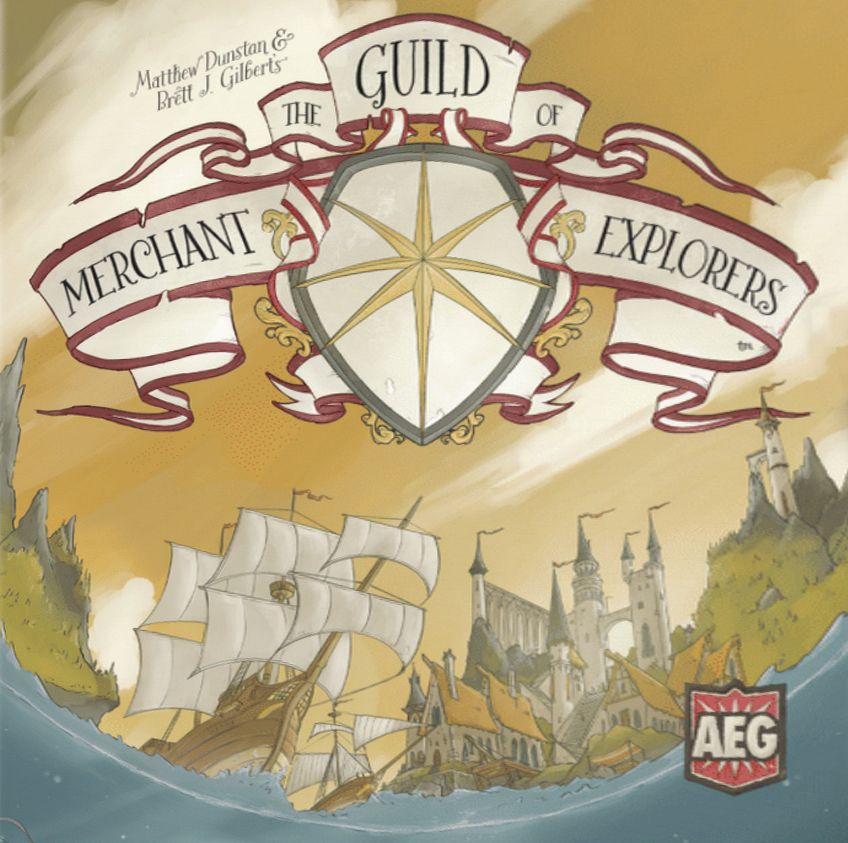
The Guild of Merchant Explorers — Prices
Alderac Entertainment Group, CMON Global Limited, Delirium Games · Board game · 2022
1–4 · best 2
Solo
45 min
Weight 2.1/5
Buy · from US$ 34.80
8.1
rating
Ludopedia
7.6
rating
BGG
Our Verdict
RECOMMENDED
Perfect for those who love 'fill-the-board' games with a touch of luck and heavy positioning strategy.
Highlights
- Addictive bingo-style mechanics
- Great for solo or remote play
- Satisfying and intuitive components
- Fast-paced and dynamic sessions
Keep in mind
- Luck of the draw dependency
- Indirect player interaction
Rules manual not indexed yet
Upload the PDF rulebook to ask questions about this game with AI.
About the game
What you do in a play session
Imagine you are an ambitious explorer trying to map uncharted lands and expand your guild's influence. In The Guild of Merchant Explorers, the fun begins with each player on their own personal map, starting from a single home city. The heart of the game is the revelation of terrain cards: as cards are flipped, all players attempt to 'fill' their maps by placing cubes that connect to their starting city or existing expansions. It's almost like a strategic bingo, where you react to the deck's draw to plot your routes.
The challenge is that you don't just want to place cubes; you need a plan to cross oceans, colonize new lands, and establish new cities. Why are cities so crucial? Because at the end of each round, all your exploration cubes are removed. If you haven't founded new cities, you're back to square one! Cities act as your new starting points, allowing you to explore further reaches in the next turn. Additionally, you can scavenge wrecked ships for treasures that provide special placement bonuses, making your expansion much smoother.
There is also a race for common objectives. Those who complete specific goals first score more points, keeping the tension high. The game is incredibly flexible: it comes with multiple different maps and was designed so you can play with friends even if everyone is in their own home with their own copy of the game, as interaction happens through the shared revelation of cards. It's the perfect blend of network planning, space management, and that little bit of luck from the terrain draw.
The challenge is that you don't just want to place cubes; you need a plan to cross oceans, colonize new lands, and establish new cities. Why are cities so crucial? Because at the end of each round, all your exploration cubes are removed. If you haven't founded new cities, you're back to square one! Cities act as your new starting points, allowing you to explore further reaches in the next turn. Additionally, you can scavenge wrecked ships for treasures that provide special placement bonuses, making your expansion much smoother.
There is also a race for common objectives. Those who complete specific goals first score more points, keeping the tension high. The game is incredibly flexible: it comes with multiple different maps and was designed so you can play with friends even if everyone is in their own home with their own copy of the game, as interaction happens through the shared revelation of cards. It's the perfect blend of network planning, space management, and that little bit of luck from the terrain draw.
Gallery
Box and component photos
Tap any photo to open fullscreen. Photos submitted by the community or publisher.
Rules videos
Learn by watching before you open the box
In English
-
 The Guild of Merchant Explorers | How to Play
-
 Peaky Boardgamer Episode #126 - The Guild of Merchant Explorers - Full rules explanation (English)
-
 Tutorial & Solo Playthrough of Guild of Merchant Explorers - Solo Board Game
-
 Jojo Teaches Guild of Merchant Explorers
-
 What's new to BGA! Guild of Merchant Explorers - Quick Start Guide on Board Game Arena.
-
 Playthrough - Guild Merchant Explorers
Best player count
BGG community vote
1
REC
2
BEST
3
BEST
4
REC
Soundtrack
Ambience suggested by Melodice
Loading playlist...
Where to Buy
Prices monitored daily
Finding best prices...
Prices unavailable at this time.
Price history — last 6 months (lowest new offer)
Alert enabled!
Join the BoardGamesBot deals group
Get the best board game deals every day — without message spam.
Join the WhatsApp groupGame details
Mechanics, categories, families and credits
Mechanics
Categories
Families
Publisher
Alderac Entertainment Group, CMON Global Limited, Delirium Games, Lucky Duck Games, Origames, Skellig Games, Tabletop KZ, YOKA Games, 株式会社ケンビル (KenBill)
Designer
Brett J. Gilbert, Matthew Dunstan
Artist
Gerralt Landman
Community
Data from BoardGameGeek
12,382owners
3,918wishlist
463want to play
Frequently Asked Questions
Quick answers before you buy
Is the game hard to learn?
Not at all! The rules are simple and intuitive, and since there's very little text, the learning curve is quite fast.
Can I play it solo?
Yes, the game features an excellent solo mode for those who want to test their exploration efficiency.
How long does a game take?
It usually lasts about 45 minutes, making it very agile.
Do I need to know English to play?
Hardly. The game has very little text, making it accessible to everyone.
How does player interaction work?
Interaction is indirect; you compete for the same common objectives and see who can expand the fastest.
Other Games You'll Like
Based on mechanics and theme