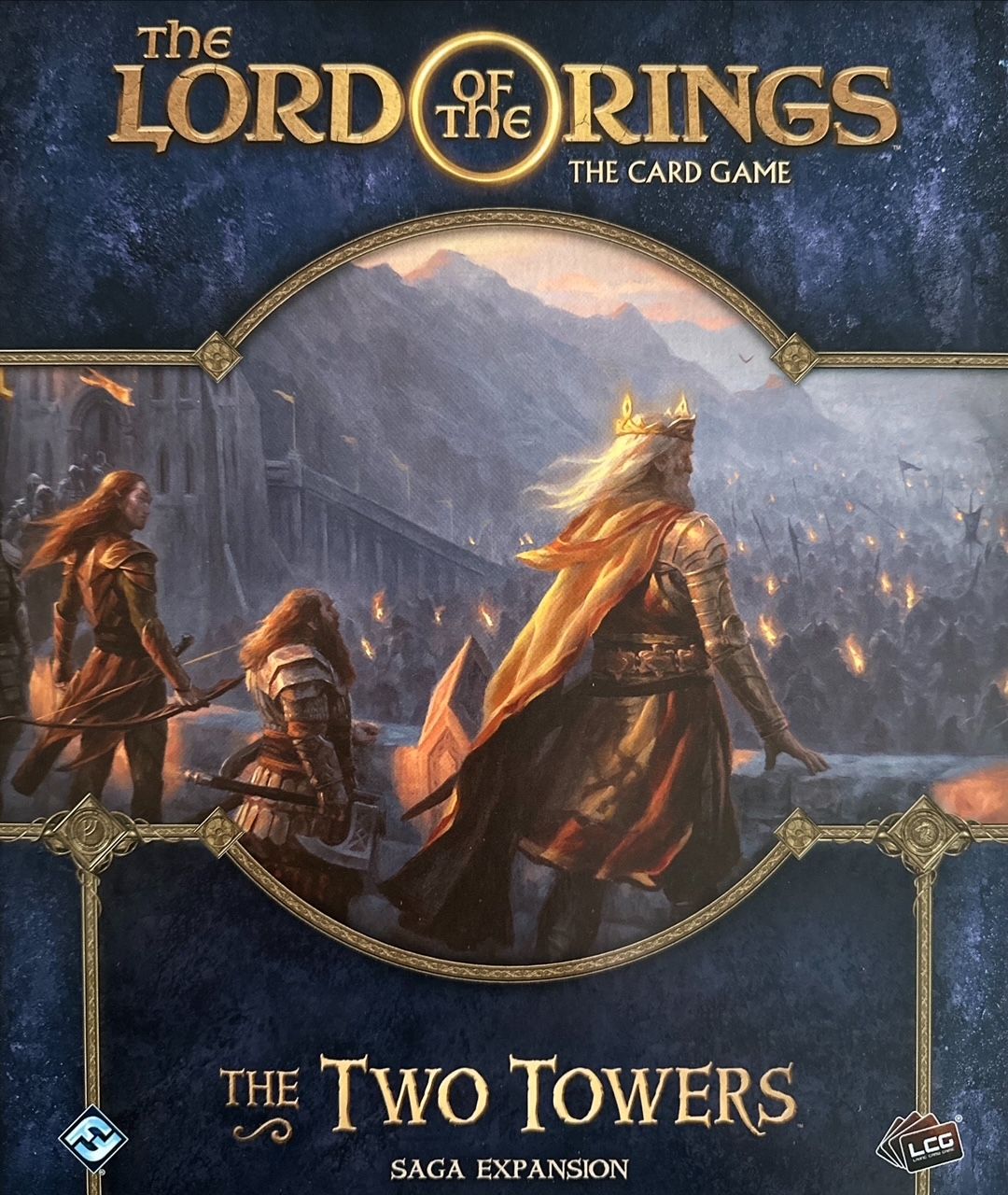
How to Play The Lord of the Rings: The Card Game – The Two Towers: Saga Expansion
Fantasy Flight Games, ADC Blackfire Entertainment · Board game · 2023What do you want to do now
Ask anything about The Lord of the Rings: The Card Game – The Two Towers: Saga Expansion: rules, setup, components, complexity, price, or whether it fits your group.
Step by step
Game Objective
The The Two Towers saga expansion for The Lord of the Rings: Card Game allows players to directly participate in the narrative events described in J.R.R. Tolkien's classic novels. The objective is to join Aragorn and his companions to combat Saruman's treachery in Rohan, and then to be part of Frodo Baggins' quest to destroy the One Ring and defeat Sauron. The expansion includes six scenarios that occur during The Two Towers novel, allowing players to experience the second third of The Lord of the Rings story.
The overall victory condition is not explicitly detailed for all scenarios, but for the "The Uruk-hai" scenario, players lose the game if the pursuit value reaches 30, indicating that the Uruk-hai have reached Isengard with the prisoners. For the "Helm's Deep" scenario, players lose the game if the Encounter Deck wins stage 4B, meaning Saruman's army has captured Helm's Deep. Additionally, if Aragorn leaves play, players lose the game. If The One Ring leaves play, players lose the game. If Sméagol is defeated, players lose the game.
Setup
When setting up a scenario from The Two Towers saga expansion, follow the steps below:
- Components: The expansion includes 330 cards, consisting of 6 Hero Cards, 63 Player Cards, 17 Quest Cards, 218 Encounter Cards, 6 Campaign Cards, and 20 Advantage and Disadvantage Cards.
- Card Identification: Cards from this expansion can be identified by a symbol preceding each card's number.
- Choosing the Fellowship Hero: The first player must take control of the appropriate Fellowship Sphere hero for the scenario:
- For "The Uruk-hai," "Helm's Deep," or "The Road to Isengard," the first player takes control of Aragorn ☺.
- For "The Dead Marshes," "Journey to the Cross-roads," or "Shelob's Lair," the first player takes control of a ☺ Sphere hero with the Ring-bearer attribute at the start of the game and attaches The One Ring to that hero.
- Hero and Ally Restrictions: Players cannot use any ally or hero card with the title "Saruman," "Gríma," or "Sméagol."
- Fellowship Sphere Heroes:
- Fellowship Sphere heroes can only be used in saga expansion scenarios.
- Only one Fellowship Sphere hero can be in play at a time.
- When using a ☺ version of Aragorn or Frodo Baggins, players cannot start with any other version of that hero as an initial hero or include it in their decks.
- Each ☺ hero collects 1 resource during the Resource Phase. Resources from a ☺ hero's Resource Pool can be spent to pay the cost of Fellowship Sphere cards and neutral cards.
- Aragorn (Specific Rules):
- Aragorn does not count towards the hero limit. The first player can start with up to 4 heroes if one of them is Aragorn.
- The first player takes control of Aragorn, all resources in his Resource Pool, and all cards attached to him when the First Player Token is passed in the Refresh Phase.
- If Aragorn leaves play, players lose the game. This text cannot be modified.
- Frodo Baggins (Specific Rules): This new version of Frodo Baggins is the only hero with the Ring-bearer attribute included in this expansion.
- The One Ring (Specific Rules):
- For "The Dead Marshes," "Journey to the Cross-roads," or "Shelob's Lair," the first player attaches The One Ring to a Ring-bearer they control.
- The hero with the The One Ring attachment does not count towards the hero limit. The first player can start with 4 heroes if one of them is a Ring-bearer with The One Ring.
- If The One Ring leaves play, players lose the game. This text cannot be modified.
- In multiplayer mode, the first player takes control of the hero with the The One Ring attachment, their resources, and attached cards when the First Player Token is passed in the Refresh Phase.
- If the hero with The One Ring is the only hero controlled by a player and leaves their control, that player is immediately eliminated.
- Card Setup Instructions:
- If a Player Card with Setup instructions is in a player's deck, they search for it and follow the instructions before drawing their opening hand.
- If an Encounter Card with Setup is in the Encounter Deck, search for it and follow the instructions before resolving the quest's Setup instructions.
- "The Uruk-hai" Scenario:
- The Encounter Deck is built with all cards from the "The Uruk-hai," "Orcs of the White Hand," and "Snaga Orcs" sets.
- Adjust the pursuit value to 10. Take an additional Threat Dial and place it next to the Quest Deck to be the Pursuit Dial.
- "Helm's Deep" Scenario:
- The Encounter Deck is built with all cards from the "Helm's Deep" and "Orcs of the White Hand" sets.
- "The Road to Isengard" Scenario:
- The Encounter Deck is built with all cards from the "The Road to Isengard" and "Snaga Orcs" sets.
- "The Dead Marshes" Scenario:
- The Encounter Deck is built with all cards from the "The Dead Marshes," "Gollum," and "Nazgûl of Morgul" sets.
- "Journey to the Cross-roads" Scenario:
- The Encounter Deck is built with all cards from the "Journey to the Cross-roads" and "Men of Harad" sets.
- "Shelob's Lair" Scenario:
- The Encounter Deck is built with all cards from the "Shelob's Lair," "The Great Spider," "Gollum," and "Nazgûl of Morgul" sets.
Game Flow
Refer to the manual for details on this section.
Actions and How to Play
Saga Organization Rules
During the organization step of the Quest Phase, players individually reveal Encounter Cards in turn order. Starting with the first player, each player reveals 1 Encounter Card and resolves its organization before the next player reveals a card.
- When an Encounter Card has an effect with the word "you," that card refers to the player who revealed it.
- When an Encounter Card has the keyword "Surge," the player who revealed it reveals an additional Encounter Card before passing the turn to the next player.
- Encounter Cards with the keyword "Cursed X" affect all players.
Keywords and Terms
- Archery X: While a card with the "Archery" keyword is in play, players must deal damage to Character Cards in play equal to the specified Archery value at the beginning of each Combat Phase. This damage can be dealt to characters controlled by any player and can be divided among players. If there is no consensus, the first player makes the final decision. If there are multiple cards with "Archery," the effects stack. Ú does not block Archery damage.
- Gollum / Sméagol: Is a unique double-sided Encounter Card.
- It has no Encounter Card face and cannot be shuffled into the Encounter Deck.
- Gollum's effect of attacking after engaging the first player during the Refresh Phase is not triggered if there is only one player in the game.
- When Gollum is defeated, discard all damage from him, flip the card to the Sméagol face, and exhaust him. Gollum leaves play and the Sméagol Objective-Ally enters play.
- If an effect causes Sméagol to be flipped to Gollum, discard all damage from Sméagol and ready him. The Sméagol Objective-Ally leaves play and the Gollum enemy enters play.
- Immune to Player Card effects: Cards with this text ignore the effects of all Player Cards and cannot be targeted by their effects.
- Invincible: An enemy with the "Invincible" keyword cannot be defeated by damage, even if the damage suffered is equivalent to its Hit Points.
- Hazard: When a player reveals an Encounter Card with the "Hazard" keyword, they must resolve that card's organization effect alone, without consulting other players. Other players cannot perform actions or activate responses during resolution.
- Permanent: A new keyword on some advantages and disadvantages. When a player gains a "Permanent" advantage or disadvantage, it is attached to a hero and recorded in the Campaign Log. It can only be attached to a single hero during the campaign. "Permanent" attachments cannot be discarded from the hero while it is in play. If a hero leaves play, "Permanent" attachments attached to it are removed.
- Poisoned Counsels and The Inquiring Eye: These treacheries function as Player Cards. They are Encounter Cards with a Player Card back that are shuffled into the player's deck. They can be drawn or added to hand, and discarded from hand or deck. They cannot be played.
- Toughness X: An enemy with the "Toughness" keyword subtracts X from the damage dealt to it each time any amount of damage is assigned to it.
- Magic: A new trigger for the "The Road to Isengard" scenario. When a location with Magic leaves play as an explored location, activate its Magic effect (even if it is not the Active Location).
- Defense: A new keyword for the "Helm's Deep" scenario. While the current quest has the "Defense" keyword, players cannot place Progress Tokens on the quest (or Active Location) for successful questing. Instead, the Encounter Deck attempts to place Progress Tokens on the current quest.
- During quest resolution, if the total $ in the staging area is greater than the total Ò of characters committed to the quest, players do not raise their threat by the difference. Instead, the first player places a number of Progress Tokens on the current quest equal to the difference.
- The Active Location still acts as a buffer for the current quest, so any Progress Tokens from the Encounter Deck or Encounter Card effects must be placed on the Active Location before being placed on the quest (unless the card effect ignores the Active Location).
- When a quest has a number of Progress Tokens equal to its Quest Points, that stage is won and players advance to the next stage.
- Bog X: A new keyword for the "The Dead Marshes" scenario. At the end of the Refresh Phase, place 1 resource on each location in the staging area with the "Bog" keyword, as a "Bog Token." When a location with the "Bog" keyword has a number of Bog Tokens equal to its Bog X value, it is immediately discarded.
- Each location with the "Bog" keyword also has a Forced effect that triggers when it is discarded from play by the "Bog" keyword. These Forced effects do not trigger when a location is discarded by another effect or when a location is discarded after being explored.
End of Game and Scoring
The game ends and players lose the game under the following conditions:
- In the "The Uruk-hai" scenario, if the pursuit value is 30 at the end of the round, the Uruk-hai have reached Isengard and delivered their prisoners to Saruman.
- In the "Helm's Deep" scenario, if the Encounter Deck wins stage 4B, Saruman's army captures Helm's Deep.
- If Aragorn leaves play.
- If The One Ring leaves play (which occurs if the hero with the attachment leaves play).
- If Sméagol is defeated.
- If a ☺ hero is the last hero under a player's control and that hero leaves the player's control, that player is immediately eliminated from the game. If the hero with the The One Ring attachment is the only hero controlled by a player and that hero leaves their control, that player is immediately eliminated from the game.
Refer to the manual for details on scoring in case of victory.
Tips for Winning
- Protect the Ring-bearer and Aragorn: If Aragorn or The One Ring (and consequently, the Ring-bearer) leave play, players lose the game. It is crucial
Rules manual
Official PDF file
Frequently Asked Questions
Quick answers about the rules
What is the objective of The Lord of the Rings: The Card Game – The Two Towers: Saga Expansion?
How do you set up The Lord of the Rings: The Card Game – The Two Towers: Saga Expansion?
How do you play The Lord of the Rings: The Card Game – The Two Towers: Saga Expansion?
How does The Lord of the Rings: The Card Game – The Two Towers: Saga Expansion end, and how do you score?
What are some tips for winning The Lord of the Rings: The Card Game – The Two Towers: Saga Expansion?
Expansion for
Published additional content