How to Play The Old King's Crown
Eerie Idol Games, Delirium Games, Devil Dice Games · Board game · 2025- Players
- 1–4 · best 3
- Players
- Solo
- Play Time
- 60–120 min
- Weight
- Weight 3.7/5
- Year
- Year 2025
- Minimum age
- Minimum age 12+
What do you want to do now
Ask anything about The Old King's Crown: rules, setup, components, complexity, price, or whether it fits your group.
Video: How to Play
Start here, then follow the written guide
Step by step
Game Objective
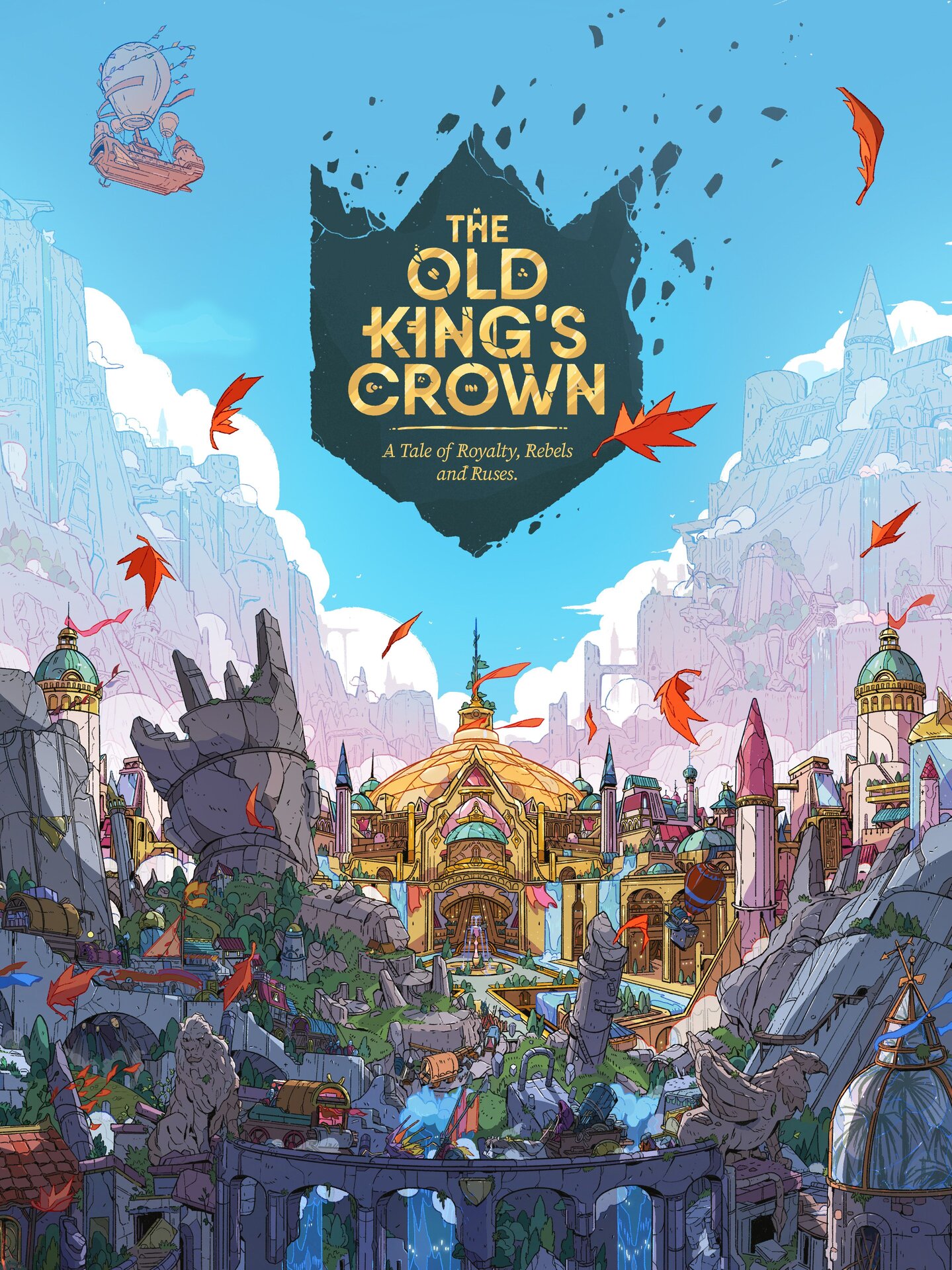
In The Old King's Crown, players take on the role of one of the old king's heirs, leading their own faction. The goal is to accumulate enough influence to claim the Old King's Crown and be declared the winner. Players will do this by outmaneuvering their rivals, using spies and agents to advance their agendas, and war machines, feints, and misdirection to control strategic locations. Additionally, they will send supporters to seek out allies, artifacts, and important places, all to accumulate influence.
Setup
- Place the Map Board within reach of all players. Position The Great Road at the bottom of the map. Then, place The Court Tile and the Order Track at the top of the Map Board, as indicated.
- Place the Collaborator Disc on the Map Board, in the Battlefield Location.
- Take all Influence Tokens (i) and create a collective Reserve within reach of all players.
- Take all Kingdom Cards and shuffle them.
- Create a face-down deck of 20 cards to form the Kingdom Deck and remove the rest from the game.
- Place the Kingdom Deck on the indicated draw space on The Great Road.
- Draw the top card of the deck and place it face-up in the rightmost available space of The Great Road and repeat until all spaces are filled with a single face-up card.
- Finally, flip the top card of the Kingdom Deck so that there are a total of four face-up Kingdom Cards on The Great Road.
- Players choose a Faction to play, or determine this randomly by shuffling and assigning Order Track Markers. Once decided, each player takes their Player Board corresponding to their Faction.
- Each player takes the Herald and Supporters associated with their Faction and places them in the corresponding spaces on their Player Board.
- Each player takes their Hand Size Tokens from their Faction and places them near their Player Board.
- Each player takes the four Tactics associated with their Faction and places them in the space below their Player Board, with the Starting side face-up.
- Each player places the Site of Power Tile associated with their Faction above the Map Board.
- Each player takes their Faction Deck and looks for any card(s) with the Trait Myth ([MYTH]). These [MYTH] cards are slotted into their Faction's Site of Power.
- Each player looks through their remaining Faction Deck for any cards with the Keyword Loyal and sets them aside. Then, they shuffle their remaining Faction Cards and form a face-down Draw Pile to the left of their Player Board.
- Each player draws cards, adding them to their reserved Loyal cards, until they have a starting Hand of six cards.
- MULLIGANS: Before completing Step 12, each player may choose to take a single mulligan. To do so, they discard all cards in their Hand, except for cards with the Keyword Loyal, to their Discard Pile. Then, they draw cards until they reach their Hand Size.
- Players determine the starting game order on the Order Track using the law of succession of Absolute Primogeniture (the oldest person first and in descending order of age), or, if preferred, determine this randomly by shuffling and assigning Faction Order Track Markers to the spaces on the track, one by one.
- The player in the first position receives the Active Player Marker and the player in the last position receives all three Resolution Markers.
Game Flow
The game is played in a series of Rounds, with each Round representing a year. A Round is divided into four main Phases: Spring, Summer, Autumn, and Winter. With two shorter maintenance Phases that conclude the Round: The Start of the Year and The End of the Year. Players will go through the Phases in sequence, resolving the steps in a Phase simultaneously or in order, as instructed.
Start of the Year
This Phase is skipped in the first Round of the game. At the Start of the Year, players must draw cards to fill their Hand Size, resolving Attrition and decreasing their Hand Size if they cannot. Then, they will reorder the Order Track, based on the players' amount of Influence (i). This will dictate the order in which players will act this Round.
- DRAW CARDS: All players simultaneously draw cards from their Draw Pile, up to their Hand Size. Players must draw up to their full Hand Size, if possible. If they cannot, they suffer Attrition. Once all players have drawn cards and resolved any resulting Attrition, they proceed to Step 2.
- A player suffers Attrition when they cannot draw a full Hand of cards, corresponding to their current Hand Size, or if they need to draw a card and cannot. To resolve Attrition, a player must shuffle their Discard Pile and then make a new face-down Draw Pile. Then, they reduce their Hand Size by one, marked by slotting a Hand Size Token into their Player Board, showing the number that corresponds to their new Hand Size. Then, if they do not have enough cards in their Hand, they continue to draw until they do.
- DETERMINE ORDER: Players then adjust the Order Track. The player with the highest i takes position one, placing their Order Marker there, then the player with the next highest i in position 2, etc. In case of a tie, the previous order of the tied players is reversed.
Spring ([SPRING])
In Spring, players, in order, will place Heralds who can gain and Steal i later in the Round. Additionally, they can play Spring Actions, such as holding the Court or moving pillaging cards and placing Supporters in Regions.
The player in first receives the Active Player Marker and the player in last receives all three Resolution Markers. The player with the Active Player Marker performs the following steps and Actions in any sequence:
- PLACE HERALDS: The Active Player must place their Herald in a Location. Heralds can be placed in a Location regardless of whether it contains a card (a Blockaded Location), another Herald or not, and there is no limit to the number of Heralds that can be in a Location at the same time.
- Heralds can be placed in a Location that contains a card with Fortify or Pillage.
- PLAY SPRING ACTIONS: The Active Player can play any number of Actions that have the timing trigger SPRING.
- SUPPORTERS: As a SPRING Action, the Active Player can place any number of Supporters from their Supporters Supply (located on their Player Board) on the Map Board, in a Region of their choice. Supporters affect the entire Region and are not placed in a specific Location. A player can play multiple Supporters in multiple Regions in a Round. Supporters can be placed in a Region regardless of whether it contains other Supporters or not, and there is no limit to the number of Supporters that can be in a Region at the same time. Each Supporter in a Region will add 1 Strength to its owner's total Strength in the first Clash that occurs in that Region, in a Round. At the End of Year, all Supporters remaining on the Map Board are removed to the Supporter Reserve. Whenever a card is moved to the Lost Pile, the card's owner can move one of their Supporters, from anywhere, to their Supporter Supply.
Once the player with the Active Player Marker has finished their turn and completed any mandatory Actions, they pass the Active Player Marker to the next player in order. Once all players have passed the marker, the game proceeds to Summer.
Summer ([SUMMER])
In Summer, players will play cards face-down by Regions of the map in an effort to win the resulting Clashes that will be Revealed in Autumn. In order, players can then play any Summer Actions, such as placing cards on The Great Road.
- PLACE CARDS: All players simultaneously play cards from their Hand, face-down. Each player must place one Faction Card next to each of the three Regions of the Map Board, for a total of three face-down cards. These cards will use their Strength, Traits, Keywords, and abilities to participate in Clashes, in Autumn.
- In the unlikely event that a player cannot complete this step by playing three cards in total, one for each Region, they lose the ability to place any cards in this step, for the remainder of the Round.
- Players can look at their own face-down cards, but cannot look at their opponents' face-down cards.
- PLAY SUMMER ACTIONS: Starting with the player who is first on the Order Track, the Active Player can play any number of Actions that have the timing trigger SUMMER.
- PLACING CARDS AT THE GREAT ROAD: As a SUMMER Action, a player can place a card on The Great Road. These cards will make a Journey along The Great Road in Winter, disputing the order in which Kingdom Cards will be gained, stolen, or consolidated.
- While any Faction card can be placed face-down on The Great Road, only Character Cards can Occupy, Steal, or Consolidate Kingdom Cards.
- PLACING CARDS AT THE GREAT ROAD: As a SUMMER Action, a player can place a card on The Great Road. These cards will make a Journey along The Great Road in Winter, disputing the order in which Kingdom Cards will be gained, stolen, or consolidated.
Once the player with the Active Player Marker has finished their turn and completed any mandatory Actions, they pass the Active Player Marker to the next player in order. Once all players have passed the marker, the game proceeds to Autumn.
Autumn ([AUTUMN])
In Autumn, the player who is last on the Order Track will determine the sequence in which the Regions will be resolved. Then all players will reveal the cards they played in a Region, resolving the resulting Clash that occurs, with the winner being able to claim the reward printed on one of the Locations in that Region. Players repeat this process until all Regions are resolved.
- PLACE RESOLUTION MARKERS: The player who is last on the Order Track places the three Resolution Markers, numbered side up, one in each Region. Once the placement of all three Resolution Markers is finished, proceed to Step 2.
- REVEAL A REGION: Choose the Region with the lowest numbered Resolution Marker, then check if there are any deployed cards in the Region:
- A) If there are no deployed cards, all players simultaneously flip their Unrevealed cards in the Region.
- B) If there are one or more deployed cards, then, in order, players resolve them and then simultaneously flip their non-deployed Unrevealed cards in the Region.
Flip the Resolution Marker of the Region to its unnumbered side and proceed to Step 3.
- RESOLVING REGIONS AND CLASHES: To resolve a Region, players must resolve any Clashes that occur there. A Clash follows this sequence:
- A) PLANNING STEP: Resolve any Planning Keywords and/or any effects that are triggered in the Planning Step, in order.
- B) ENGAGEMENT STEP: Apply any Engagement Keywords and/or any effects that are triggered in the Engagement Step, simultaneously. Then, sum the combined total Strength for each player in the Clash using:
- The Strength value of the Revealed Character Card(s).
- 1 Strength for each Supporter in the Region.
- Any additional Strength from other sources, such as Tactics, Kingdom Cards etc. that affect Clashes.
Clashes are considered resolved in one of three ways for each player involved:
- WIN: A player who has the highest combined Strength or who has met a specific condition on a card or effect. Only one player can win a Clash. Any other opponents are considered to have lost the Clash, unless they have retreated.
- LOSS: There can be multiple players who are considered to have lost a Clash.
- TIE: If players have equal combined Strength/have met some Tie condition on a card or effect, then a Clash is resolved as a Tie.
- RESOLVING TIED CLASHES: If, after following steps A and B of a Clash, the Clash results in players with the highest Strength tied, or an effect creating a Tie, then a new Clash begins. In order, the tied players can choose to play another Faction Card from their Hand face-down. Once all players involved in the Tie have chosen whether or not to participate, then those players who played cards reveal them simultaneously. This continues until a winner is declared or the result ends in an unresolvable Tie (either by all tied players refusing or being unable to play another card).
- The Clash that results from a Tie is considered a new Clash, separate and distinct from the previous one. As such, the Strength, Traits, Keywords, or any other effects of previously Revealed cards, as well as the Strength provided by Supporters or activated abilities, do not count towards this new Clash, unless stated otherwise.
- GAIN REWARDS FROM CLASHES: If a player wins a Clash in a Region, they choose a Location in that Region and gain rewards in this sequence:
More videos
More rules explanations from the community
In English
-
 Game in a Nutshell - The Old King's Crown (How to Play)
-
 How to Play The Old King's Crown in 23 Minutes
-
 The Old King's Crown - Tutorial & Playthrough
-
 The Old King's Crown (The DEFINITIVE Guide)
-
 The Old King's Crown: Faction Guide for Beginners
-
 Ranking Every Kingdom Card in The Old King’s Crown
-
 BOX OF DELIGHTS Solo playthrough series
-
 Box of Delights Presents..... THE OLD KING'S CROWN - SOLO PREVIEW - 1 of 2
-
 Do you know the difference between Actions and Commands?
-
 Game in a Nutshell - The Old King's Crown SOLO (How to Play)
-
 Learning the Old King's Crown ft Lord of the Board & Nevakanezah
Rules manual
Official PDF file
Frequently Asked Questions
Quick answers about the rules
What is the objective of The Old King's Crown?
How do you set up The Old King's Crown?
How do you play The Old King's Crown?
Expansions
Published additional content

Other Games You'll Like
Based on mechanics and theme