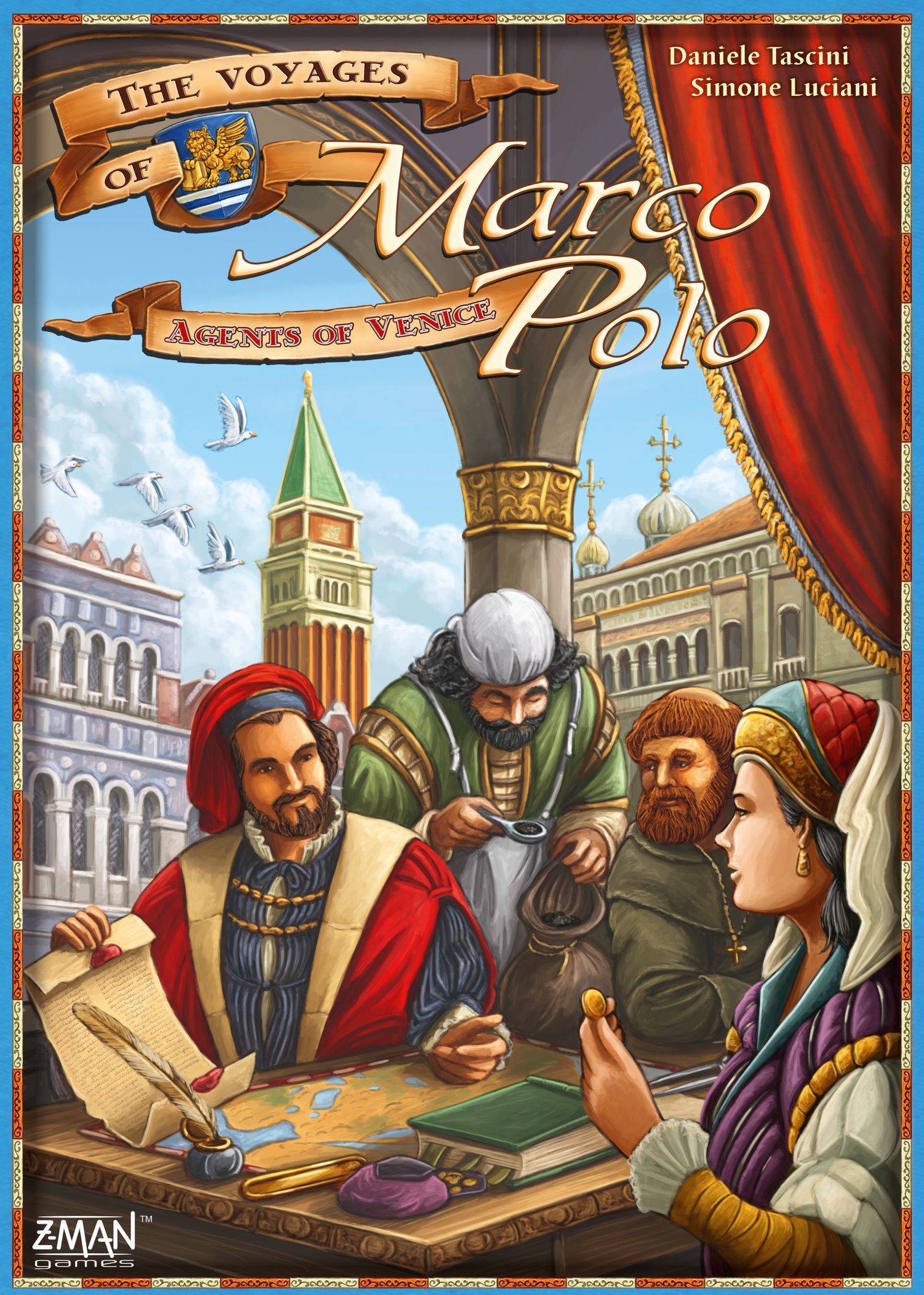
How to Play The Voyages of Marco Polo: Agents of Venice
Hans im Glück, 999 Games, Devir · Board game · 2017What do you want to do now
Ask anything about The Voyages of Marco Polo: Agents of Venice: rules, setup, components, complexity, price, or whether it fits your group.
Video: How to Play
Start here, then follow the written guide
Step by step
Objective of the Game
In "The Voyages of Marco Polo: The Agents of Venice," players return to Venice at the end of the 13th century, where Marco Polo has just returned from his long journey. Players aim to secure privileges, gain access to noble families' palaces, and increase Marco's reputation in the city. This, in turn, provides additional benefits. The game expands on the base game, allowing players to experience these new challenges and opportunities.
Preparation (Setup)
Set up the game as usual, with the following additions/changes:
- Fit the 2 pieces of the Venice Game Board together and place it to the left of the base game Game Board.
- When distributing the Large City Cards, place one of them on each of the large Palace fields on the Venice board. A total of 12 Large City Cards will now be used in the game.
- Mix face down all of the Small Town Bonus Tiles you are using (from the base game and/or this expansion), and when distributing them randomly, also place them on the corresponding small Palace fields on the Venice board, for a total of 9.
- Each player takes the 4 additional Trading Posts in his color and places them above his Player Board, near the other Trading Posts.
- The Venice Game Board features a new action space area. During setup, depending on the number of players, place an appropriate number of dice (each showing a 1) of a color not being used on 1, 2, or 3 of the action spaces, starting from the left. These dice remain in place for the entire game. The number of dice action spaces available is the number of players - 1 (i.e., 3 spaces in a 4-player game).
- Shuffle face down all of the Agent Tiles and place them in a face down stack below the main Game Board. Reveal 6 of them and place them face up in a row next to the stack.
Components for the 5th Player:
If playing with 5 players, you must use the City of Venice module. You will also need the following components:
- 1 Player Board
- 3 Player Figures (in the player color: purple)
- 6 Dice (5 in the player color: purple and 1 in black)
- 13 Trading Posts (in the player color: purple)
- 1 50/100-Point Token
In a 5-player game, assume that there is a 5th space for Trading Posts at each of the Small Towns and Large Cities on the base game board. When setting up the game, you now place 6 Black Dice in their designated place on the game board. Beyond these, no additional changes to the base game rules are necessary.
Flow of the Game
The game proceeds as usual, with the following additions at the end of a round:
- All Agent Tiles are collected and re-shuffled. Collect all Agent Tiles (those that are still in the face down stack and face up display, as well as any that have been taken by players during the round), and shuffle them face down to create a new Agent stack for the next round.
- Reveal 6 Agents for the next round. Draw 6 Agent tiles from the stack and place them face up next to the stack (this is not done after the 5th round).
Actions and How to Play
This expansion introduces new action spaces and character abilities:
The City of Venice – New Action Spaces
- The Venice Game Board features a new action space area that allows players to place their Trading Posts in Venice.
- This action space area functions similarly to that of “The Favor of Khan” in the base game. The first player to use this area places a die showing any number on the leftmost action space.
- The next player to place a die here places it in the next empty space from left to right, and the die must show an equal or higher number than the one to its left, otherwise the player cannot place a die here.
- As in “The Favor of Khan” area, each player color may only be placed in this area once per round.
- Placing a die on a City of Venice action area space allows you to place 1 Trading Post on the Venice game board.
- You must always place your first Trading Post in Venice on the large Palace field to the right of the action space area. All subsequent Trading Posts must be placed adjacent to one of your existing Trading Posts. Palace fields that are connected by a dashed line are considered to be adjacent.
- You must always pay any costs shown to place an adjacent Trading Post. Some of the connections between 2 Palaces have costs associated with them. If you want to place an adjacent Trading Post that is marked with a cost, you must pay those costs before placing your Trading Post on the Palace field.
- After placing a Trading Post on a large Palace field, you may use an action space on the card(s) there, as in the base game.
- When placing a Trading Post on a small Palace field, you immediately (and at the start of each new round) receive the bonus shown on the Small Town Bonus Tile there, as in the base game.
- There are 2 action spaces on the final (Northernmost) Palace field. These are treated as if they were action spaces on 2 separate Large City Cards.
- If the action space where you wish to place your die/dice is already occupied, you must pay Coins as in the base game.
The Agents of Venice – They accompany you for a Round.
On the front of each Agent Tile you can see the special benefit that the Agent will provide you with. On the back of the tiles there is an action space, by which the Agent Tile stack forms a new action area that can be used multiple times in the game.
To perform the Agent action, you must place 1 die on the action space. You then take 1 Good of your choice from the supply. You also take 1 of the face up Agent Tiles and place it in front of you. The Agent’s benefit is now available to you during the current round. You may own any number of Agents in a round.
The benefits of most Agents are available as many times as you want to use them. However, some benefits are only available once per round, and are marked with a “1x”. After using these Agents, put them aside.
What Benefits do each Agent Provide?
- Saracen: Once during the round you may use Camels in place of Coins (or vice versa) for 1 action.
- Scribe: Each time you complete a Contract, you may either pay 1 less of the required items or take 3 extra points.
- Money Changer: This Agent has his own action space. You may place 1 die there and receive 8 Coins. You may use this action space several times with no extra costs. In addition, once during the round you may return 1 Good of your choice to the supply and receive 5 Coins.
- Gondolier: (Only used if playing with the City of Venice module). The Gondolier has his own action space. You may place 1 die there and place a Trading Post on the Venice game Board according to the normal rules.
- Cartographer: Each time you must pay additional travel costs (Camels or Coins), you may pay 2 less Camels on land routes and 5 less Coins on sea routes. You may not reduce the costs shown between the Palaces on the Venice Game Board.
- Bodyguard: Each time you “Travel” your cost is only 2 Coins per step. (Other costs must still be paid.) This Agent’s benefit cannot be used on the Venice board.
- Nun: Each time you use a die, you may increase or decrease its value by 2. (You may not cycle from 6 to 1 or vice versa).
- Diplomat: Once during the round you may place 1 die on a Large City Card without having a Trading Post there. The other rules for Large City Cards still apply. You may then perform the action on that card once, as normal.
- Merchant: Each time you perform the “Marketplace” action, you may use 1 die less than required (you must still use at least 1 die). In addition, you may take the Goods (or other rewards) from the column corresponding to 2 pips higher than the actual placed die.
The New Characters – What do they do?
- Bellela, Fantina & Moreta: If you have this Character Tile, draw 5 Character Tiles from those unused in the game (after all players have chosen their Character). At the start of each round (before rolling your dice), you must decide which Character to play with that round. At the end of the round, remove that Character Tile from the game. You therefore play each round with a different Character.
- Advanced Variant: When playing with this Character, draw the 5 Character Tiles to be used with it before players choose their Characters. This adds a higher level of strategy.
- Special Rules:
- Niccolo & Marco Polo: Take your second Figure and place it in the same location as your first Figure. You then have 2 Figures you may Travel with during the round. At the end of the round, you must decide which Figure to keep in the game. The other Figure is returned to the box.
- Wilhelm von Rubruk: You do not take the 2 black Trading Posts, and do not earn any extra points. You may still, however, place Trading Posts in any locations you pass through.
- Kubilai Khan: You can not use Kubilai Khan with this Character! If you draw it, you must return it to the box and draw another Character to replace it.
- Khan Arghun: Draw 3 Large City Cards from the unused stack. You may select 1 of these cards to use per turn in this round. You do not need to place a die to use a card.
- Fratre Nicolao: You may take 2 of the 3 drawn Gifts.
- Rusticiano: Draw 3 Bonus Cards from the stack. You may use these in the current round. At the end of the round, return any unused Bonus Cards to the box.
- Donata Badoer: You still take all of the Dice Tiles, but you may only use 1 of them in the current round.
- Piedro Tartarino: Only if you choose to use Piedro in the first round can you place your Figure on one of the depicted Oases. Otherwise, you may not use this portion of the Character’s ability.
- Papa Gregorio X: (Only used if playing with the Agents of Venice module). If you have this Character, select 1 of the face up Agents at the beginning of each round. Then reveal a new Agent tile from the stack and place it in the display. You may use the Agent’s benefit as usual, and must return it at the end of the round.
- Donata Badoer: If you have this Character, take the 5 Dice Tiles (with values of 2 – 6) at the start of the game. You must use 1 of the 5 Dice Tiles in each round, and when you do, you remove the used tile from the game, and turn the Donata Badoer tile face down to indicate that you have used a Dice Tile this round. At the start of each round you receive 1 Camel and you turn the Donata tile face up again. A Dice Tile is considered to be a die without color and it has the value indicated on it. You may use a tile alone, or in combination with other dice. You may not adjust the value of the Dice Tile up or down, nor may you “reroll” it to change its value.
- Rusticiano: If you have this Character, at the start of the game shuffle all of the Bonus Cards and draw 6 of them. All remaining Bonus Cards are returned to the box. You treat the Bonus Cards as Additional Actions, which means that you can use as many of them as you wish, before or after your main action. You may only use each Bonus Card once, and must then return it to the box.
- Advanced Variant: When playing with this Character, you may draw the 6 Bonus Cards to be used with it before players choose their Characters. This adds a higher level of strategy.
- Piedro Tartarino: If you have this Character, place your Figure on 1 of the 3 depicted Oases locations at the start of the game, instead of Venezia. In addition, once per turn, you may clear one action space. Choose 1 action space, take all of the dice that are there, and set them aside. (Exception: If you choose the “Favor of Khan” or “City of Venice” action areas, you only set aside the rightmost die from the action spaces.) You may then continue with your turn as usual, and may use the action space that has just been cleared. After doing so, turn the Piedro tile face down to indicate that you have used his ability this round. At the start of each round, you turn the Piedro tile face up again.
What Additional Action does each Bonus Card provide?
- Pay 15 Coins, then place 1 Trading Post on a small or large City, or a Venice Palace, of your choice (according to the normal rules) with the exception of Beijing or Sumatra. This may only be done once (you may not pay additional Coins to place additional Trading Posts).
- Take 2 Contracts from the Special stack, and 2 Camels from the general supply.
- For every 2 of your Trading Posts that you have placed, you gain 1 point.
- You may clear 1 action space 1 time (see rules or Piedro Tartarino above).
- For each Small Town or Large City you pass during a Travel action, you may pay 3 Camels to place a Trading Post in that location. Note: This Bonus Card is only used if you are playing with the Agents of Venice module.
- Take 1 of the available Agent Tiles from the face up display. You may use this Agent according to the normal rules.
- Take 1 Black Die from the general supply.
- Take the bonus from 1 Small Town Bonus Tile where you have already placed a Trading Post.
- Draw 3 Large City Cards from the unused stack and select 1 of them. You may use the action on this card once at a time of your choice. Treat the action space on the card as if you had placed a die there showing a “6”.
- When you complete a Contract, you may take the bonus 2 times (but still only gain the points once). If you take 1 step 2 times, this is counted as 1 move, so you may only place 1 Trading Post at the end of your movement.
- Replace 1 Large City Card in a location where you have already placed a Trading Post with a new card. To do this, draw 3 Large City Cards from the unused stack and select 1 of them.
New Symbols
Consulte o manual para detalhes sobre esta seção.
End of Game and Scoring
Consulte o manual para detalhes sobre esta seção.
End of Game Points
- On the
Rules manual
Official PDF file
Frequently Asked Questions
Quick answers about the rules
What is the objective of The Voyages of Marco Polo: Agents of Venice?
How do you set up The Voyages of Marco Polo: Agents of Venice?
How do you play The Voyages of Marco Polo: Agents of Venice?
How does The Voyages of Marco Polo: Agents of Venice end, and how do you score?
Expansion for
Published additional content