How to Play Trismegistus: Roll & Write
Board&Dice · Board game · 2020What do you want to do now
Ask anything about Trismegistus: Roll & Write: rules, setup, components, complexity, price, or whether it fits your group.
Step by step
Game Objective
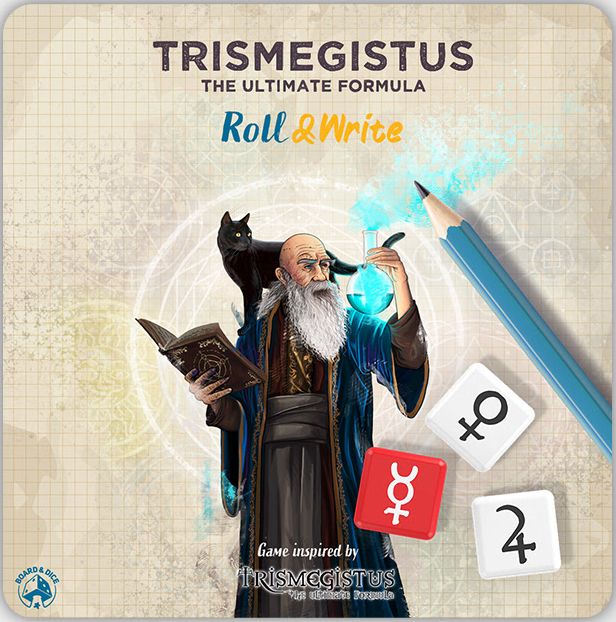
In Trismegistus: Roll & Write, you assume the role of an apprentice in a master alchemist's sanctuary. The objective is to perform experiments and transmutations to transform basic elements into wondrous compounds. You must compete with other apprentices to impress your mentor, aiming to accumulate the most Victory Points (VP). The player with the most VP at the end of the game will be declared the winner and earn the master's trust.
Preparation (Setup)
- Place the Potency Tracks (black, white, and red) in the center of the table, leaving space for cards to the right of each.
- Randomly distribute 1 Writing Marker, 1 Workshop Sheet, and 1 Mastery Sheet to each player.
- Divide the Experiment/Artifact Cards into 3 decks by color (black, white, and red). Shuffle each separately and place them with the Artifact side face up next to their respective Potency Track. Draw the top card from each deck and place it below the corresponding deck with the Experiment side face up.
- The player who most recently brewed a potion is the First Player and receives the First Player Marker.
- The player to the left of the first player rolls all the dice. If any die shows the ? symbol, it must be re-rolled until it shows one of the 5 Metals. Choose 2 dice and gain a Metal of the corresponding type. Pass the dice to the next player to the left, who repeats the process until everyone has 3 Metals marked on their Workshop Sheets (including the printed mark on the Lead tube).
- Roll the dice again. Place each die on the corresponding Potency Track, in a space equivalent to the number of players.
- Each player marks with an "X" the 1st Round in the upper left corner of their Workshop Sheet and the left side of their Mastery Sheet.
Game Flow
The game is played over 5 Rounds. In each round, players play in clockwise order until everyone has taken 2 turns. At the end of each round, the dice are re-rolled and placed on the Potency Tracks as per setup. The First Player Marker passes to the player on the left.
On your turn, you must follow these steps in order:
- Choose a die that still has Potency (that is not in a track space).
- Move that die down 1 space on the track (reducing its Potency).
- Perform an optional action: gain 2 Metals represented on the die (for the ? symbol, you can choose any Metal except Silver or Gold) OR perform a Transmutation following the color of the chosen die.
- Advance on the Elemental Mastery Track indicated on the Artifact Card next to the chosen die.
- Perform the Experiment or activate the Artifact corresponding to the chosen die.
- Card cycle: Take the Artifact Card from the deck corresponding to the chosen die and place it with the Experiment side face up on top of the Experiment deck. If the Artifact deck is empty, shuffle all cards from the Experiment deck (except the top one) to create a new Artifact deck.
Important: Steps 1, 2, and 6 are mandatory. Steps 3, 4, and 5 are optional and can be waived without compensation.
Actions and How to Play
Metals and Exhaust
There are 7 Metals in the game. When gaining a Metal, mark an "X" in the lowest empty space of the corresponding tube on your Workshop Sheet. If the tube is already full, the effect is lost. You can Exhaust a Metal to gain powerful benefits, covering the lowest "X" in the tube. Exhausted Metals cannot be used to perform Experiments, but they still count for Transmutations.
Transmutation
Transmutation allows you to gain new Metals and advance on the Mastery Tracks. You can perform a Transmutation if:
- There are more Metals marked (including exhausted ones) in the chosen column than in the next column to the right.
- The Transmutation path of the chosen die's color has not yet been crossed.
When performing Transmutation, you mark the lowest empty space in the metal tube to the right and cross the path of the die's color. You also advance on the Elemental Mastery Track corresponding to the crossed path.
Experiment and Artifact
- Perform an Experiment: You must possess the required Metals (marked, but not exhausted) and reach the corresponding Elemental Mastery level (which is equal to the current round number). You can use Wild Reagents to substitute for any Metal (except Silver or Gold). Upon completion, you gain Victory Points (VP), a Knowledge Circle, and a part of the Philosopher's Stone.
- Activate an Artifact: You can choose the effect of an Artifact instead of performing an Experiment. Some Artifacts allow you to Exhaust specific metals for stronger effects.
Other Components
- Aqua Regia: Can be used to treat a die as if it had a different color for Transmutations or Artifact/Experiment effects.
- Elemental Reduction: Reduces the Elemental Mastery requirement to perform an Experiment by 1.
- Wild Reagent: Acts as any 1 Metal (except Silver or Gold).
End of Game and Scoring
The game ends after the 5th Round. Before final scoring, you can Exhaust your remaining Gold to cross a space on the Philosopher's Stone grid for each unit of Gold.
Point Count:
- Start with the VP gained during the game (from Experiments, etc.).
- Add the highest value reached in each Metal tube.
- Add the highest value reached on the Aqua Regia shelf.
- Calculate the VP for each Element: The value depends on how many Knowledge Circles are filled (from 0 to 4 VP) multiplied by the number of marked squares in the corresponding section of the Philosopher's Stone grid (0 to 18 squares).
The player with the most VP is the winner.
Tips for Winning
- Refer to the manual for details on this section.
- Refer to the manual for details on this section.
Rules manual
Official PDF file
Frequently Asked Questions
Quick answers about the rules
What is the objective of Trismegistus: Roll & Write?
How do you set up Trismegistus: Roll & Write?
How do you play Trismegistus: Roll & Write?
How does Trismegistus: Roll & Write end, and how do you score?
What are some tips for winning Trismegistus: Roll & Write?
Other Games You'll Like
Based on mechanics and theme