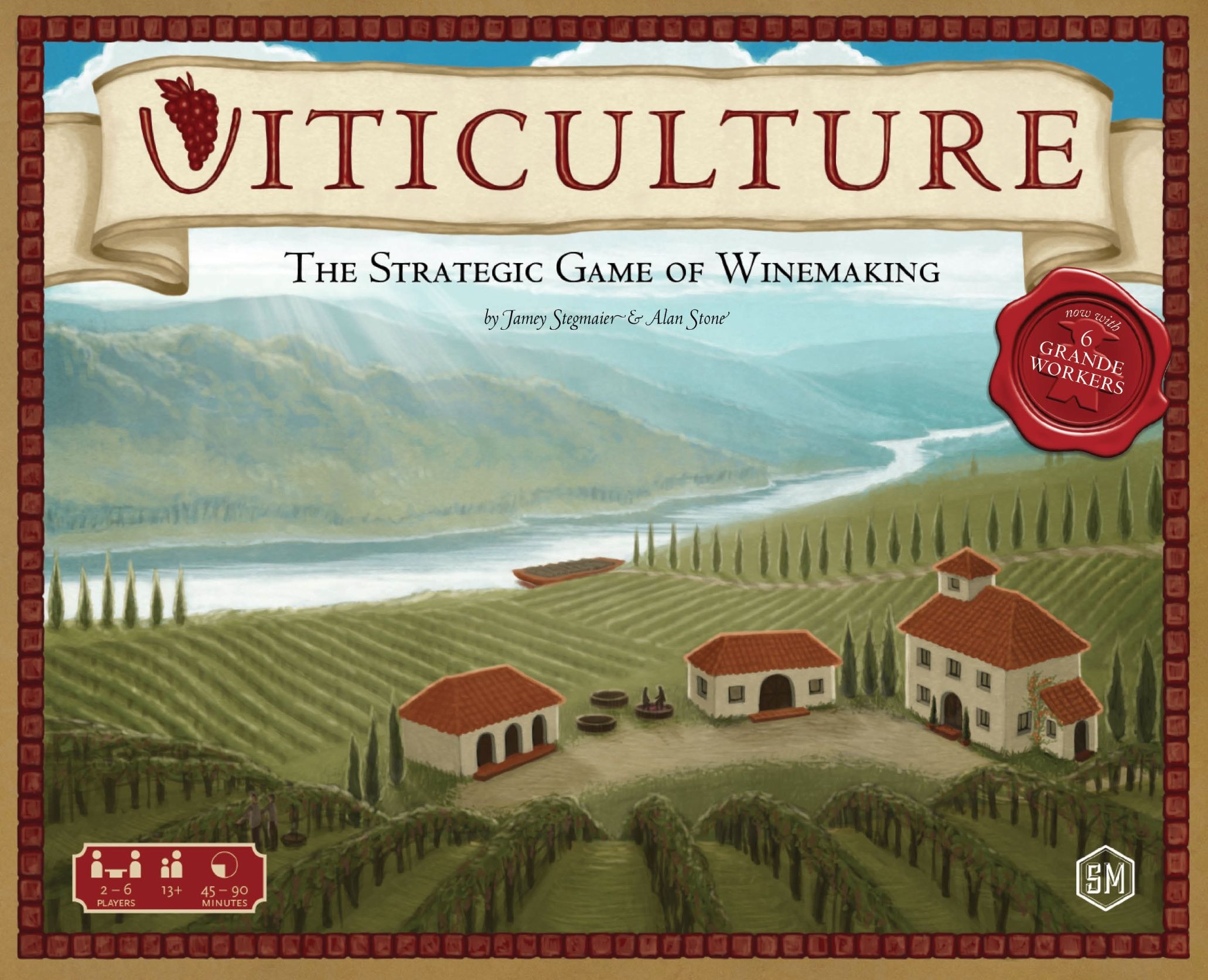
How to Play Viticulture: Bordeaux Expansion
Albi, Delta Vision Publishing, Feuerland Spiele · Board game · 2026What do you want to do now
Ask anything about Viticulture: Bordeaux Expansion: rules, setup, components, complexity, price, or whether it fits your group.
Video: How to Play
Start here, then follow the written guide
Step by step
Game Objective
The objective in Viticulture: Bordeaux Expansion is to have the most victory points (VP) at the end of the game. The game ends at the end of the year in which a player reaches 25 or more VP before passing out of the Winter season. The Bordeaux expansion uses the same core rules, objectives, and winemaking process as Viticulture.
Setup
Game setup follows the steps below:
- Board: Place the first player token in the bottom-right corner of the wake-up track. After shuffling the decks, reveal 2 vine cards and 2 wine order cards (these cards are not eligible to be bought during setup). If playing with structure cards, keep them in a single face-down deck, like the visitor cards.
- Players: Each player starts with only one 6-value field. The other two fields start with the "sold" side face up. Each player also starts with 4 cubes of their player color and 1 reference card. In addition to the starting benefits from the red and blue cards, each player also receives the following (gain all setup benefits in any order):
- ₤: 3 lira.
- Grape: One 2-value grape (choose red or white).
- Wine: One 1-value wine token (choose red or white).
- Residual: Level 1 residual.
If playing with structure cards (from the Tuscany expansion): After gaining the above benefits, shuffle the structure cards and place the deck near the board. Each player draws 4 structure cards, chooses 1 to keep, and passes the remaining cards clockwise. Repeat until all players have chosen 4 structure cards. Each player also gains a building mat.
- Starting Player Order: Randomly select a player to choose a row of the wake-up track (Spring column) with their rooster token, and then continue clockwise for initial wake-up order selection. No one may select the first row of the wake-up track (since no one has the first player token). There are no benefits to be gained by placing your rooster token in the Spring column.
Game Flow
The game progresses in years, and each year is divided into four worker placement seasons: Spring, Summer, Autumn, and Winter.
On your turn, you may either (a) place a worker on an available action space in the current season or on a private action space, or (b) pass to the next season. When you pass from season to season, you gain a benefit as shown on the wake-up track, based on the position you chose for the current year.
After you pass, you may not take another action until all other players have also passed. At that point, the highest player on the wake-up track takes the first turn in the new season, followed by each player below them in order.
When you pass out of the Winter season, immediately perform the 5 end-of-year upkeep steps, from right to left, as indicated below the wake-up track:
- Retrieve Workers: Retrieve your workers (including the temporary worker, if you controlled it this year). This may free up action spaces in Winter for players who have not yet passed.
- Age Grapes and Wine: Increase the value of all grape and wine tokens by 1. Wine tokens cannot be moved to cellars you have not built.
- Discard Cards: Discard down to 7 cards in hand.
- Receive Residual Payments: Collect your residual payments.
- Choose Wake-Up Position: Choose your wake-up position for the next year. You no longer pass the first player token for wake-up selection (the token no longer serves any purpose other than to remind the player who woke up 7th the previous year to now wake up 1st).
The Gain space is always available for multiple workers and is not limited to the Winter season.
Actions and How to Play
Actions are divided by season. The number of available action spaces depends on the number of players:
- 2 players: Use only the leftmost action space.
- 3-4 players: Use only the middle and leftmost action spaces.
- 5-6 players: Use all action spaces.
There are always 2 vine cards and 2 wine order cards available face up on the board. They are eligible to be bought at any time you can buy these card types. The top card of the deck is also available. If you buy a face-up card, immediately replace it.
The residual track: Whenever you cross from 2 to 3, 4 to 5, or 6 to 7, immediately gain 1 VP. These VP are one-time instant benefits, not benefits gained at the end of each year. In rare cases where you lose a residual (e.g., going from 3 to 2), you do not lose the VP, and you may then gain the VP again.
The wake-up track: The icon in the top row of the wake-up track (ALL) means "all players" (including you). There are also icons for aging 1 (or all) grapes and 1 (or all) wine tokens, an icon for refreshing the face-up cards (discard all face-up cards and replace them with cards drawn from the deck), icons for buying 1 of any card (including structure cards if you are playing with them), and an icon for retrieving 1 of your regular workers from the Autumn season (if you do not have a regular worker placed on the board in Autumn, nothing happens), and an option in the last row to choose between buying any card or gaining 1 VP.
Spring Actions
- Buy a Vine: Pay ₤X to gain an X-value grape.
- Give Tour to Gain X: Gain ₤1 per worker here; this applies to your workers and any other workers on this action.
- Pay to Hire a Specialist: If you take this action, place a cube of your color in the white box below any action that does not yet have a cube. There is a limit of 4 specialists per player; you may not use this action if you already have 4 specialists. Gain any 1 bonus exposed on the chosen action (i.e., the action where you are placing a specialist token). Any bonus exposed on the chosen action is eligible (not just for your player count). This applies even on the turn you first hire this specialist. Gaining a bonus is not the same as performing an action, so the specialist benefit on the chosen action has no effect as a result of this specialist benefit.
- Make a Trade: Before this action, you may remove 1 trade token. Do this once on your turn before making any trades (e.g., you cannot use the bonus action space to make a trade, remove a token, and then make the same trade). If you use this action, pay a cost on the table and gain an open benefit, placing a glass token (not a colored cube) to block that trade from happening again. The bonus on the leftmost action space (BUY OR HARVEST ONE) is to make a second trade.
Summer Actions
- Play a Summer Visitor: If you play only 1 summer visitor (instead of playing 2 total via bonus), you may change instances of "or" on the card to "and" (regardless of whether "OR" is capitalized or lowercase on the card). If a card specifies that you choose a specific number of options (e.g., "choose 1"), you are still limited to that number. If a card presents two options and allows you to "do both" if you pay a cost, the cost is negated by this specialist.
- Buy or Harvest a Field: You may not sell a field. You may only harvest each field once per year. Gain 1 residual.
- Pay to Build a Structure: You may build one or two structures (pay for both). If you own 4-6 structures, gain 1 VP; if you own 7 (or more) structures, gain 2 VP instead.
- Plant a Vine: Ignore 1 prerequisite (e.g., ignore the Trellis requirement on vines you plant this turn). If you own 4-6 planted vines, gain 1 VP; if you own 7 (or more) planted vines, gain 2 VP instead.
Autumn Actions
- Buy a Wine Order: Discard X cards from your hand to gain an X-value wine token.
- Harvest up to Two Fields: This action now allows you to harvest one or two different fields by default. Gain a different exposed bonus here per field harvested. There are 3 different bonuses on this action. You will gain 1 of them if you place a worker on an action space (e.g., buy a winter visitor), then if you harvest 1 field, you will gain a different bonus (e.g., 1 VP); if you harvest 2 fields, you will gain the remaining bonus as well (e.g., age 1 grape). You may gain the extra bonuses after each field is harvested (e.g., you may harvest 1 field, gain the "age 1 grape" bonus, and then harvest a second field).
- Make up to Two Wine Tokens: You may combine grapes of the same type to make wine tokens; gain 1 VP if you do. That is, you may combine a 2-value red grape and a 5-value red grape to make a 7-value red wine token. If you do this at least once, gain 1 VP (this does not apply to sparkling wine production, which requires 2 red grapes and 1 white grape).
- Pay to Perform Any Action: Choose another action on the board (any season) and perform it without placing a worker on the selected action (do not gain an action space bonus). If you have a specialist for the selected action, you may use its benefit. You must refresh all face-up cards to gain 1 VP. Discard the face-up vines and wine orders from the board, and then reveal replacements from their decks.
Winter Actions
- Play a Winter Visitor: If you play only 1 winter visitor (instead of playing 2 total via bonus), you may change instances of "or" on the card to "and" (regardless of whether "OR" is capitalized or lowercase on the card). If a card specifies that you choose a specific number of options (e.g., "choose 1"), you are still limited to that number. If a card presents two options and allows you to "do both" if you pay a cost, the cost is negated by this specialist.
- Pay to Train a Worker: You may place the worker in Spring or Summer now. The action space you choose must be available for the player count; perform the action and gain the bonus (if any).
- Sell a Wine Token: Discard a wine token from your cellar to gain the VP shown on the table. Only the wine type matters, not its value. If the wine token you sold was in your medium cellar, gain ₤2. If it was in your large cellar, gain 2 VP.
- Fill a Wine Order: You have an extra action space you can use to perform this action. Your bonus is to increase your residual level.
Reminder: In Viticulture, you may only choose an action if you perform it.
End of Game and Scoring
The game ends at the end of the year in which a player reaches 25 or more VP before passing out of the Winter season. All players complete the end-of-year steps (including gaining residuals).
For final scoring, convert wine and grapes into lira (each wine token for its value and each grape token for its selling price). Then, every ₤10 becomes 1 VP (₤10 = 1 VP). There is no maximum VP limit.
Tips for Winning
- Leverage Wake-Up Track Bonuses: The wake-up track offers a variety of benefits when passing seasons. Strategically choosing your position can provide VP, grapes, wine, cards, or even worker retrieval, which can be crucial for optimizing your turns.
- Maximize Specialist Benefits: Hiring specialists can significantly enhance your actions. For example, the Vine Planting specialist allows you to ignore prerequisites, and the Structure Building specialist can grant additional VP based on the number of structures you own. Plan which specialists to hire to complement your winemaking strategy.
- Harvesting and Winemaking Strategy: The Harvest up to Two Fields action in Autumn offers additional bonuses for each field harvested. Aiming to harvest two fields can yield multiple benefits, such as VP, cards, or aging grapes. Additionally, combining grapes of the same color to make wine can earn 1 VP, encouraging efficient wine production.
More videos
More rules explanations from the community


Rules manual
Official PDF file
Frequently Asked Questions
Quick answers about the rules
What is the objective of Viticulture: Bordeaux Expansion?
How do you set up Viticulture: Bordeaux Expansion?
How do you play Viticulture: Bordeaux Expansion?
How does Viticulture: Bordeaux Expansion end, and how do you score?
What are some tips for winning Viticulture: Bordeaux Expansion?
Expansion for
Published additional content