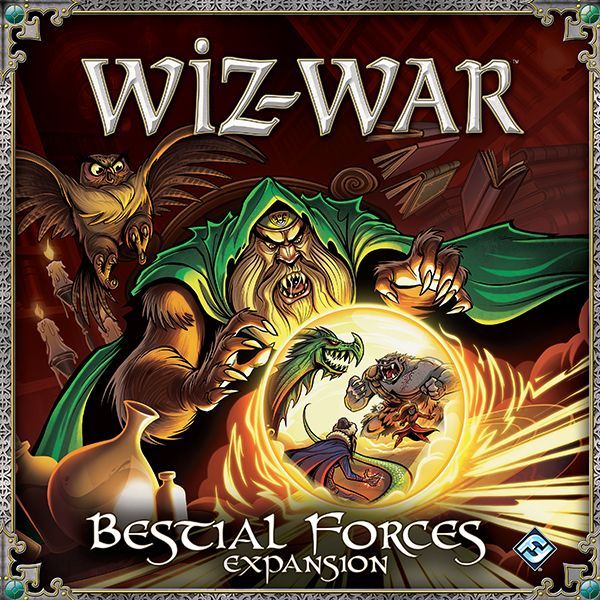
How to Play Wiz-War: Bestial Forces
Fantasy Flight Games, Giochi Uniti, Heidelberger Spieleverlag · Board game · 2014What do you want to do now
Ask anything about Wiz-War: Bestial Forces: rules, setup, components, complexity, price, or whether it fits your group.
Step by step
Game Objective
In Wiz-War: Bestial Forces, wild creatures have appeared in the labyrinth to aid the wizards in their quest to become the Master. Wizards can summon legendary forces using the school of Mythology, invoke ancestral spirits with the school of Totem, or embody the powerful dragon forms with the Draconic school. The ultimate goal is to become the Master, but the specific victory condition is not detailed in this context.
Preparation (Setup)
To incorporate the Bestial Forces expansion into the Wiz-War base game, follow these steps:
- Prepare the Creatures: Place each creature miniature on a gray base. These creatures will enter play when a wizard uses a corresponding summon card.
- Add New Schools of Magic: Add the Mythology, Totem, and Draconic schools to the available schools of magic chosen during step 4 of the base game setup.
- Assemble Creature Life Trackers: Assemble the creature life trackers according to the image in the manual (not provided in context).
Expansion Components:
- 6 Creatures and Bases
- 6 Tokens (type not specified)
- 72 Magic Cards (marked with the Bestial Forces expansion icon)
- 12 Totem Tokens
- 5 Energy Tokens
- 4 Relic Tokens
Game Flow
The general game flow follows the rules of the Wiz-War base game, with the following additions and modifications related to the creatures and spells of the expansion:
Summoning Creatures
When a wizard casts a spell with the creature characteristic, they perform the following steps in order:
- Cast Summoning Spell: Place the magic card in your play area. If another wizard intends to cast a counter-spell, they must cast it now.
- Suffer Damage: Roll a die and suffer damage equal to one less than the result. This damage cannot be avoided or reduced in any way.
- Creature Life: Take the life tracker corresponding to the creature to be summoned. Then, add the die result from step 2 to the creature's base life, which is located on the right side of the creature summoning card. This is the creature's starting life.
- Place the Creature on the Board.
Activating Creatures
To activate a creature, the wizard controlling it spends two movement points. During each creature activation, the wizard controlling it cannot move and can only cast counter-spells. A wizard can activate each of their creatures during their turn. Each creature can activate once per turn, and after its activation, the wizard controlling it continues their turn. Each time a creature is activated, it can move and make an attack.
Time Passage Phase
Stun tokens are removed from creatures during the Remove Stun step of the controlling wizard in the Time Passage phase. When a stun token is removed from a creature, that creature can only perform its movement or one attack during its activation that turn.
Actions and How to Play
Casting Summoning Spells
As described in "Summoning Creatures," wizards can cast spells with the creature characteristic to bring creatures into play. This involves casting the spell, suffering damage, and determining the creature's starting life before placing it on the board.
Activating Creatures
A wizard can activate their creatures by spending two movement points. During a creature's activation, the wizard cannot move and can only cast counter-spells. Each creature can be activated once per turn, allowing it to move and attack.
Creature Movement
Each time a creature is activated, it gains movement points equal to its base speed, located on the left side of the creature summoning card. Creatures follow the same movement rules as wizards but cannot increase their speed.
Creature Attack
A creature can perform its attack at any time during its activation, in two ways:
- The wizard controlling the creature selects an attack from the creature card and follows its instruction.
- The wizard controlling the creature plays a creature attack spell. The creature is treated as the spellcaster, and the spell is discarded after use.
Note: A wizard can also cast a creature attack spell as their own attack, as indicated by the normal attack icon on the magic card.
Creatures cannot attack on the first turn of the game.
Using Flash Energy
Players can use a "Flash Energy" card to boost spells. When a player casts a spell, they can discard a "Flash Energy" card to power the spell. However, a player cannot use a "Flash Energy" card to increase their speed.
Healing Creatures
Some spells can heal creatures. When a creature is healed, the wizard controlling it adjusts the creature's life on the life tracker. A creature's life can exceed its starting life but cannot exceed 12.
Transforming Creatures
The school of Mutation allows wizards to transform creatures into other forms, modifying their abilities. When a wizard casts a spell that transforms a creature they control, the player removes the creature figure from its base and places the transformed figure that corresponds to the spell on the base. When the transformation ends, the player replaces the transformed figure with the creature figure. When a transformation spell conflicts with a creature's base speed or other abilities, the text of the transformation spell overrides that of the creature summoning card. However, a creature's mutation is never total, so any abilities that do not conflict with the transformation spell still apply. While the "Big Man Form," "Werewolf Form," or "Golem Form" spells are held on a creature, that creature gains the ability to punch.
Interacting with Relics
Relics are items of immense power, identified by the relic icon. When a player has a relic in their play area, they must also place the relic token on their wizard's colored base as if it were a treasure. Each wizard can carry one relic or one treasure. If a wizard is carrying a relic or treasure, they must drop it before they can pick up a different relic or treasure. When a wizard drops a relic, they place its token on their square and the corresponding magic card near the game board as if it were an item. If a card effect causes a wizard to be able to carry more than one relic or treasure, they must immediately drop relics and treasures until they are carrying only one.
Stun Effects
Some spells in the Bestial Forces expansion can cause a wizard to gain stun tokens. If a wizard discards a stun token during their Time Passage phase, they are stunned until the end of that turn. Creatures can also gain stun tokens.
Creatures in the Labyrinth
Creatures cannot carry treasures or items. If a magic card allows a creature to pick up or steal a treasure or item, the creature immediately drops the treasure or item in its square. The boggart is the exception to this rule; it can pick up and carry treasures. A creature can move and attack through an adjacent door that belongs to its controlling wizard. The creature cannot hold doors open.
End of Game and Scoring
If a creature's attack kills a wizard, the wizard controlling the creature gains one victory point.
A creature dies if:
- Its life is reduced to zero or less.
- The wizard controlling the creature dies.
- A creature's summoning card is discarded from the game.
When a creature dies, remove the miniature from the board, discard its summoning card, and all held spells that were cast on it.
Refer to the manual for details on the overall game victory condition.
Tips for Winning
- Manage Summoning Damage: When summoning creatures, you will suffer damage. Plan your summons carefully, considering your current life and the creature's immediate need.
- Position Your Creatures Strategically: Remember that creatures cannot attack on the first turn of the game. Position them to maximize their impact in future turns, protecting them from initial attacks.
- Utilize the Abilities of the Schools of Magic: The Mythology, Totem, and Draconic schools offer different advantages. The Mythology school focuses on epic feats, emblematic creatures, and relics. The Totem school allows a wizard to empower all aspects of their being, and their collective power grows. The Draconic school mimics and harnesses the power of dragons, protecting their treasures. Choose and utilize the schools that best suit your strategy.
Rules manual
Official PDF file
Frequently Asked Questions
Quick answers about the rules