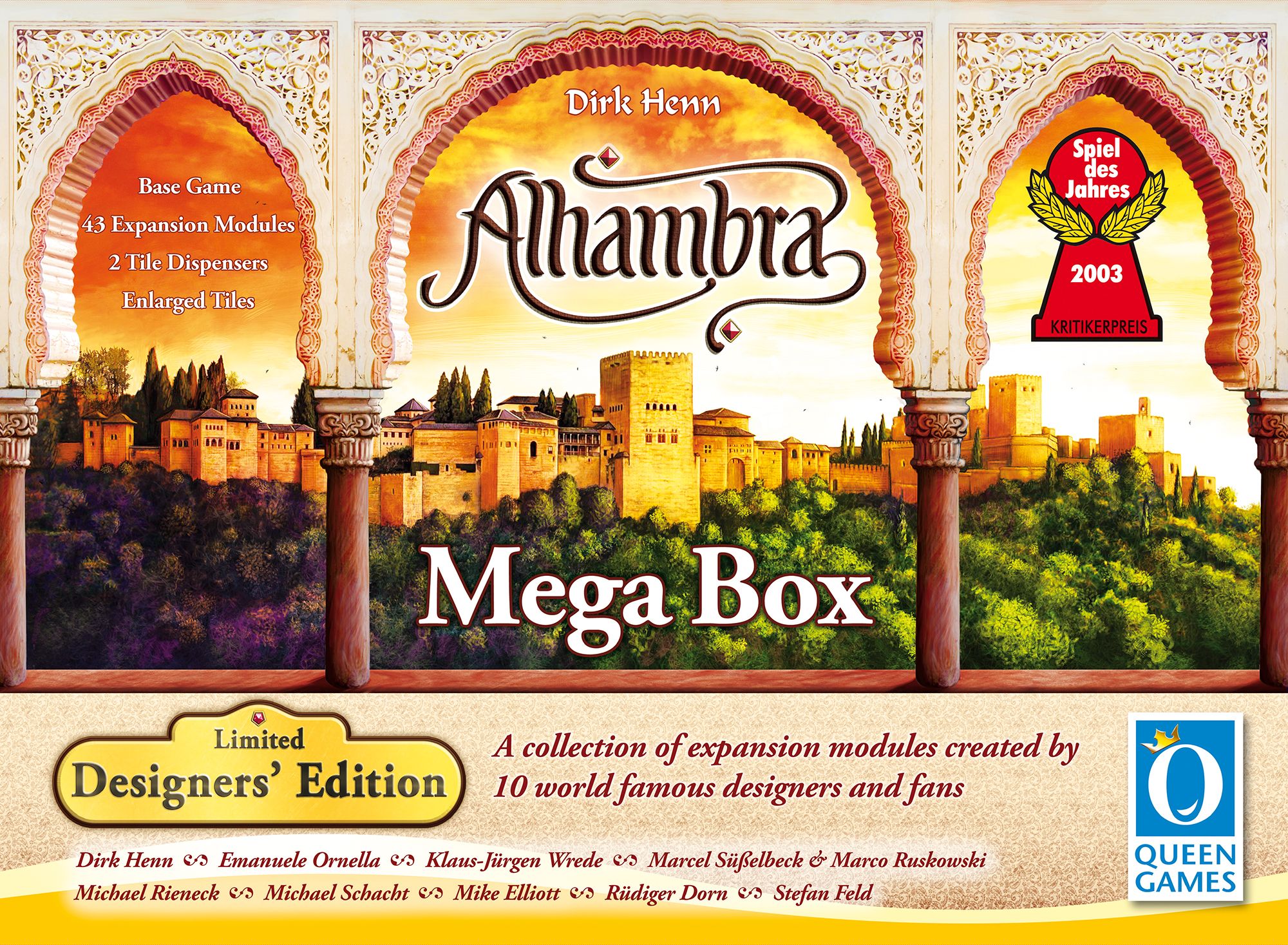
How to Play Alhambra: Mega Box
Queen Games · Board game · 2019What do you want to do now
Ask anything about Alhambra: Mega Box: rules, setup, components, complexity, price, or whether it fits your group.
Step by step
Game Objective
In Alhambra: Designers' Edition Mega Box, players take on the role of Europe and Arabia's best master builders, competing to build the most impressive Alhambra. To do this, they must employ the best teams of builders and ensure they have the right currency to pay them. Players build towers, gardens, pavilions, arcades, seraglios, and chambers, competing against their opponents.
The goal is to have the most building tiles of each type in your Alhambra at the right moments (scoring rounds) and the longest continuous wall around your Alhambra. The winner is the player who has accumulated the most points by the end of the game.
Preparation (Setup)
- Place the game board, which consists of the building market and the card display, in the center of the table, and the scoring board at the edge of the table.
- Each player receives a starting tile, which should be placed on the table in front of them, and 1 marker of their color, which is placed on the 0/100 space of the scoring board.
- The 54 building tiles are shuffled face down and stacked in the tile dispenser tower.
- Four building tiles are drawn from the tower and placed in order on the four numbered spaces of the building market, starting with space 1.
- Each player receives a tile reserve board with a points table, which should be placed in plain sight in front of them. The points table shows how many of each building type there are and how many points each will yield.
- Separate the two scoring cards and shuffle the deck of currency cards.
- Each player receives their starting money. One card at a time, deal currency cards face up to a player until the total is 20 or more (the currency color is not important at this point). Continue doing this until all players have received their starting money. Players can now pick up their cards. From now on, the player's hand of currency cards must be kept secret.
- The player with the fewest cards starts; if two or more players are tied, the player with the lowest amount of money starts. If players are still tied, the youngest player starts.
- Finally, the four spaces of the card display are filled by drawing one currency card and placing it face up in each space.
- The remaining currency cards are divided into five roughly equal piles. Shuffle the first scoring card into the second pile and the second scoring card into the fourth. Then, place the piles on top of each other, with the fifth pile at the bottom, then the fourth, the third, the second, and finally the first on top. The pile is placed in the leftmost space of the card display section on the game board.
Module: Vizier's Favor
- Before the game begins, each player receives the vizier tile of their color, which is placed with the "awake" side up in front of them. Unneeded tiles are removed from the game.
Module: Currency Exchange Cards
- When the currency cards are divided into five piles at the start of the game, two currency exchange cards are shuffled into the 2nd, 3rd, and 4th piles.
Module: Bonus Cards
- The bonus cards are shuffled and dealt face down to all players as follows: with 2 or 3 players, each player receives 3 bonus cards; with 4 or 5 players, each player receives 2 bonus cards; with 6 players, each player receives 1 bonus card. The bonus cards that were not dealt are set aside face down.
Module: Squares
- Separate the squares by color. Shuffle each of the six piles and place them face down next to the building market. Flip over the top tile of each pile.
Module: City Gates
- Take one wooden city gate and one city gate card for each player. When the base game currency cards are divided into five piles at the start of the game, the city gate cards are inserted face down – spread as evenly as possible – into the 3rd, 4th, and 5th piles. The wooden gates are placed near the building market.
Module: Diamonds
- The diamond cards are shuffled along with the other currency cards. Players then receive their starting money and the game continues according to the base game rules.
Module: Characters
- When the base game currency cards are divided into the five piles at the start of the game, shuffle two character cards into the 2nd, 3rd, and 4th piles. The remaining character cards are set aside face down.
Module: Camps
- The camps are shuffled along with all building tiles during setup.
Module: City Walls
- When the currency cards are divided into five piles at the start of the game, two city wall cards are randomly shuffled into the 2nd, 3rd, 4th, and 5th piles. The wooden city wall segments are placed ready next to the building market.
Module: Thieves
- The thieves are shuffled and dealt face down to all players: With 2 and 3 players, each player receives 4 thieves. With 4 players, 3 thieves. With 5 and 6 players, 2 thieves. The thieves that were not dealt are removed, face down, from the game.
Module: Change
- Place all coins in the bag and place it near the players.
Module: Street Merchant
- Before the building tiles are placed in the building market, each player receives a merchant tile and one citizen of each color. The player secretly chooses three of these citizens and places them on their merchant tile. All other citizens form the general supply next to the building market. Each player places their merchant tiles with the three selected figures on either side of their starting tile.
Module: Treasury Chamber
- Place the treasury chamber in the playing area. All 42 treasure chests are placed in the bag, and 4 chests are drawn and placed in each room of the treasury chamber.
Module: Master Builders
- The master builder cards are shuffled, and 2 cards are secretly given to each player. Then, each player receives their starting money. When the base game currency cards are divided into five piles, 3 master builder cards are shuffled into the 3rd pile and 3 into the 5th pile. If there are 6 players, only 1 master builder card is placed in the 5th pile. If there are fewer than 5 players, some master builder cards are left over and are removed from the game.
Module: Invaders
- The invasion cards are shuffled and set aside face down. The scout cards are also shuffled and the top two cards are flipped face up.
Module: Bazaars
- The bazaars are shuffled with the building tiles and placed in the tile dispenser tower.
Game Flow
The game proceeds clockwise, starting with the starting player. The active player must perform one of the following three actions:
- Take money
- Buy a building tile
- Redesign the Alhambra
If a player buys a building tile, they must build it into their Alhambra at the end of their turn. Purchased building tiles are placed next to the player's Alhambra (they are built into the Alhambra only at the end of the turn).
When all purchased building tiles are built into the Alhambra or placed on the reserve board, the turn ends. The currency card display is then refilled by drawing one card from the draw pile for each empty space. If the draw pile is empty, the discard pile is shuffled and used as the new draw pile. Each empty space in the building market is filled with a new tile from the tile dispenser tower. The building market is always filled in ascending order from 1 to 4.
There are 3 scoring rounds during the game. The first two occur when the scoring cards are drawn from the currency card pile. The third and final scoring round occurs at the end of the game. When a scoring card is drawn, it is placed in front of the next player in turn order and the next card or cards are used to fill the display. Before the next player begins their turn, scores are calculated. When scoring ends, the player begins their turn.
Module: Vizier's Favor
Each time a player completely finishes their turn, any of the players can interrupt the normal game order and make a Special Move by buying a building tile from the building market and building it. However, they can only do this if they meet the following conditions:
- Their vizier tile must be "awake" (awake side up).
- They must pay for the building tile with exact money.
A player who makes this special move does not receive the extra turn they would normally get by paying exactly. The player then flips their vizier tile (sleeping side) – it is no longer in play. The player takes the building they want, pays the exact price, and builds it according to the building rules or places it on their reserve board. The player does not get an extra turn. The building market is then refilled so that there are 4 buildings. The normal game order then resumes with the player who would be next.
If multiple players want to use their vizier at the same time, the player who would be next in turn order goes first. The other players can then decide again if they want to use their vizier tile.
Module: Currency Exchange Cards
When the top card drawn from the money pile is a currency exchange card, you place it (like any other card) face up in the card display. There is always a maximum of four visible cards, regardless of whether they are currency exchange cards or currency cards. The active player can now take a currency exchange card instead of money.
Module: Characters
If the top card drawn from the money pile is a character card, the game is immediately interrupted and the card is auctioned. The player who is next to play takes on the role of auctioneer and makes the first bid or passes. Each player must, in turn, raise the bid or pass. Players can only make bids they can afford in one currency. Whoever passes cannot make any more bids for this card. The player who makes the highest bid discards their currency cards used for the bid, wins the character card, places it face up in front of them, and can, from now on, use the card's effect. If no one bids for a character card, it is removed from the game. After the auction, the game continues with the player who was the auctioneer.
Module: City Walls
If the top card drawn from the money pile is a city wall card, it is placed face up next to the board (multiple cards can be face up next to the board at any time). A new card is drawn from the deck so that the total returns to 4.
Module: Thieves
Each time a turn is completely finished, a player can interrupt the normal turn order and, as a special turn, use their thief, taking one of the face-up currency cards in the represented currency. The thief that was played is then removed from the game. Exception: A player cannot use a thief before their own turn.
If multiple players want to take a specific currency card at the same time, the player who is first in turn order has priority. (The player whose turn is next would be first - the player who just finished their turn would be last in this turn order. Note: the player whose turn is next cannot play a thief.)
If a player wants to play the Vizier and another wants to play a thief, the turn order also decides in this case. But a player can first play a thief and then the vizier marker. (Note: the turn order is determined as above. A player can play a thief and then a vizier. The player whose turn is ending can only play a vizier.)
Module: Invaders
Directly after a scoring round, the top invasion card is flipped face up, showing from which direction the Alhambra is being attacked. Each player's Alhambra is compared with the direction of the attack, with each player's buildings being considered pointing north (i.e., all roofs always point north).
Module: Bazaars
If a bazaar is drawn from the tile dispenser when the building market is being filled, it is placed face up next to the building market. More building tiles are drawn until there are 4 buildings in the building market. The bazaar can then be bought like any other building tile. The currency on the tile shows the required currency. The price is the same as the corresponding currency's building tile in the building market. A bazaar can only be paid for with exact money. The player then gets another turn.
Actions and How to Play
The active player must perform one of the following three actions:
1. Take money
A player can take any of the currency cards from the display, or multiple currency cards if they do not total more than 5 (the currency does not matter).
2. Buy a building tile
Rules manual
Official PDF file
Frequently Asked Questions
Quick answers about the rules
What is the objective of Alhambra: Mega Box?
How do you set up Alhambra: Mega Box?
How do you play Alhambra: Mega Box?
Other Games You'll Like
Based on mechanics and theme