
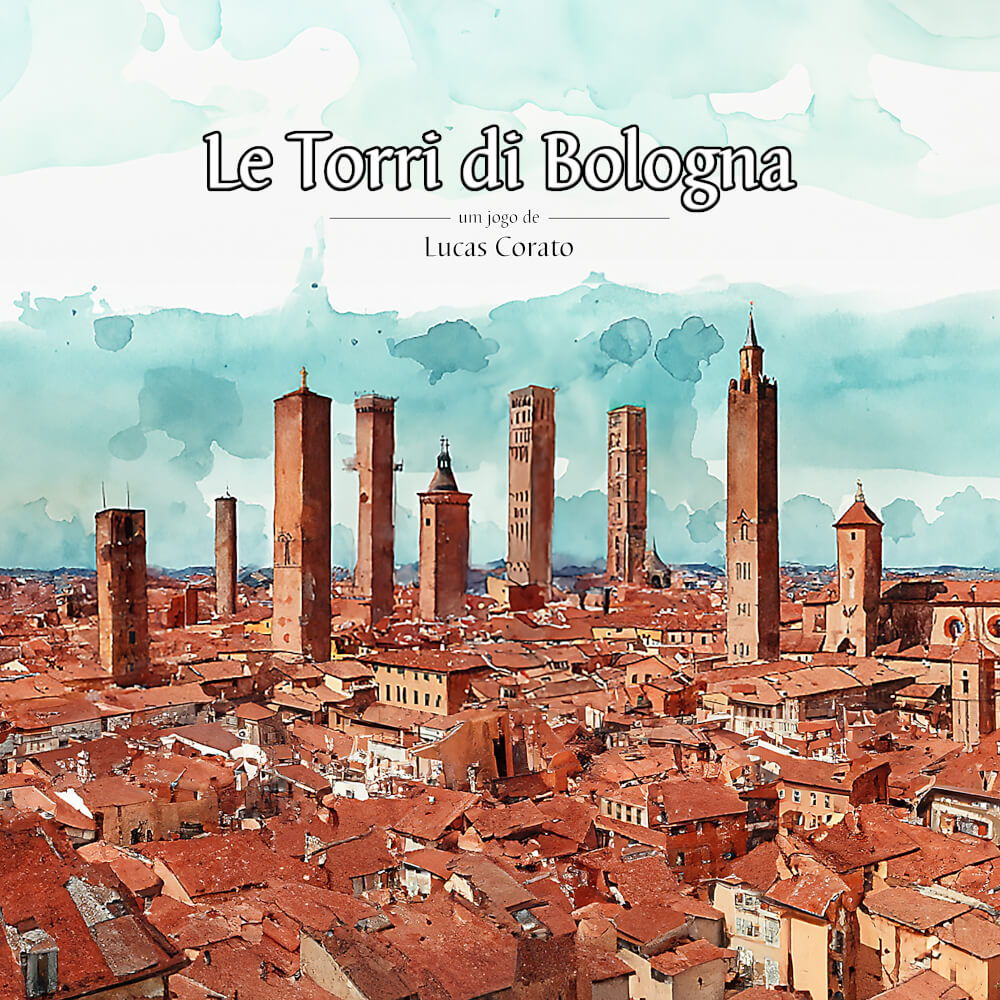
What is your question about Bologna?
Ask before downloading the manual: the assistant was trained on this file and answers instantly, citing the exact page.
Ask questions about the game
Ask anything about Bologna: rules, setup, components, complexity, price, or whether it fits your group.
Write your question first. You will create your free account to see the answer — it takes 20 seconds.
Full rulebook
Browse the manual or download the original PDFFull manual text available to read Open text
Martin Holeksa, Robert Milička / Mico
Bologna
Rulebook
2 10+ 30'
TLAMA
games
---
Credits
TLAMA games – Miroslav Tlamicha
Praha, Czech Republic
www.tlamagames.com
info@tlamagames.com
Game Design: Martin Holeksa, Robert Milička
Art: Mihajlo Dimitrievski (Mico)
Development: Miroslav Tlamicha
Proofreading: Pavel Skalický, Tomáš Tvrdý,
Eliška Schmucková
Graphic Design: Michal Hubáček
We dedicate this game to our first playtesters and supportive wives, Martina and
Martina, and to our youngest playtesters, our children: Albert, Apolena, and Hedvika.
In Bologna, players take the roles of the leaders of two of the most powerful factions in northern
Italy: The Guelphs and the Ghibellines. Just like in the 12th century, they will fill the districts of
Bologna with towers and fortified palaces. However, the ultimate authority in the city belongs to
the podestà: a designated foreigner who acts as both a magistrate and a judge. Winning his favour is
crucial. Otherwise, the strength of your towers will decide the outcome.
The feuds between these noble factions brought the medieval metropolis of Bologna to the brink of
civil war within its own walls. This struggle for power, control over trade routes, and the never-ending
conflict between the Pope and the Emperor turned the city into a battlefield. Fortified family towers
became both a sanctuary for the wealthiest and a symbol of their immense power. By the first half of
the 13th century, Bologna was already dotted with over 150 towers. Some reached heights of up to 100
metres. Of these towers, 22 have survived to the present day. The most famous are the Due Torri. The
taller tower, Asinelli, stands 97 metres high, while Garisenda leans even more than the Leaning Tower of
Pisa. Its tilt forced it to be shortened in the 14th century, and concerns about its stability still remain.
Components
5× size 34× size 2 3× size 54× size 4 1× size 6
Buildings
6× double-sided district tiles
12× school
6× Landmarks (in the following quantities)
4× Councilman’s
house
1× Cathedral 1× Town hall
1× podestà pawn2× player aid
34× player building (17 in each player colour in the following sizes)
---
Setup
• Assemble the game board using the double-sided district tiles to form a complete city
layout where numbers on the scale have to match (see image above). Randomly choose
a side for each district tile, or agree on the sides before the game begins.
• Each player takes the 17 player buildings of various sizes in their chosen colour and places
them into their personal supply:
1× size 6
3× size 5
4× size 4
5× size 3
4× size 2
It is recommended to sort player buildings by size similar to the
image above.
• Each player takes 6 schools and places them into their personal supply.
• Place the landmarks near the edge of the game board:
4× Councilman’s houses, 1× Town hall, 1× Cathedral
• Place the podestà pawn on space 0 of the influence track.
• The yellow player (representing the Guelph faction) is the
first player. The red player represents the Ghibelline faction.
3
2
3
4
5
6
1
4
S4
S3
L3
M4
S4
M3
L4
1
3
5
2
---
Goal of the game
When a courtyard is enclosed, the player who wins its majority gains influence based on the courtyard’s size. If a player reaches or passes space 15 on the influence track during the game, they immediately win. Otherwise, the game continues until all player-coloured buildings have been placed. The tallest towers then grant their owners influence for the landmarks and schools in their districts. The player who gained more influence from district majorities and enclosed courtyards wins the game.
Gameplay
Players alternate turns. On your turn, you must place one of your player buildings from your personal supply into one of the districts. A player building can be placed in one of three ways:
1) Build a house: Take a player building of any size from your personal supply and place it horizontally (flat) onto an empty grid space in any city district on the game board, in accordance with the placement rules.
2) Build a house with a school: Take a player building of any size from your personal supply and place it horizontally (flat) together with one neutral school from your personal supply onto an empty grid space in any city district on the game board, in accordance with the placement rules.
3) Build a tower: Take a player building of any size from your personal supply and place it vertically (upright) into any city district on the game board, in accordance with the placement rules.
The personal supply of unplaced buildings must always remain clearly visible to both players throughout the game.
Landmarks –
When placing the first player building into an empty city district, a player must also place one available landmark in that district during the same turn in accordance with the placement rules. They may choose any landmark that is still available near the game board. Each district can contain a maximum of 1 landmark (a school is not a landmark). A landmark is a neutral piece that does not belong to any player. See the Landmarks section for more details.
Schools – A school building remains neutral throughout the entire game and adds 1 bonus point to the landmark scoring (see Landmarks). However, it is not a landmark itself.
4
---
Placement rules
1) Player building must align with the grid of the
city districts. A building is not allowed to cover
(even partially) more grid spaces than its actual
size.
2) Player building cannot extend beyond
the marked borders of a district and must
be contained entirely within one district.
3) At least one side of the placed player building
must touch the outer edge of the district into
which it is being placed. Touching the edge with
only a corner of a building is not sufficient.
4) When building a house with a school, the school
must touch the shorter side of the house being
built. A school can only be placed on a triangular
space at the edge of the district. It cannot be placed
on a standard square grid space of the district.
Reminder: a school cannot be built together with
a tower (an upright player building).
If the newly placed school touches the edge of the
district, this is sufficient to satisfy rule 3.
Courtyards
What is a courtyard?
1) A courtyard is a connected area of empty grid spaces completely enclosed by buildings.
2) The edge of a district does not count as a border of a courtyard. The courtyard must be
separated from the edge by buildings.
3) An enclosed courtyard is worth a number of influence points equal to the number of square
grid spaces that courtyard encloses within the district.
4) A single district can contain multiple courtyards.
5) A grid space that connects to a courtyard only by a corner may remain empty.
Thus, two courtyards can share a common corner.
5
Placement rules
of the city districts. A building is not allowed to cover
(even partially) more grid spaces than its actual
size.
At least one side of the placed player building
into which it is being placed. Touching the edge with
At least one side of the placed player building
must touch the shorter side of the house being
built. A school can only be placed on a triangular
space at the edge of the district. It cannot be placed
Reminder: a school cannot be built together with
district, the school
must touch the shorter side of the house being
---
Influence track and immediate victory
The influence track indicates the influence of the rival factions in Bologna.
During the game, the podestà pawn shows the current difference in influence
between the two players. As soon as any player reaches or exceeds 15 influence
points, they win the game immediately.
Courtyard scoring
As soon as a courtyard is formed, you immediately score it and determine which player receives the influence points for this courtyard. The player with the most houses touching the courtyard wins the courtyard. If tied, the player occupying the most grid spaces touching the courtyard wins instead. The winner gains a number of influence points equal to the number of
empty grid spaces within the courtyard. They then move the podestà pawn on the influence track by the corresponding number of spaces
towards space 15 on their side of the track
(in their colour). Resolve the courtyard majority
using the following criteria in order:
1) Number of houses: The player with the most
houses surrounding the courtyard earns
the influence points. The size of the individual
houses does not matter. Count only houses
that touch the courtyard with at least part
of their side. Houses touching only with
a corner do not count. While landmarks,
towers, and schools are buildings and help
enclose courtyards, they have no effect on
courtyard scoring. Only houses (flat player pieces)
count.
2) Number of grid spaces: In the case of
a tie for the number of houses, the influence
points for the courtyard are awarded to the
player who occupies (i.e. has a player building
of their colour) the most grid spaces touching
the courtyard with at least one side, not
a corner. Grid spaces occupied by towers
are also counted. Landmarks and schools
have no effect on winning a courtyard.
3) Tie: If a tie continues, neither
player
receives the influence points
for the courtyard.
Example: In this case, both players have the same number of houses around the courtyard (3 houses). Therefore, the courtyard majority will be decided based on the number of occupied grid spaces in the respective colours (including towers). The red player
touches the courtyard with 7 grid spaces containing their player buildings. The
yellow player touches it with 5. The red player
therefore wins the courtyard. Since the courtyard contains 11 empty grid spaces, they gain 11 influence points and move
the corresponding number of spaces on the influence track.
Example: In this district, the red player has 3 houses and the
yellow player has 2 houses touching the courtyard. The red player
therefore gains 11 influence points for the enclosed courtyard and
moves 11 spaces towards space 15 on their side of the influence
track.
---
Landmarks
What are landmarks?
Landmarks represent significant buildings in Bologna. During the game, they act as neutral
buildings and can be used strategically, for example, to help enclose courtyards.
At the end of the game, landmarks award influence points based on their size and significance:
Landmark Scoring
If a player wins an immediate victory, landmarks and schools are not scored. Otherwise,
landmarks and schools are scored separately in each district at the end of the game.
Influence points are awarded to the player who wins the tower comparison in that district,
following these criteria in order:
1) Tallest tower: The influence points for the landmark and any schools are awarded to the
player with the tallest tower in that district.
2) Number of towers: If both players’ tallest towers are the same height, the landmark is
awarded to the player who has more towers in that district. When comparing the number
of towers, ignore the heights of all other towers.
3) Tie: If the tie continues, no influence points are awarded for this district.
Note: Houses have no effect on landmark scoring.
End of the game
If no player manages to achieve an immediate victory during the game, the game ends as soon as
the last player building is placed. Then, score influence points for all placed landmarks and schools.
The player who currently has less influence chooses a district to score. They have to choose a district
in which they have majority (either tallest tower or number of towers). Calculate the number of
influence points for landmarks and schools in that district. That player moves the podestà pawn
the corresponding number of spaces on the influence track. The player with less influence keeps
choosing districts to score until the podestà pawn is on their side of the track. Then, the other player
takes over, scoring the remaining districts until the pawn is back on their side. Continue in this way
until all districts have been scored. Whenever the podestà is on space 0, any player may choose
a district to score. The final position of the podestà pawn determines the winner. If the pawn is on
a player’s side of the track, that player wins! That player’s faction becomes the new ruling faction of
Bologna. If the podestà pawn ends on space 0, the game ends in a tie.
Schools are not landmarks, but they grant 1 additional influence point during the final scoring.
until all districts have been scored. Whenever the podestà is on space 0, any player may choose
a district to score. The final position of the podestà pawn determines the winner. If the pawn is on
a player’s side of the track, that player wins! That player’s faction becomes the new ruling faction of
Bologna. If the podestà pawn ends on space 0, the game ends in a tie.
Councilman’s house: 4 influence points
Town hall: 6 influence points
Cathedral: 10 influence points
7
Landmark Scoring
If a player wins an immediate victory, landmarks and schools are not scored. Otherwise,
landmarks and schools are scored separately in each district at the end of the game.
Influence points are awarded to the player who wins the tower comparison in that district,
following these criteria in order:
1) Tallest tower: The influence points for the landmark and any schools are awarded to the
player with the tallest tower in that district.
2) Number of towers: If both players’ tallest towers are the same height, the landmark is
awarded to the player who has more towers in that district. When comparing the number
of towers, ignore the heights of all other towers.
3) Tie: If the tie continues, no influence points are awarded for this district.
Note: Houses have no effect on landmark scoring.
End of the game
If no player manages to achieve an immediate victory during the game, the game ends as soon as
the last player building is placed. Then, score influence points for all placed landmarks and schools.
The player who currently has less influence chooses a district to score. They have to choose a district
in which they have majority (either tallest tower or number of towers). Calculate the number of
influence points for landmarks and schools in that district. That player moves the podestà pawn
the corresponding number of spaces on the influence track. The player with less influence keeps
Schools are not landmarks, but they grant 1 additional influence point during the are not landmarks, but they grant 1 additional influence point during the
final scoring.
---
Final Scoring Example
Neither player gained enough influence points from enclosed courtyards to trigger an immediate victory.
Therefore, the game ended after the last player building was placed. The podestà is located on space 7
on the red player’s side. Now landmarks and schools will be scored (since the red player is leading, the
yellow player chooses the first district to score, and continues until all districts are scored):
After scoring the individual districts and tallying up the points for landmarks and schools, the red
player adds 21 points (5+11+5) to their 7 points for the courtyards, and the yellow player adds
14 points (8+6). Overall, the
red player wins, having gained 14 points more than the
yellow player.
The Ghibelline faction gains control over the city of Bologna!
District 6: The landmark is worth 4 influence points + 1 influence point for the school. Neither
player gains the 5 points. Both players’ tallest tower has the same height: 4. Both players have
the same number of towers: 2.
District 2: The landmark is worth 4 influence points + 1 influence point for the school.
The 5 points go to the red player. They are the only player with a tower in this district.
The podestà is now located on space 4 of the red player’s side of the track. The yellow
player will choose the next district to be scored (as always, it has to be a district in
which they have majority).
District 1: The landmark is worth 6 influence points + 2 influence points for the
schools. The 8 points go to the yellow player. Both players’ tallest tower has the same
height: 5. The yellow player has more towers (2) than the red player (1). The podestà
is now located on space 1 of the yellow player’s side of the track. The red player will
therefore choose the next district to be scored (it has to be a district in which they have majority).
District 4: The landmark is worth 10 influence points + 1 influence point for the school.
The 11 points go to the red player. The height of the tallest tower of the red player (6) is higher
than the height of the tallest tower of the
yellow player (5). The number of towers does not
matter in this case (1 red tower vs. 2 yellow towers). The podestà is now located on space 9
of the red player’s side of the track. The yellow player would normally choose the next district
to score, but since there is no district in which they would control a majority of tower height or number, the red player keeps choosing.
District 5: The landmark is worth 4 influence points + 1 influence point for the school.
The 5 points go to the red player. They are the only player to have at least one tower in this
district. The podestà is located on space 14 of the red player’s side of the track.
District 3: The landmark is worth
4 influence points + 2 influence points for the
schools. The 6 points go to the
yellow player. They are the only player to have
at least one tower in this district. The podestà is now located on space 2 of the
yellow player’s side of the track. The red player will choose the next district
to be scored.
---
Why ask BoardGamesBot
Instead of flipping through the whole manual- Accurate answers Based exactly on this manual, with the source page.
- Save time Find the rule in seconds, without flipping 8 pages.
- Anytime Settle rules mid-game, straight from your phone.
- 100% free Create your free account and start using it now.
How it works
Three steps to the answer- 1 Ask your question Type your question about this game's rules.
- 2 Create your free account Takes 20 seconds — it only saves your history.
- 3 Get the answer The AI finds the exact rule and cites the manual page.
Other Games You'll Like
Based on mechanics and theme

Manual published by the publisher · for rules reference only. More about the game on BoardGameGeek and Ludopedia .
