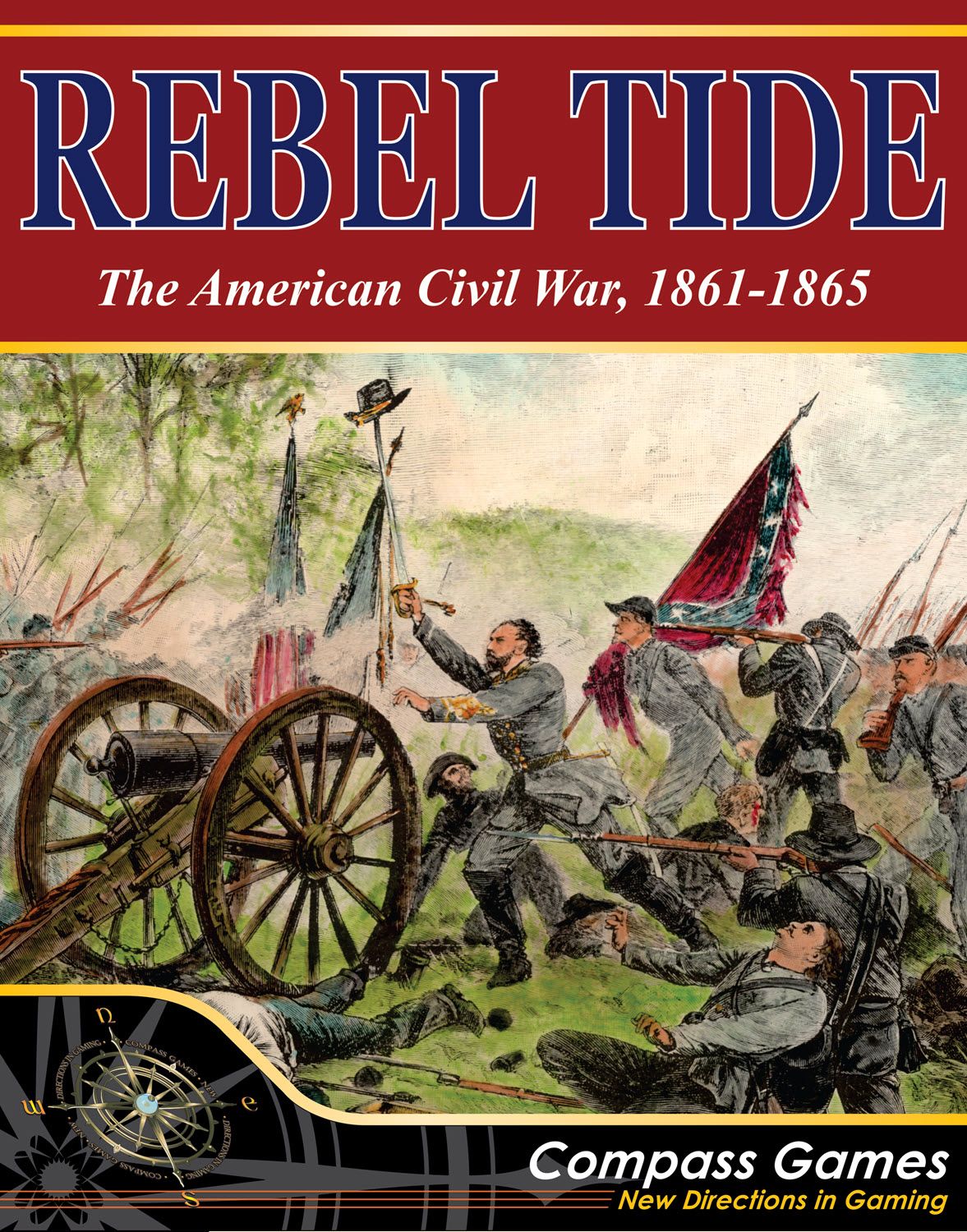
What is your question about Rebel Tide: The American Civil War?
Ask before downloading the manual: the assistant was trained on this file and answers instantly, citing the exact page.
Ask questions about the game
Ask anything about Rebel Tide: The American Civil War: rules, setup, components, complexity, price, or whether it fits your group.
Write your question first. You will create your free account to see the answer — it takes 20 seconds.
Full rulebook
Browse the manual or download the original PDFFull manual text available to read Open text
REBEL TIDE - Rules Summary v-1.2
1) START OF YEAR
1. Reveal the New Year card.
2. Give both sides their listed Resource Points for that year.
3. Place any new leaders allowed (maximum # indicated) by the Year card.
4. In 1861, the CSA goes first, and there is no build phase. CSA starts and plays Fort Sumter first. No build phase in 1861. Breastworks and entrenchment can still be used. NOTE: players do not divide card stacks during the 1861 year.
5. See starting unit card for victory conditions.
2) BUILD PHASE (not in 1861)
● Each player secretly spends Build Points to rebuy cards from the discard pile.
● Cards with a star cannot be rebought.
● You may spend 1 Build Point to gain +1 extra Resource Point for the coming (next) year.
● After buying, shuffle your hand and split the cards into two (2) face-down stacks; this does not happen in 1861. Take the larger stack, otherwise you choose one.
3) CARD PLAY
● Players alternate playing cards.
● Resolve card text top to bottom.
● A card may tell the other player to go next, or allow another action immediately.
● “Pass the turn” only means pass to the opponent, not end the year. You may continue playing after other player finishes his turn.
● If both players pass with no card play or resource action, the year ends.
● IMPORTANT: During card play, when a player has one card remaining in their hand, he may now take the second card stack playing out the year normally.
4) What a card can do
A card may let you: (NOTE: You do not have to use every option on the card, but anything you do must be done in the printed order.) Move units, Attack (adjacent), Entrench, Raid, Use special card effects. IMPORTANT: A player may exchange one card for a resource point.
---
REBEL TIDE - Rules Summary v-1.2
5) MOVEMENT:
When a card activates MOVEMENT:
Pick one area.
All units in that area may move (one or more areas within stacking limits and following movement rules).
Players can pick up other units enroute to their intended destination following normal movement rules.
INF usually moves 1 area; CAV, ART, NAVAL, and Leaders can move up to 2.
NAVAL units must stay on river locations.
Units may freely move onto unoccupied enemy areas (converting to their Control). They may continue taking unoccupied areas even if they are out of supply.
Friendly units entering an unoccupied fort immediately destroy the fort. Movement stops immediately upon entering the unoccupied fort. You cannot enter using movement onto an occupied enemy Fort. This requires an Attack order from a card.
Movement must be finished before doing anything else from that card. Important movement limits:
- Units cannot move and also attack on the same card. (exception: Foot Cavalry)
- Mountains and enemy forts (occupied or not) stop all movement.
- Gunboats only move on rivers.
- Sea movement is for the Union only from a friendly port to another friendly port (maximum of 1 unit in transport at a time).
- CAV special case - they can bypass enemy INF if there is no enemy CAV present.
- CAV units that are out of supply can live off the land (immune to supply effects) but their movement is reduced to one (1) area at a time.
- INF that receives a two-area movement bonus can move two connected areas via:
- Road + Road
- Road + River/Rail (For a rail bonus to occur, both ends of the rail travelled must start in friendly control).
- Rail + Rail/River/Road
- River + River
---
REBEL TIDE - Rules Summary v-1.2
6) ENTRENCHMENT
Spend a movement or card text to entrench INF or CAV in a friendly area.
Entrenched units give the attacker a +1 left CRT column shift.
Artillery alone cannot entrench, but can benefit if stacked with entrenched units.
Units leaving an entrenched area lose that status unless they move into another entrenched area.
IMPORTANT: If entrenched units that attack an adjacent enemy unit(s) win/lose/tie and if they advance after combat, they would lose their entrenchment status. But, if they did not advance (for whatever reason) into the enemy’s location, they would remain as entrenched units in their initial starting location.
7) STACKING LIMITS
● Each area normally allows only one INF stack, one CAV stack, and one ART stack to the maximum counter size in the unit pool (5 INF, 2 ART USA, 2 CAV CSA).
● 1 Gunboat may be stacked in a friendly river area. (Note: Gunboats can use their 1 SP for attacks AND defense).
● Leaders stack freely, but only the best leader in the area is used. (Note: all stacked Leaders are required to make a survival roll during combat).
8) COMBAT
A battle is always one area attacking one area per card played.
Combat sequence
1. Apply any card effects that cause losses first.
2. Add up combat strength of Attackers and Defenders. (Note: you can use my BGG uploaded Combat Player Aid to assist you).
3. Apply terrain, entrenchment, leaders, combined arms, forts, and other shifts/drms.
4. Both sides roll 2D6 on the combat table. Check and cross reference dice rolled to the column.
5. The number shown on CRT is the total losses your army inflicts on enemy army units.
IMPORTANT: The winning side is the player who inflicts MORE casualties to his enemy player. A five (5) or more total combined losses in this battle AND one side caused more losses is considered a MAJOR VICTORY for your side. That player will gain a +1 Political Point shift in their favor. Otherwise no effect on the Political chart if battle ends in a tie.
6. Remove losses, keeping those defenders that were not forced to retreat in their entrenchment state.
7. If allowed, the attacker may advance (if he caused more losses); the defender must retreat if the attacker is successful in making the advance into the area post combat. Remember; the defender may retreat to different locations as long as they are within 2 areas away to the rear of the battle area and into friendly controlled areas.
---
REBEL TIDE - Rules Summary v-1.2
Combat reminders:
Forts help defenders if occupied:
- Counts as 1 SP for the defender.
- The defender must take Fort Point for damage FIRST and mark it as DESTROYED.
- If Attacker moves into an unoccupied Fort location, immediately mark it as DESTROYED. NOTE: all movement stops when entering an undamaged fort (occupied or not).
- Forts (occupied or not) do BLOCK supply paths unless destroyed.
Mountain areas benefit defenders, giving attackers a shift 1 left.
Combined Arms requires INF + CAV + ART in the same area at the start of combat and provides a +1 DRM for both attacker AND defenders.
Entrenchment benefits only the Defender giving the Attacker a 1 shift LEFT on CRT.
Gunboats add 1 SP in attack/defense and must be removed first to satisfy any losses.
Forts are removed first when taking losses (before Naval units too).
9) LEADERS
Each Year Card indicates the hard Leader limit that can be on the board at any given time. If your side has the maximum allowed, no new Leader can be drawn (barring special case leaders Lee/Meade).
Leaders assist in combat:
- A player in a battle has a Leader with a 2+ leadership rating over your enemy leader’s rating (or they have no leader present) receives a 1 column shift to the right.
- Roll 1D6 to determine if the attacker who inflicted more casualties than the defender in this battle. If the 1D6 roll result is equal to or less than this leadership number (or 2 for leaderless attacking group) will (optionally) allow the attacker to advance into this area.
The defender must now retreat if the attacker enters the area (they may retreat to separate areas away and into friendly controlled areas). The attacker moves in his forces (as many as he wishes) into the newly vacated area.
- Leaders can be wounded or killed after battle. If WIA, put back into the cup (do not draw replacement), if KIA - leader is out of the game.
- IMPORTANT: All “stacked” leaders must undergo a survival test at the END of the battle (after advancement).
Meade and Lee are special leaders as they are not drawn like other leaders. They enter play through card play and do not count towards the year’s leader maximum limit.
Leaders can also be “sacked” with a movement action once per card play, immediately drawing his replacement from the cup. A sacked leader is out of the game.
4
---
REBEL TIDE - Rules Summary v-1.2
Optional Rule: A nameless Leader token (drawn) is used like any other Leader, but only presents himself when a battle occurs. At that moment, the owner draws one random Leader and uses the drawn leader normally.
Leaders wounded are placed back into the draw cup (this include Meade/Lee who would then be limited to total # of Leaders available if they are redrawn).
10) ADVANCE / RETREAT AFTER COMBAT
The attacker must pass the leader check to advance (equal/less than Leader Rating or if no leader, 2 is the rating used).
Defenders that took more losses must retreat (to a friendly area adjacent to the battle area) if the attacker passes the advance after combat check.
Attackers are never required to advance. NOTE: entrenchment rule above.
Defenders may retreat to different friendly areas (i.e. they do not have to go to the same area together - but stacking restrictions remain in effect).
11) SUPPLY AND CONTROL
Supply is traced to any friendly reinforcement area or capital city (or alternative if already captured) free from enemy control areas and/or forts (occupied or not), or UNION may trace to NY city or a controlled friendly port.
Supply is checked at the start of each card play. OUT OF SUPPLY units are so marked.
Effects of being out of supply are:
a) They cannot attack.
b) They can move and defend normally.
c) All INF/ART/NAVAL units that are still out of supply at year’s end, surrender.
d) CAV units feed off of the land and are never out of supply, however their movement is reduced to 1 area only AND attack/defend at 1 SP (IMPORTANT: no matter their size).
CONTROL - the last army side to have entered the area.
IMPORTANT: if captured, both WDC/Richmond must be garrisoned by at least 1 INF (not CAV/ART) unit or control immediately reverts back to original owner’s control.
If the Union controls ALL Mississippi River areas (Dubuque to N.O.) by year’s end, reduce -1 CSA build point.
Political Track (1861-1863 only) advancement for:
a. Major land victory (5+) combined losses in a single battle.
b. General Lee entered play (+1) before 1863.
c. First time capturing or recapturing Major Resource areas (+1). Mark them in the appropriate box using supplied counters. If the area is recaptured, flip counter and gain (+1) PP.
5
---
REBEL TIDE - Rules Summary v-1.2
d. At -5 PT, it will cease to be affected for the remainder of the game (no foreign involvement).
Political Track (1864-1865 only) advancement at +5 does NOT end the game, but England and France do recognize the CSA as legitimate. The following effects if CSA PT reaches 5+ during 1864-1865 year:
a. The Union BLOCKADE card cannot be played.
b. CSA gets a +1 Build Point each remaining year(s).
c. The use of the Political Track ceases for the remainder of the game.
12) GUNBOATS
Gunboats come into play only via card play and only into RIVER areas.
Gunboats provide both Attacker and Defender with 1 SP in combat.
Gunboats cannot advance after combat unless in a river area.
Gunboats take the first loss in combat (after Forts).
IMPORTANT: Gunboats themselves do not provide control of an area.
Gunboats must trace supply like other units.
13) NEUTRAL TERRITORIES
Kentucky entered the USA side via card play (1862).
USA units cannot enter Kentucky until card played or CSA has invaded.
WVa automatically joins the USA on their first card play in 1863. No effect on either side for movement - but they still joins the USA side of the war when the card is played.
14) END OF YEAR
Once both players pass with no card play or resource use, the year ends.
- Players may hold cards in their hand w/o penalty (no maximum hand size and cards will not cost any RP’s this turn when held).
- Players may leave “cards on the table effect” or collect them from the board and purchase them like any other discarded non-star card. Doing so the player will be able to use the text (movement) this year.
Delete any resource points remaining (they are not carried over).
Check for OUT of SUPPLY units, if they remain OS by year’s end, they immediately (including any attached Leaders) surrender and are out of the game.
Flip all “used” CAV, ART, NAV, Leader markers in preparatory for next year.
Remember to ADD any build points to next year’s card if you added these points this year.
Play continues until instant Victory (1861-1862) has been achieved or end of 1865.
---
REBEL TIDE - Rules Summary v-1.2
IMPORTANT OVERLOOKED RULES / RULE CLARIFICATIONS:
● Leaders shift CRT 1 right (benefitting their side) if no enemy leader is present (Def/Attacker) or if their Leader is 2 or greater in leadership value than their opponent’s Leader value.
● Attacker may advance after combat, 1D6 equal to or less than leadership number (2 w/no leader) if the attacker inflicted MORE casualties.
● All Leaders in battle must roll 2D6 for survival after battle resolution (win or lose). Note: ties are rolled in the winning values 11 WIA / 12 KIA.
● Leaders left alone in location may retreat up to 2 areas away. If unable (no friendly areas), he is captured. NOTE: USA leaders alone in a PORT may use sea movement to a friendly port.
● Lee and Meade are "bonus" leaders essentially - they do not count against your annual leader limit.
● Running your opponent out of cards is a strong tactic.
● Union player may move 1 INF/ART/CAV unit from one friendly Port to another friendly Port per movement card.
● River/Rail movement (2 areas) must be contiguous (i.e. river/river or rail/rail) and both ends must be friendly.
● IMPORTANT: units not involved in an attack may move into an area that launched an attack earlier on the same card played but cannot move into the area that was attacked.
● Stacking = 1 of each type to the maximum size available.
● Undestroyed Fort for defender counts as 1 strength point (defense) if occupied.
● Mountain areas - attacker has a 1 shift LEFT on CRT penalty when attacking defenders inside a mountain hex.
● Forts BLOCK enemy supply path (occupied or not).
● For every combined loss of five (5) or more in a single battle engagement (either side), the Political Track is moved 1 space in their favor.
● 1st time CSA takes WDC, +1 for CSA on the Political Track (PT).
● 1st time USA takes Richmond, the USA receives a +1 on the PT (left).
● 1st time either side takes a Major Reinforcement area (**) or Marked Cities, the PT is adjusted to the side taking control. IMPORTANT: PT points are won/lost when taking OR retaking these areas.
● If the USA player gets the PT to -5, then the PT is no longer valid for the remainder of the game.
● Supply is traced unblocked by enemy forces/forts to your Reinforcement areas or your Capital City.
● Players may keep cards in hand for next year. They can keep cards “in play” on table or buy them.
● Entering an enemy area with only ART unit(s) you must STOP movement. The ART unit is captured on a 1D6 roll of 1-2 or destroyed on a 3-6 result. If captured, replace the unit.
● No unit can perform movement then any other activity with the same card played. (exception: Foot Cavalry. They can move and then attack on the same card).
● Naval Assaults - USA rolls 2D6 on CRT 4 column (3 if CSA is entrenched). If at least one CSA unit survived, the assault FAILED. If no CSA survived, place 1 USA INF unit.
● USA player’s units are always in supply from a friendly Port.
● Neutral States - USA cannot move into Kentucky unless:
○ If the CSA player invades a neutral Kentucky state, they immediately lose -1 Political Point.
○ West Virginia enters Union side on card play. Either side may freely enter W.V. state areas w/o penalty.
---
REBEL TIDE - Rules Summary v-1.2
Bonus: Combat Player Aid charts (print on cardstock and cut out, one for each side)
CSA FIREPOWER
1 2 3 4 5 6 7 8
ROLLED
TTL HITS GENERATED
1 2 3 4 5 6 7 8
FORT/NAV +1 SP / ENTRENCHMENT ← 1 Left / LEADER (+2) → 1 Right / COMBINED ARMS +1 DRM
Leader Survival Roll : Victory or TIED : 11 WIA / 12 KIA Loser : 3 / 11 WIA 2 / 12 KIA
USA FIREPOWER
1 2 3 4 5 6 7 8
ROLLED
TTL HITS GENERATED
1 2 3 4 5 6 7 8
FORT/NAV +1 SP / ENTRENCHMENT ← 1 Left / LEADER (+2) → 1 Right / COMBINED ARMS +1 DRM
Leader Survival Roll : Victory or TIED : 11 WIA / 12 KIA Loser : 3 / 11 WIA 2 / 12 KIA
8
---
Why ask BoardGamesBot
Instead of flipping through the whole manual- Accurate answers Based exactly on this manual, with the source page.
- Save time Find the rule in seconds, without flipping 8 pages.
- Anytime Settle rules mid-game, straight from your phone.
- 100% free Create your free account and start using it now.
How it works
Three steps to the answer- 1 Ask your question Type your question about this game's rules.
- 2 Create your free account Takes 20 seconds — it only saves your history.
- 3 Get the answer The AI finds the exact rule and cites the manual page.
Other Games You'll Like
Based on mechanics and theme



Manual published by the publisher · for rules reference only. More about the game on BoardGameGeek and Ludopedia .