/pic7182951.jpg)
What is your question about Tri*T*Area?
Ask before downloading the manual: the assistant was trained on this file and answers instantly, citing the exact page.
Ask questions about the game
Ask anything about Tri*T*Area: rules, setup, components, complexity, price, or whether it fits your group.
Write your question first. You will create your free account to see the answer — it takes 20 seconds.
Full rulebook
Browse the manual or download the original PDFFull manual text available to read Open text
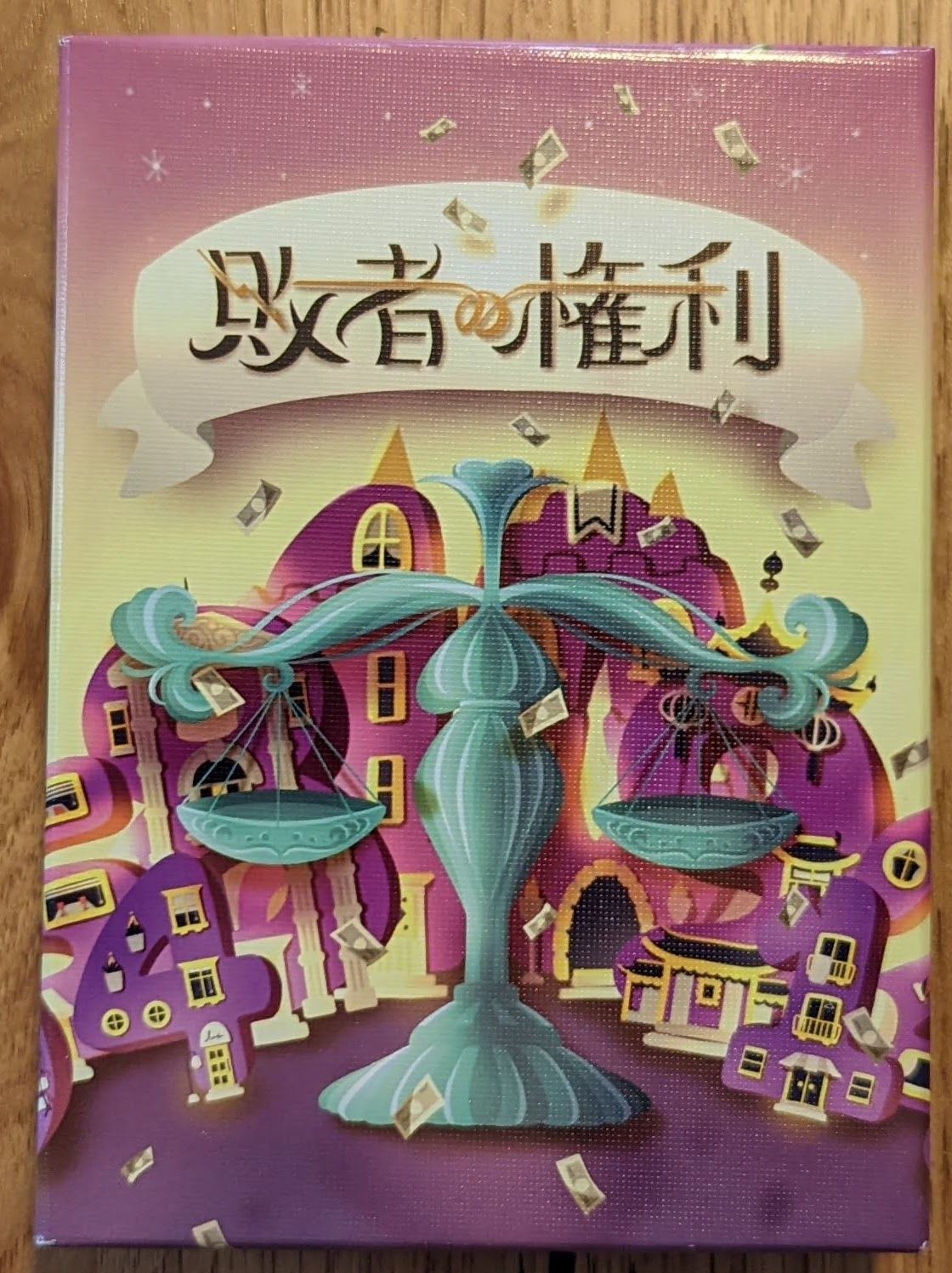
TRI*TAREA
都市開発計画ゲーム
トリテア
1-4
10+
45 min
Game Overview:
The players are developers undertaking urban development of the
new city Tri*Area (Tritería). During "meetings", players will
compete for the rights to construct buildings by making
presentations using plan cards from their hand. Players that earn
rights during a meeting can then build in order to occupy areas and
buildings and have the tallest building. Players may earn immediate
victory points when placing some buildings and when evaluating at
the end of the round. The game takes place over three rounds of
development simulation, each with a slightly different set of rules. At
the end of the game, the player with the most victory points wins!
Important Rule! Determining exclusive use of "area" and "building"
Exclusive use of area
For each area, the player color
that has the most blocks visible
from above
(if tied, check the heights of the
buildings)
Building occupancy
For a building, it is the
most present color.
(if tied, the lowest player color wins)
1st
2nd
1st
Game Flow: (4 player rules)
The flow of the game is structured as shown in the
diagram to the right. Perform 3 rounds of development
simulations. Regulations change and new rules are added
for each round. The cycle of "meeting phase" and
"construction phase" is called a "trick". After completing 8
tricks in a round, perform the "settlement phase".
After three rounds, the game is over.
Contents:
Plan Cards: 36
The 36 cards represent a development plan (hereafter
referred to as "plan"). There are four types of development
concepts (colors/suits), "Intelligent" (blue), "Modern"
(yellow), "Ecology" (green), and "Happiness" (red), each
with a rank of 1-9. The higher the rank, the faster the
construction speed. The cards ranked "5" have a special
ability and can change to a 0 or 10 (details below).
Board: 1
There are 4 areas corresponding to 4 types of development
concepts, each showing 4 squares for a total of 16
construction spaces. The edge of the board is the scoring
track.
Blocks: 9 pieces per player (36 total) (Note: block color may
vary)
Blocks are the material for constructing buildings.
You indicate that you have built a building placing it on the
square of each area of the board
Leader Marker: 1 | Scoring Markers: 4 | Overview: 4 | Rulebook
*Affix the stickers provided to the leader marker and scoring markers
Set Preparations
Hand/
Round
Size
Blocks
Rules/regulations
1
8
7
Remove the four
rank 5 cards.
per player
per player
2
9
8
Declaration of
intent
(remaining card)
per player
per player
3
9
9
- Lead area
declaration (pre-
round)
- Advance block sale
per player
per player
Round 1
Prepare Round 1
Trick
meeting phase
construction
phase
8 times
Round 1 settlement
Round 2
Prepare Round 2
Trick
meeting phase
construction
phase
8 times
Round 2 settlement
Round 3
Prepare Round 3
Trick
meeting phase
construction
phase
8 times
Round 3 settlement
Game Over
Preparation: Round 1
Place the board in the center of the table within
reach of the players. Place the 4 scoring markers,
blank side up, on the board in the "start" space.
Determine the "start player" in any appropriate
manner. The start player removes the four 5's from
the 36 cards and sets them aside. The 32 cards are
then shuffled and dealt eight cards to
each player. Each player holds the cards dealt to
them so that they only can see them. This is called
their hand.
Each player chooses a color of their choice and
takes seven blocks of that color. The two unused
blocks are set aside.
When ready, proceed to the "Meeting Phase."
Preparation: Rounds 2-3
Collect the blocks of your color which were
placed on the board. Score markers remain
where they are.
The player with the highest score becomes the
start player. This player adds the four 5's
removed from during the initial preparation,
shuffles the 36 cards, and deals nine cards face
down to each player.
In round 2, each player has eight blocks of their
color, with one block set aside unused. In round
3, each player uses all nine of their blocks.
Additionally, for round 3, perform the following
additional steps:
Lead Area Declaration:
At the beginning of the round, each player declares
their intention to be the leader in an area by selecting a card
from their hand. At the end of the round, a player earns
points equal to the rank of the plan if they rank first in the
area indicated by the published plan, and loses points
equal to the rank of the plan if they rank third or lower.
Second place is ±0.
Once each person has finished selecting their plan, the
cards are simultaneously revealed. The cards should not
be commingled with any other cards and should be
visible to all players.
nine of their blocks Additionally for round 3 perform the following additional steps Lead Area Declaration At the beginning of the round each player declares their intention to be the leader in an area by selecting a card from their hand At the end of the round a player earns points equal to the rank of the plan if they rank first in the area indicated by the published plan and loses points equal to the rank of the plan if they rank third or lower Second place is 0 Once each person has finished selecting their plan the cards are simultaneously revealed The cards should not be commingled with any other cards and should be visible to all players
Selling and Buying Blocks:
Before the start of round 3, blocks may be sold. You
immediately gain 3 points for each block removed from
in front of you. (When the round ends, you must pay 2
points for each block which you did not place on the
board.)
Beginning with the player to the right of the start player,
in counterclockwise order, declare how many pieces to
sell and remove, advancing the score markers to the
scoring track.
Additional Rule for Round 1:
No 5's are used/included in the cards
*The 5's are special cards which can be changed into a
0 or a 10 in exchange for VP. This change can occur for
all uses, such as playing or if used as a bidding card.
Additional Rule for Round 2:
Declaration of Intent:
In round 2, the players will play 8 tricks, but have 9
cards in their hand. The remaining card is each
player's "Declaration of Intent". At the end of the
round, if the player ranks first in the area shown on
this card, they earn additional points (there is no
benefit for being ranked 2nd or lower in that area.)
Additional Rule for Round 3:
(This section is missing from the image)
---
Meeting Phase:
1. One of the players is the start player of the
"meeting". Place the Leader marker in front of the
start player. Players take turns in clockwise order,
beginning with the Leader.
2. On your turn, choose a "Plan" card from your hand
and place it face up in front of you. This is called your
"proposal".
You may choose any plan in hand. You may support a
plan with the same concept (color) as the "proposal"
or a plan with a different concept, a "counter-
proposal".
*All players are required to submit one plan at a time. Even if
you do not have a plan that you want to submit, you must
submit one.
3. After all plans have been submitted, compare them to
determine the two rights holders that will build in the
construction phase.
4. Players who did not earn the right to build turn the
cards face down and play proceeds to the Construction
Phase.
Construction Phase:
1. The players who earned rights during meeting phase
place blocks according to the rules shown below.
Rightholder 1 places blocks first, followed by
Rightholder 2.
Any other players do nothing during this phase.
2. When placing blocks, score points
if any points have been earned from the
placement of a block and adjust scoring
markers accordingly.
3. When complete, place the place card
face down aside. Rightholder 1 becomes
the next lead player and receives the lead
player marker. Then advance to the next
trick. If this is the eighth trick, proceed to
the settlement phase.
Placement of Blocks:
Rightholder 1: Basic Construction (+ Additional Construction)
Place one of your blocks on any of the four squares in the corresponding to concept (suit). You may place a
block on top of a square that already has your own block or another block on it.
Rightholder 2: Basic Construction (+ Additional Construction)
Place one of your blocks in the same way as Rightholder 1, but player may optionally place a second block on top at
the same location. The two blocks may not be placed on different spaces.
Additional Construction - If conditions are met, execute immediately after Basic Construction:
If you have placed a block orthogonally adjacent to a block of your own color that has already been
placed, you gain the right to additional construction. Optionally, you may place an additional block on top
of a square orthogonally adjacent to the building where you placed this turn.
Settlement Phase
After 8 tricks have been completed, the settlement of phase
(score calculation) is performed. Check the scores of the
current set of accounts in order and move each player's
score marker.
Area Exclusivity (all rounds):
The players with the first and second most blocks on the top of
buildings in each area receive the specified number of victory points
(as indicated on the board and on the summary card).
For ties, first check the heights of the buildings; the taller building
wins. Then, if still tied, add the points and divide, rounding up any
fractions. If you needed to "add and divide" for first place, do not
award second place points.
Declaration of Intent (2nd round):
Each player potentially earns points for the unplayed plan card
remaining in their hand. If the player is ranked first in the area scoring
for the color corresponding to their remaining card (suit), the player
earns points equal to the card's rank.
Lead Area Declaration (3rd round):
Players for the number on the card revealed
before the beginning of the round. Specifically, a player earns points for
the rank of the plan if they rank first in the area indicated by the
published plan (suit), and loses points for the rank of the plan if they
rank third or lower in that area. Second place is 20.
Remaining Block Purchase (3rd round):
Each player loses 2 points for each block left in front of them.
*If the card used for Declaration of Intent or Lead Area Declaration is a 5,
the number can be changed to 0 or 10 by paying victory points
DETERMINATION OF BUILDING RIGHTS:
The plans submitted by everyone are reviewed and the concept (suit) with more support (cards in play) is
adopted. (Example 1 below) Two of the supporters of the adopted concept will receive the right to build:
Rightholder 1: The player who supported the adopted concept and submits the plan with the fastest
construction speed (lowest number) will be the leader in the next trick and will build first during the
construction phase.
Rightholder 2: The player who supported the adopted concept and submitted the plan with the largest
construction scale (higher number) and will build second during the construction phase.
If the number of votes is 2 to 2, the concept with the larger rank difference will be adopted. (Example 2
below) If the rank difference is also equal, the concept (suit) proposed (played) by the leader is adopted.
Example 1 below Two of the supporters of the adopted concept will receive the right to build Rightholder 1 The player who supported the adopted concept and submits the plan with the fastest construction speed lowest number will be the leader in the next trick and will build first during the construction phase Rightholder 2 The player who supported the adopted concept and submitted the plan with the largest construction scale higher number and will build second during the construction phase If the number of votes is 2 to 2 the concept with the larger rank difference will be adopted Example 2 below If the rank difference is also equal the concept suit proposed played by the leader is adopted
If all players propose different concepts, the leader's concept is adopted; the leader is the first rights
holder and no second rights holder is granted. (Example 3 below)
Ex.1: 9 6 2 1 Ex.2: 3 9 1 8 Ex.3: 4 9 3 8
The red suit wins: majority 3 to 1.
Red 1 becomes Rightholder 1 and
Red 9 becomes Rightholder 2.
The suits are tied 2-2. Green
wins since the difference
between the 2 cards is larger.
1.e. 18-1) > (9-3)
Ex.4: 9 3 5 2
Since everyone's votes are
divided, the leader becomes
Rightholder 1 and there is no
Rightholder 2.
The player who played the Yellow 5
pays 2 points to change to a 10
and becomes Rightholder 2.
*In rounds 2 and 3, a player who plays a 5 may change the rank of the plan
(card) to 0 by paying 1 point or to 10 by paying 2 points when determining
the rightful owner. This is optional. (Example 4 to the right)
Points when Building:
When a block is placed on an empty square whose
space is printed with a score, the player gains that score
(+1 to +3) immediately.
However, if the entitled player does not place any blocks
when they have the right, they are in "default" and
immediately lose points equal to the rank of the card
played. (In the case of a 5, a player could pay 1 point to
reduce the rank to 0, therefore only losing the 1 point.)
Players' scores cannot go below 0.
Additional construction
In the picture shown,
if a player places their
block down on the ↓
and it is adjacent to one
of their existing blocks,
they may place an
additional block on any
of the locations showing
a O.
Tallest Building (all rounds):
The player who has the majority of blocks in the tallest building
(among all buildings) earns points. If one building is the tallest, the player with
the majority of blocks in that building earns 10 points; if there is a tie for
building height among two towers, the eligible players earn 6 points
each. If three or more buildings are tied, the eligible players earn 4
points per building. (For intra-building ties for majority, the player
whose block is lower in the building wins the tie.)
Scoring
123 Area Exclusivity 123 Tallest Building
1st 2nd single
10
8 2
6
7 3
4
5 5
4 6
each
each
2 Declaration of Intent
Remaining card area
1st: X
3rd/4th: X
3 Lead Area Declaration
declared card area
1st: X
Remaining Block Purchase
per block
2
Round 1 Settlement Phase
Area Exclusivity Tallest Building
prepare round 2
Round 2 Settlement Phase
Area Exclusivity Tallest Building
Declaration of Intent (remaining card)
prepare round 3
Round 3 Settlement Phase
Area Exclusivity Tallest Building
Lead Area Declaration (declared at start of round)
Remaining Block purchase
Game End
At the end of three rounds, the player with the most
points wins. In case of a tie, the victory is shared.
---
Example Play
Meeting Phase
(2) Hmm, I think
Modern instead.
(3) Maybe I won't try
to win this one.
(1) I propose an intelligent
development with a 9!
プ ト を 提案
(4) I support the Modern
development!
Leader Marker
*The player is leader in this round because
they were Rightholder 1 in the previous round
Let's liven up the game using fun corporate jargon and meeting-speak!
Hooray, it's Modern!
ンセプトが決定
Whatever, at least I
saved one of my
blocks to use later.
Oh,
biscuits!
I lost
Woo-hoo! O yea!
*Rightholder 2: Their concept was adopted (most
of suit played) and they played the lowest card.
Construction Phase
Rightholder 1 Turn
I'll build on this
spot in the Modern
area and earn 2
points right away!
決定したコンセプトのエリアに建設
When building on an
empty space with points
showing, players earn
the points immediately
OS
T
Move player marker
Rightholder 2 Turn (Basic Construction)
Rightholder 2 may
place 2 blocks on the
same location. One is
mandatory but the
second is optional.
I will do large
scale construction
and place two
blocks here!
Rightholder 2 Turn (Additional Construction)
When placing next to an
adjacent block of their own,
player may place an
additional block in an
adjacent location.
It does not have to be in the
same area as the proposed
concept.
Great! Since I placed
my blocks next to one
of my other blocks (in
the circle), I can build
again in an adjacent
location. I can and I
will!
Scoring example
8/2
1st:
2nd:
8 points
2 points
*Green is taller building and beats
orange for second place
Area exclusivity and tallest
building
7/3
1st:
5 points each
*In the event of a tie for area exclusivity, players split
the total points for 1st and 2nd place (10) and
receive 5 points each
"The green player beats the
blue player for tallest
building occupancy by
playing the lowest block in
the building.
tallest building
6 points
each
"Orange has the
most blocks
5/5
1st:
2nd:
5 points
3 points each
*5 points for 2nd place is shared and rounded up
4/6
1st:
2nd:
4 points
6 points
*Orange ranked first for height
difference
Score when building
*added during play
Declaration of Intent
*If in first place of the announced area, receive points for card
success!
3 points
fail!
0 points
success!
9 points
success!
6 points
Results for this round (Round 2Examp
Scored when building
Area Exclusivity
Tallest Building
Declaration of Intent
Total Score:
*Scores above calculated based on assumption that there
was no breach of contract and no one changed a 5 to a 0
or 10
---
Why ask BoardGamesBot
Instead of flipping through the whole manual- Accurate answers Based exactly on this manual, with the source page.
- Save time Find the rule in seconds, without flipping 3 pages.
- Anytime Settle rules mid-game, straight from your phone.
- 100% free Create your free account and start using it now.
How it works
Three steps to the answer- 1 Ask your question Type your question about this game's rules.
- 2 Create your free account Takes 20 seconds — it only saves your history.
- 3 Get the answer The AI finds the exact rule and cites the manual page.
Other Games You'll Like
Based on mechanics and theme






Manual published by the publisher · for rules reference only. More about the game on BoardGameGeek and Ludopedia .