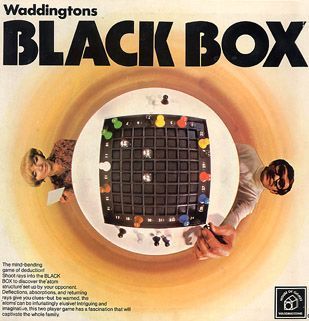
Black Box
Alga, Capiépa Éditeur: Jeux Éducatifs, Clipper · Board game · 1977
1–2 · best 2
Solo
20 min
Weight 2.1/5
Buy
8.5
rating
Ludopedia
6.4
rating
BGG
Our Verdict
HIGHLY RECOMMENDED
If you love to rack your brain and feel like a true logic detective, Black Box is a treat! A timeless classic of pure deduction.
Highlights
- Pure elegant deduction
- Constant intellectual challenge
- High replayability
- Excellent solo mode
- Simple rules, huge depth
Keep in mind
- Can be frustrating for some
- Requires patience and observation
- Indirect interaction
Rules manual not indexed yet
Upload the PDF rulebook to ask questions about this game with AI.
About the game
What you do in a play session
Black Box, also known as 'KO-code', is a classic puzzle and deduction game that elegantly challenges your mind. Here, one player takes on the role of the puzzle master, secretly hiding between four and five 'atoms' (marbles) on an 8x8 grid board. The other player's goal is simple, but far from easy: to discover the exact location of each of these atoms using the fewest possible 'rays'.
How does this atomic hunt work? The player who is deducing 'shoots' rays into the edges of the board. Depending on how these rays interact with the hidden atoms, they can behave in three different ways: be absorbed (if they hit an atom directly), be deflected (if they graze it, changing their trajectory), or be reflected (returning from where they entered, if the interaction is specific). The puzzle master only informs where the ray exited the board, or if it was absorbed or reflected. Based on this crucial information, the player marks their hypotheses and tries to map the atoms' positions.
This game is a true mental workout, where each 'shot' of a ray is a question, and the answer given by the puzzle master is a vital clue. The beauty of Black Box lies in its rule simplicity and the strategic depth that emerges from this interaction. It's a pure intelligence duel, where observation and inferential ability are your greatest weapons. And the best part? After solving the mystery, players switch roles, ensuring both experience both sides of the coin.
Oh, and for those who enjoy playing alone, Black Box also offers a solo mode with a challenge booklet, where you consult a table to see the result of each ray. A historical tidbit: the first German edition was named LOGO, but the LEGO-Company wasn't too thrilled with the similar name, so Parker renamed the second edition to ORDO.
How does this atomic hunt work? The player who is deducing 'shoots' rays into the edges of the board. Depending on how these rays interact with the hidden atoms, they can behave in three different ways: be absorbed (if they hit an atom directly), be deflected (if they graze it, changing their trajectory), or be reflected (returning from where they entered, if the interaction is specific). The puzzle master only informs where the ray exited the board, or if it was absorbed or reflected. Based on this crucial information, the player marks their hypotheses and tries to map the atoms' positions.
This game is a true mental workout, where each 'shot' of a ray is a question, and the answer given by the puzzle master is a vital clue. The beauty of Black Box lies in its rule simplicity and the strategic depth that emerges from this interaction. It's a pure intelligence duel, where observation and inferential ability are your greatest weapons. And the best part? After solving the mystery, players switch roles, ensuring both experience both sides of the coin.
Oh, and for those who enjoy playing alone, Black Box also offers a solo mode with a challenge booklet, where you consult a table to see the result of each ray. A historical tidbit: the first German edition was named LOGO, but the LEGO-Company wasn't too thrilled with the similar name, so Parker renamed the second edition to ORDO.
Gallery
Box and component photos
Tap any photo to open fullscreen. Photos submitted by the community or publisher.
Rules videos
Learn by watching before you open the box
Best player count
BGG community vote
1
OK
2
BEST
Soundtrack
Ambience suggested by Melodice
Loading playlist...
Where to Buy
Prices monitored daily
Finding best prices...
Prices unavailable at this time.
Price history — last 6 months (lowest new offer)
Alert enabled!
Join the BoardGamesBot deals group
Get the best board game deals every day — without message spam.
Join the WhatsApp groupGame details
Mechanics, categories, families and credits
Mechanics
Categories
Families
Publisher
Alga, Capiépa Éditeur: Jeux Éducatifs, Clipper, franjos Spieleverlag, MB Spiele, Parker Brothers, Waddingtons
Designer
Eric Solomon
Artist
Franz-Josef Schulte
Community
Data from BoardGameGeek
1,811owners
119wishlist
13want to play
Frequently Asked Questions
Quick answers before you buy
Is Black Box a complex game to learn?
Not at all! Black Box's rules are super simple and easy to pick up. The challenge lies in mastering the deduction and logic to find the hidden atoms, not in the complexity of the rules.
How many players can participate in a game?
Black Box is ideal for two players, where one hides and the other deduces, and then they switch roles. But it also has a really cool solo mode, with specific challenges for you to enjoy by yourself.
What's the average game duration?
A game of Black Box usually lasts between 20 and 40 minutes. It's a quick game, but one that demands a lot of concentration and reasoning, perfect for a puzzle session without taking too much time.
Are the game components good?
The game is known for its elegant simplicity. It usually comes with a board, marbles (the 'atoms'), and perhaps some markers. It's a game where the mechanics shine more than super elaborate components.
Is this a game that appeals to all types of players?
Black Box is a game for those who love puzzles, logic, and pure deduction. If you prefer games with lots of direct interaction or luck, it might not be your cup of tea. But for fans of the genre, it's an unmissable classic!
Are there any expansions for Black Box?
There are no known official expansions for Black Box. Its replayability comes from the infinite combinations of atom placement, which ensures a new challenge every game.
Other Games You'll Like
Based on mechanics and theme