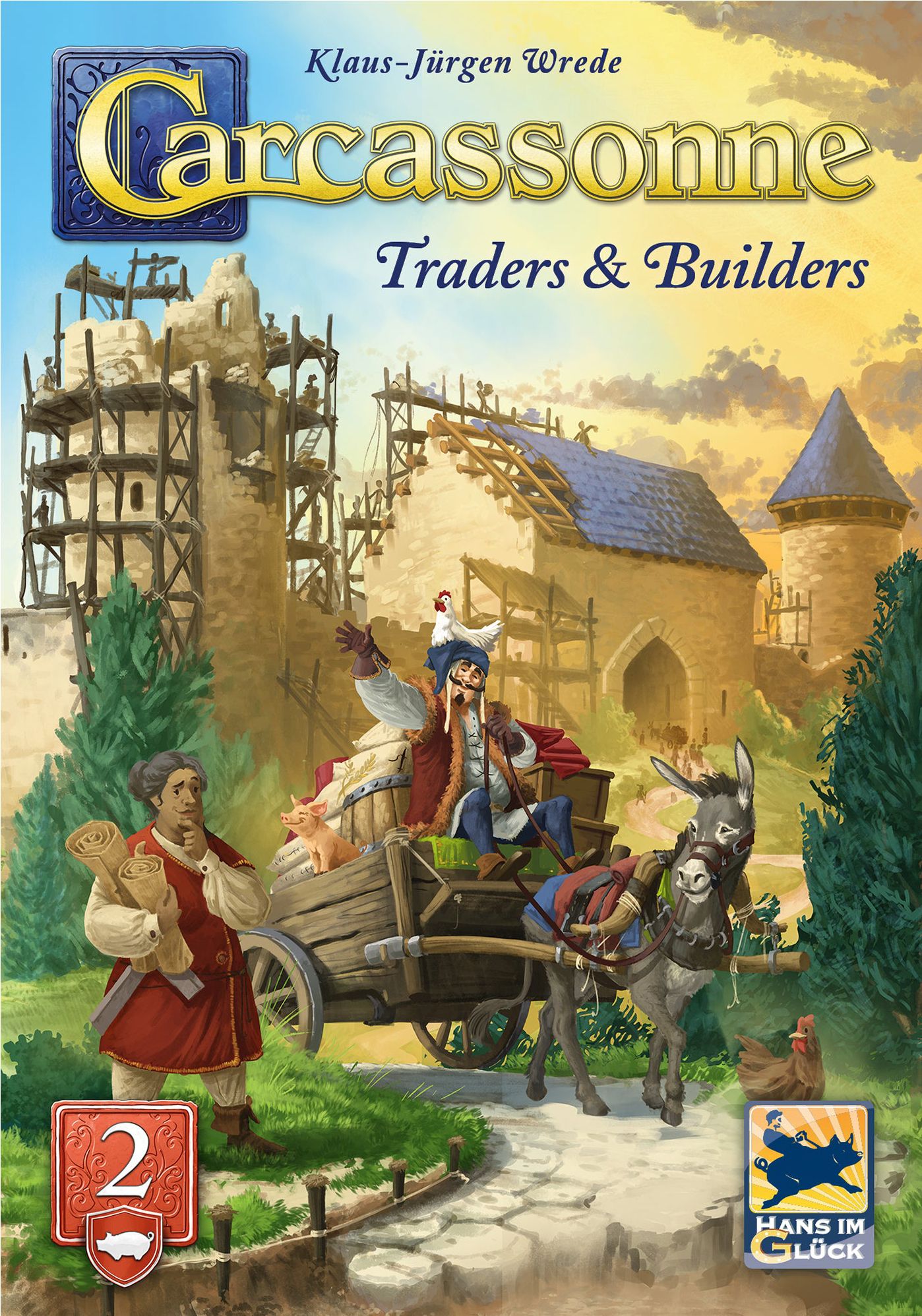
How to Play Carcassonne: Traders & Builders
Hans im Glück, 999 Games, Albi · Board game · 2003What do you want to do now
Ask anything about Carcassonne: Traders & Builders: rules, setup, components, complexity, price, or whether it fits your group.
Video: How to Play
Start here, then follow the written guide
Step by step
Game Objective
The objective of the game, with the Traders & Builders expansion, remains the same as the basic Carcassonne game: players seek to expand the territory around the fortified city of Carcassonne by building cities, roads, monasteries, and fields. The expansion adds new ways to score and interact with these constructions, mainly through collecting commodity tokens and using builders and pigs, which influence the final score and actions during the game.
Preparation (Setup)
To set up the game with the Traders & Builders expansion, follow these steps:
- Mix the 24 new land tiles (indicated with an expansion icon) with the land tiles from the basic game.
- Flip all tiles face down and form several stacks with them, as usual. Alternatively, you can place them in the cloth bag and draw one per turn.
- Place the 20 commodity tokens (9 wine, 6 grain, and 5 cloth) near the playing area, creating a supply.
- Each player receives their followers from the basic game. Additionally, each player will have a builder and a pig in their supply.
Game Flow
The game flow follows the basic phases of Carcassonne, with some additions and modifications to the follower placement and scoring phases. The main phases are:
- Place a tile: The current player draws a land tile and places it adjacent to a tile already in play, following the usual rules for connecting elements.
- Place a follower: After placing the tile, the player can choose to place one of their followers (or a builder or pig) on the newly placed tile, following the specific rules for each type of figure.
- Score points: If the placement of the tile completes a city, road, or monastery, points are scored, and the followers return to the player's supply. Commodity tokens are collected at this time if a city with commodity icons is completed.
Phases "1. Place a tile", "2. Place a follower", and "3. Score points" do not change in their basic structure, but the new land tiles, commodity tokens, builders, and pigs introduce new interactions and rules within these phases.
Actions and How to Play
The New Land Tiles
The new land tiles are mixed with those from the basic game. They may feature commodity icons (wine, grain, cloth) in cities. Some tiles have peculiarities:
- A bridge is not considered a crossroads (village); one road crosses the tile from left to right and another from top to bottom, separating 4 distinct fields.
- A monastery can divide a road into 3 distinct parts and separate the field into 3 parts.
- Some tiles may have three city parts and a field in the center.
- One road can end in a city and another in a crossroads (village), separating 3 distinct fields.
Commodity Tokens
Commodity tokens (wine, grain, cloth) are collected during the "3. Score points" phase when a city is completed:
- If a player completes a city that has one or more commodity icons, the city's points are scored normally.
- The player who completed the city takes the corresponding commodity tokens from the supply. For each commodity icon in the city, the player receives 1 commodity token of the corresponding type.
- It does not matter if the player who completed the city had a knight in it or not; they will always get the commodity tokens.
- The commodity tokens must be placed face up in front of the player.
Builders
The builder is a special figure that starts in the player's supply. It has no effect in the "1. Place a land tile" phase.
- Placing a builder: You can place your builder on the newly placed tile, but only on a road or city. You must have at least one of your followers (thief or knight) in the zone (road or city) where you wish to place the builder.
- Builder's return: The builder returns to your supply if none of your followers remain in the zone where it was. This primarily occurs when the points for that zone are scored.
- Double turn: If you place a tile on a road or city where your builder is already located, you may draw an additional tile and place it. This second tile can be placed anywhere (following the usual rules). During a double turn, you can perform phases "1. Place a tile", "2. Place a follower", and "3. Score points" twice.
- Builder's scoring: The builder does not affect normal scoring rules and is not counted to determine majorities in a zone. It returns to the supply along with the other followers after the zone is scored.
- Builder's permanence: The builder remains on the road or city as long as you have at least one follower on it. If you have no followers, the builder must be returned to your supply.
- Restrictions: You can never place a builder on a field or a monastery.
Pigs
The pig is a special figure that starts in the player's supply. It has no role in the "1. Place a tile" phase.
- Placing a pig: You can only place a pig on a field that already has one of your farmers.
- Pig's permanence: The pig will remain in the field until the end of the game.
- Pig's scoring: The pig gives more points in the final tally. To do this, you must have the majority of farmers in the field containing your pig. The pig does not count towards determining the majority. If you have the majority, instead of the usual 3 points per field, you get 4 points for each completed city bordering your field containing the pig. A rival's pig does not affect your score. In case of a tie in the number of farmers, you also have the majority.
The Bag
The cloth bag can be used to store the mixed land tiles. Instead of forming stacks, players draw tiles from the bag each turn.
End of Game and Scoring
The game ends when all land tiles have been placed. The final score is calculated as follows:
- Commodity token scoring: At the end of the game, the commodity tokens are tallied. If you have the most tokens of a type (wine, grain, or cloth), you receive 10 points for each majority. In case of a tie, all tied players earn 10 points.
- Scoring fields with pigs: For each field where you have a pig and the majority of farmers, you get 4 points for each completed city bordering that field, instead of the usual 3 points.
- Scoring incomplete elements: Refer to the manual for details on this section.
- Scoring complete elements: Refer to the manual for details on this section.
The player with the highest total score is the winner.
Tips for Winning
- Maximize commodity collection: Prioritize completing cities that contain commodity icons, even if you don't have a knight in them. Commodity tokens can yield many points at the end of the game, especially if you achieve a majority in one or more types.
- Use the builder for strategic double turns: Placing a builder on a road or city you intend to expand can allow for a double turn. This means more actions and the possibility of scoring twice in a single turn, accelerating your progress and surprising your opponents.
- Position the pig in lucrative fields: Place your pig in fields that already have one of your farmers and that border several completed cities. Having the majority of farmers in that field with the pig can significantly increase your final score, turning 3 points per city into 4.
More videos
More rules explanations from the community


Rules manual
Official PDF file
Frequently Asked Questions
Quick answers about the rules
What is the objective of Carcassonne: Traders & Builders?
How do you set up Carcassonne: Traders & Builders?
How do you play Carcassonne: Traders & Builders?
How does Carcassonne: Traders & Builders end, and how do you score?
What are some tips for winning Carcassonne: Traders & Builders?
Expansion for
Published additional content