4.0
rating
Ludopedia
7.5
rating
BGG
Our Verdict
RECOMMENDED
An elegant mathematical puzzle that challenges your spatial awareness.
Highlights
- Simple and elegant rules
- Portable and fast-paced
- Satisfying mental challenge
- Versatile play modes
Keep in mind
- Requires constant focus
- Can be tricky for beginners
Rules manual not indexed yet
Upload the PDF rulebook to ask questions about this game with AI.
About the game
What you do in a play session
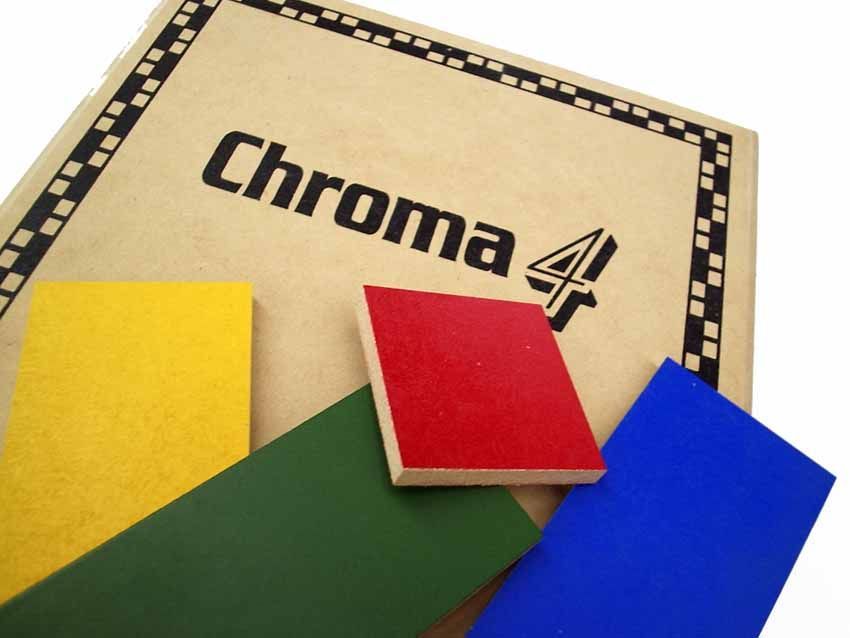
Ever wondered what happens when pure mathematics meets tabletop fun? That is exactly what Chroma 4 brings to your gaming table. Based on the famous four-color theorem from topology, this game transforms an academic concept into a highly engaging visual and mental challenge. At first glance, the goal seems straightforward: players must build a perfect 30x30 cm square using various colored rectangular pieces. But don't let that simplicity fool you! The golden rule is that no two pieces of the same color can touch each other—not horizontally, vertically, or even diagonally. It is essentially a high-stakes game of 'don't touch your color twin.'
The gameplay is fast-paced and snappy. Pieces are distributed among players, and on each turn, you must place a piece while maintaining the color pattern and avoiding blocking your own future moves. This game is incredibly versatile; it can be played as a solo puzzle, a competitive head-to-head match, or even a cooperative challenge where everyone works together to build the largest possible square without making a mistake. If the game reaches a stalemate where no more moves are possible, the winner is the player with the fewest pieces left in hand. It is the kind of game where you start thinking it's just about fitting shapes together, only to find yourself deeply calculating spatial patterns to avoid needing a fifth color (which, mathematically, shouldn't happen, but human error is the real boss here!). Compact, clever, and perfect for those who love games that test spatial awareness and logical reasoning without requiring a 50-page rulebook.
The gameplay is fast-paced and snappy. Pieces are distributed among players, and on each turn, you must place a piece while maintaining the color pattern and avoiding blocking your own future moves. This game is incredibly versatile; it can be played as a solo puzzle, a competitive head-to-head match, or even a cooperative challenge where everyone works together to build the largest possible square without making a mistake. If the game reaches a stalemate where no more moves are possible, the winner is the player with the fewest pieces left in hand. It is the kind of game where you start thinking it's just about fitting shapes together, only to find yourself deeply calculating spatial patterns to avoid needing a fifth color (which, mathematically, shouldn't happen, but human error is the real boss here!). Compact, clever, and perfect for those who love games that test spatial awareness and logical reasoning without requiring a 50-page rulebook.
Gallery
Box and component photos
Tap any photo to open fullscreen. Photos submitted by the community or publisher.
Best player count
BGG community vote
1
OK
2
OK
Soundtrack
Ambience suggested by Melodice
Loading playlist...
Where to Buy
Prices monitored daily
Finding best prices...
Prices unavailable at this time.
Price history — last 6 months (lowest new offer)
As an Amazon Associate I earn from qualifying purchases. Prices and availability subject to change.
Alert enabled!
Join the BoardGamesBot deals group
Get the best board game deals every day — without message spam.
Join the WhatsApp groupGame details
Mechanics, categories, families and credits
Mechanics
Categories
Families
Publisher
Mitra
Community
Data from BoardGameGeek
4owners
Frequently Asked Questions
Quick answers before you buy
How long does a game last?
It's super quick! Usually between 15 to 20 minutes.
Is it hard to learn?
The basic rule is very simple, but the real challenge lies in the placement strategy.
How many players can play?
It works great for 1 or 2 players, but can be played in groups cooperatively or competitively.
Is it kid-friendly?
Yes! It's an excellent logic exercise for kids, though adults will enjoy it just as much.
Do I need a board?
No, the pieces themselves form the game structure on the table.
What is the difficulty level?
Learning is easy (low), but the strategic depth is high (medium/high).
Other Games You'll Like
Based on mechanics and theme