Darkest Night
Victory Point Games · Board game · 2012
1–4 · best 4
Solo
150 min
Weight 2.8/5
Buy · from US$ 110.78
7.3
rating
Ludopedia
7.0
rating
BGG
Our Verdict
HIGHLY RECOMMENDED
If you're into epic cooperative adventures with a touch of horror, Darkest Night will keep you glued to your seat for hours!
Highlights
- Intense cooperation
- Varied hero powers
- Immersive theme
- Escalating challenge
- Excellent solo mode
Keep in mind
- Long playtimes
- Dice luck dependency
- Learning curve
Rules manual not indexed yet
Upload the PDF rulebook to ask questions about this game with AI.
About the game
What you do in a play session
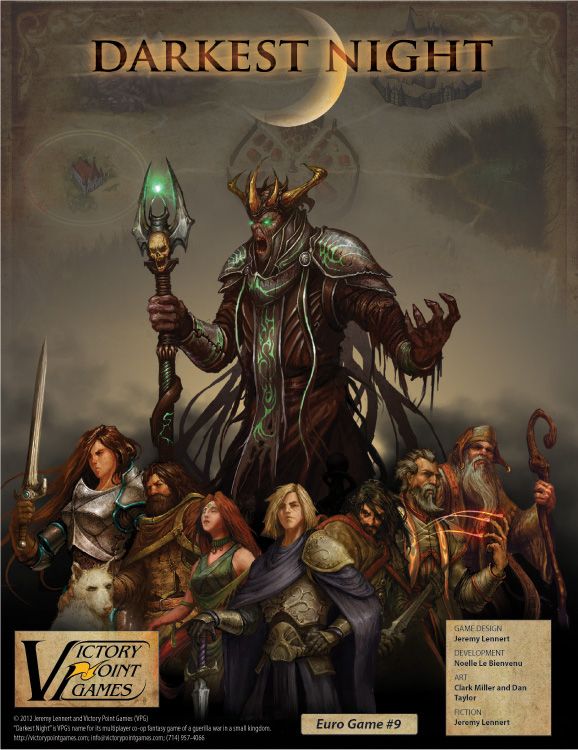
In Darkest Night, the kingdom is in deep trouble, all thanks to a sinister necromancer who has cast his shadow far and wide. This is a cooperative game for 1 to 4 players (with variants for up to 6), where the gang teams up to kick the villain's butt. Each of you takes on the role of one of nine available heroes, each with their own unique abilities, ready to save the homeland. The idea is to explore the kingdom, find new powers and awesome equipment to strengthen the group, as well as collect the keys that unlock the sacred relics, essential to ending the necromancer's party. You'll discover a variety of abilities unique to your hero, which can help you fight the undead, evade the necromancer's forces, speed up your item searches, and much more. The Knight, for example, is a fearless warrior, while the Prince inspires the people, and the Scholar is great at unearthing ancient treasures. But hey, it's not easy! Ravenous undead roam around, and the necromancer keeps growing, blighting the land and steadily increasing his army. As the game progresses, he becomes more and more powerful, spreading blight faster. If an area becomes too corrupted, it gets overrun, and the blight spills over to the monastery. If the monastery falls, it's game over for you, and the kingdom is swallowed in darkness! The mission is clear: before the monastery crumbles, you need to defeat the necromancer in one of two ways. Either gather three holy relics and bring them back to the monastery for a powerful ritual, or go for a direct combat showdown with the necromancer. But beware, he won't hesitate to sacrifice his minions to save himself. So, do you have the courage, cunning, and will to face this darkest night and bring light back to the kingdom?
Gallery
Box and component photos
Tap any photo to open fullscreen. Photos submitted by the community or publisher.
Rules videos
Learn by watching before you open the box


Best player count
BGG community vote
1
BEST
2
REC
3
REC
4
BEST
Soundtrack
Ambience suggested by Melodice
Loading playlist...
Where to Buy
Prices monitored daily
Finding best prices...
Prices unavailable at this time.
Price history — last 6 months (lowest new offer)
Alert enabled!
Join the BoardGamesBot deals group
Get the best board game deals every day — without message spam.
Join the WhatsApp groupGame details
Mechanics, categories, families and credits
Mechanics
Categories
Families
Publisher
Victory Point Games
Designer
Jeremy Lennert
Artist
Clark Miller, Dan Taylor (II)
Community
Data from BoardGameGeek
Frequently Asked Questions
Quick answers before you buy
How many players can play Darkest Night?
Darkest Night is designed for 1 to 4 players, but official variants exist that allow up to 6 people to play, if you're looking for more chaos and heroes!
What is the average playtime for a game?
Prepare for a longer session! A game of Darkest Night typically takes between 150 to 150 minutes, which is about 2.5 to 3 hours. It's an adventure meant to be savored.
What is the complexity level of the game?
It has a BGG weight of 2.8143/5, placing it in the medium to high complexity category. It's not overly difficult, but it does require some dedication to grasp all the nuances of the rules and strategies.
Do I need strong English skills to play?
Yes, the game has moderate language dependency. The cards and hero abilities contain important text. A translated spreadsheet or cards can be very helpful for non-native English speakers.
Is Darkest Night good for solo play?
Absolutely! The solo mode is one of the game's highlights, with a 9/9 rating for solo suitability on BGG. It offers a complete and challenging experience for a single player.
What are the main objectives in the game?
Your primary goal is to defeat the necromancer before he destroys the kingdom. This can be achieved in two ways: by collecting three holy relics and performing a ritual at the monastery, or by confronting and defeating the necromancer in direct combat.
What are the 'standees' mentioned in the components?
Standees are cardboard or plastic pieces with illustrations that represent the heroes, the necromancer, and other game elements on the board. They serve the function of miniatures but in a more economical and lightweight form.
Other Games You'll Like
Based on mechanics and theme