
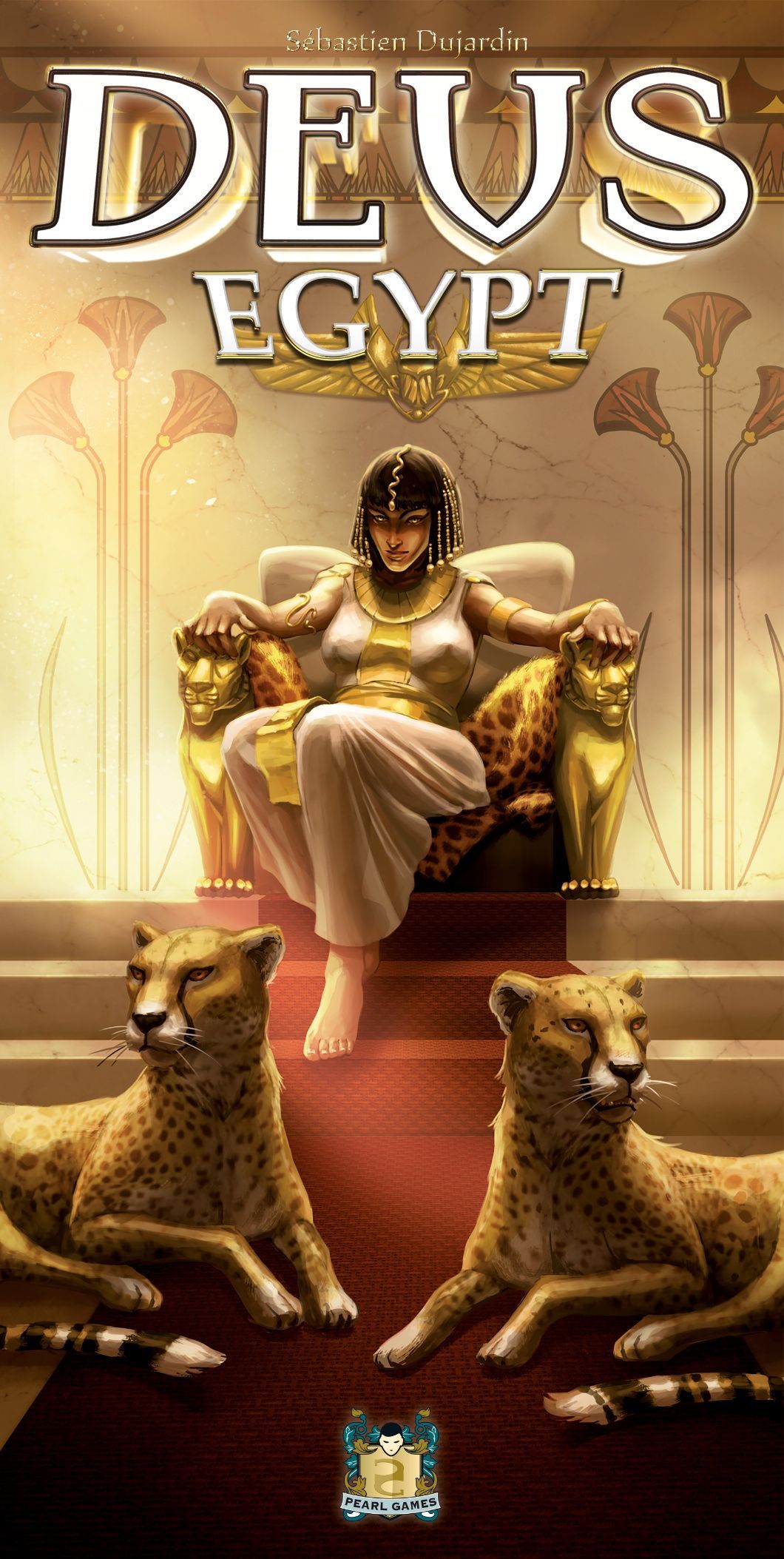
How to Play Deus: Egypt
Pearl Games, asmodee, Maldito Games · Board game · 2016
2–4 · best 3
60–90 min
Weight 3.1/5
7.3
rating
Ludopedia
7.6
rating
BGG
What do you want to do now
Ask questions about the game
Ask anything about Deus: Egypt: rules, setup, components, complexity, price, or whether it fits your group.
Example questions
Continue this chat in the Assistant
Game page
Prices, ratings and our review
Rules manual
Official PDF file
Step by step
Objective of the Game
As the leader of ancient Egypt, your goal is to contribute to the growth of your dynasty and extend its influence throughout new uncharted territories. The specific condition for victory is not detailed in the provided context, but it involves accumulating influence and developing your civilization.
Preparation (Setup)
General Setup
- The Egypt expansion contains 96 Building cards (16 of each color), which replace some or all of the cards from the base game. For each color, you choose whether to use the cards from the base game or the expansion.
- The expansion includes: 16 maritime buildings, 16 production buildings, 16 scientific buildings, 16 civil buildings, 16 military units, and 16 temples.
- It also includes: 1 Market tile, 4 Scribe tokens (1 in each player color), 20 Combat tokens (5 in each player color), and 24 Barque tiles of sizes 1 (×7), 2 (×8), and 3 (×9).
Specific Setup for Card Types
Maritime Buildings
- Replace the 16 Maritime Building cards from the base game with the 16 Maritime Building cards from the expansion.
- Place the Market tile near the gameboard.
- Place a resource of each type on the central space of the Market tile. In a 2- or 3-player game, take these resources from the unused resources that were discarded to the box; in a 4-player game, take these resources from the general supply.
Production Buildings
- Replace the 16 Production Building cards from the base game with the 16 Production Building cards from the expansion.
- Each player starts the game with a size-2 barque and a size-3 barque near their player board.
- Place the rest of the Barque tiles near the gameboard.
Scientific Buildings
- Replace the 16 Scientific Building cards from the base game with the 16 Scientific Building cards from the expansion.
Civil Buildings
- Replace the 16 Civil Building cards from the base game with the 16 Civil Building cards from the expansion.
- Each player takes a Scribe token.
Military Units
- Replace the 16 Military Unit cards from the base game with the 16 Military Unit cards from the expansion.
- Place each player’s 5 Combat tokens in the general supply, near the buildings. Return the other ones to the box.
Temples
- Replace the 16 Temple cards from the base game with the 16 Temple cards of the expansion.
- Variant: Shuffle the 16 Temple cards from the base game with the ones from this expansion. Use 16 random facedown Temple cards, and return the rest to the box.
Fluxo do Jogo
Consulte o manual para detalhes sobre esta seção.
Ações e Como Jogar
General Rules
"1×" Effects
- Certain cards have a "1×" effect listed at their very top. These effects are activated only once per game, no matter what.
- The "1×" effect is only triggered when you place the card.
- You can choose whether to use the "1×" effect before or after activating the primary effect of the card.
- Using the "1×" effect is optional.
Special Construction Conditions
- Certain buildings have a special icon above their construction cost.
- This icon indicates the minimum number of buildings that must be present in the region where the player constructs the building associated with this card.
- It is impossible to construct such a building in an empty region if the icon indicates a minimum of 1 building.
Specific Rules for Card Types
Maritime Buildings
- All Maritime Building cards feature a "1×" effect that modifies the value of resources by moving the tokens placed on the Market tile.
- The initial value of resources is 4 gold/2 VP.
- The value of a resource affects the game in 3 ways:
- When constructing a building, its value in gold (2, 4, or 6) is the cost you must pay if you want to buy any of the required resources.
- For D cards, its value in gold (2, 4, or 6) or its value in VP (1, 2, or 3) determines the cost or benefit.
- For W cards, its value in VP (1, 2, or 3) determines the number of VP the player receives for having the most of that resource.
- Having the most gold is always worth 2 VP at the end of the game.
Production Buildings
- Each space on a barque can accommodate one resource. Resources placed on a barque can be of different types.
- You can rearrange your resources among your different barques at any time, as if they were one gigantic barque.
- At the end of your turn, you must store your resources on your barques, and return any unstored resources to the general supply.
- The only way to acquire additional barques is by constructing a Production building and activating its "1×" effect. When you do, take the barque of the indicated size from the general supply and place it near your player board.
Scientific Buildings
- There are no specific gameplay changes, but the Scientific Building cards all have particularly powerful "1×" effects.
Civil Buildings
- Each time you build a Civil building, you must place your Scribe token under the wooden building you place. This token moves each time you construct a new Civil building.
Military Units
- You claim your Combat tokens by using the "1×" effect of each Military Unit card (put the tokens on your player board).
- You may use Combat tokens whenever a Military Unit card explicitly allows you to do so, but it is never mandatory.
- As long as you do it during different turns, you can reactivate a primary effect that requires a Combat token.
- A region with a Combat token in it is considered occupied by the player whose token is there. That player can thus construct a building in a region adjacent to the Combat token.
- A region with a Combat token in it is also taken into account when determining whether a barbarian village is attacked.
- However, Combat tokens do not count as Military Units.
Temples
- Unlike the Temples from the base game, the new Temples have permanent effects instead of endgame effects. You benefit from these effects from the moment you place them above your player board.
- Temples have no "1×" effect.
- The box in the upper part of the card indicates either the number of VP gained immediately or the number of VP tokens to be placed on the card.
- Any token placed on a Temple card acts as an "activation counter": each time the indicated condition is met, you gain one of the VP tokens from the card, plus three other VP from the general supply.
- Once the card no longer has any VP tokens on it, it can no longer be activated.
- At the end of the game, you gain any VP remaining on your Temple cards; however, you do not get additional VP from the general supply.
Card Effects and Clarifications
- Barge: Choose a resource; decrease its market value by 1 space. Sell up to 2 sets of 2 clay. For each set you sell, gain VP equal to the market value of clay. You can sell 1 or 2 sets (2 or 4 of the resource).
- Great Souk: Swap the market value of 2 resources. Sell up to 4 resources of your choice. Gain gold equal to the market value of each resource you sell. You cannot use the "1×" effect during the transaction. You sell resources either before or after swapping market values, not both.
- Merchant Ship: Swap the market value of 2 resources. Sell precisely 1 resource of each type to gain 6 VP. Requires precisely one resource of each type (1 wheat, 1 wood, 1 clay, and 1 stone).
- Papyrus Barque: Choose a resource; increase its market value by 1 space. Sell up to 6 clay. Gain gold equal to the market value of each clay you sell.
- Souk: Increase or decrease the market value of clay by 1 space. Move 1 of your ships to any sea space of the same ocean. Buy up to 5 resources of your choice. Each resource costs half its market value in gold. It is possible to buy resources without moving the ship. During your move, you can traverse sea regions occupied by other ships, but must end on an unoccupied sea region. You may buy up to 5 resources in any combination.
- Barn: "1×" effect: Gain a size-1 Barque tile. Primary effect: Produce 1 resource in each region you occupy with at least 2 buildings, one of which is a production building. Produced resources are associated with the regions where you have the indicated number of buildings.
- Intensive Production: "1×" effect: If you have a production building in a swamp and one of your barques is completely empty, fill that barque with clay. Primary effect: Gain a size-1 Barque tile. You can reorganize resources in your Barques at any time to have an empty Barque before activating this effect.
- Mill: "1×" effect: Gain a size-3 Barque tile. Primary effect: Choose 1 of your production buildings. Gain Y resources associated with its region, where Y is the rank of this card. Y is the rank of the card, corresponding to its position above the player board.
- Outsourced Production: "1×" effect: Gain a size-1 Barque tile. Primary effect: One of your production buildings produces 1 resource per building present in its region. Those resources are associated with the adjacent regions. The number of resources depends on the number of buildings in the chosen region (including the production building). Resource types depend on adjacent regions, even if occupied by an opponent.
- Seasonal Production: "1×" effect: Gain a size-2 Barque tile. Primary effect: Each of your production buildings produces 1 resource associated with its region.
- Architect Workshop: "1×" effect: Gain wooden buildings so you have 2 of each type. Primary effect: Draw the top 2 cards of the discard pile. You can never have more than 10 cards in your hand.
- House of Life: "1×" effect: Gain 2 gold for each wooden building on your board. Primary effect: Draw any number of cards; each card costs you 1 gold. The "1×" effect counts wooden buildings on your player board, not in the general supply or on the gameboard. You must announce the number of cards to draw, pay, then draw. Hand limit is 10 cards.
- Library: "1×" effect: Activate another card in your tableau. Primary effect: Return all the buildings of one type from your player board to the supply. Gain 1 VP per building returned this way. The "1×" effect allows you to activate any card already played, regardless of rank or color.
- Manufactory: "1×" effect: Gain 1 VP for every two wooden buildings on your board. Primary effect: Gain 1 wooden building of your choice.
- Observatory: "1×" effect: Draw cards until you have 8 in your hand. Primary effect: Place 1 gold from your supply on another card you have played in your tableau. When you later activate that card, discard the gold and activate the card twice. Gold comes from your personal supply. You cannot place gold on a card that already has gold.
- Royal Archives: "1×" effect: Gain 2 VP per card in your tableau. Primary effect: Activate 1 card of the same rank in your tableau. The "1×" effect grants 2 VP for every card of the indicated type above your player board. You can activate one card of the same rank (e.g., if this card is rank 3, activate another rank 3 card).
- Scribe School: "1×" effect: Draw cards until you have 8 in your hand. Primary effect: Buy up to 3 wooden buildings of your choice for 2 gold each.
- Inn: Gain 1 VP per region you occupy that is the same type as the region with your Scribe token. For example, if your Scribe token is on a swamp region, you gain 3 gold/1 VP for each swamp region with one of your buildings in it, including regions with only your Combat token. The region with your Scribe token counts as well.
- Lighthouse: Gain 1 VP per ocean adjacent to at least one land region you occupy. An ocean is composed of one or more adjacent sea regions, which can span multiple Continent tiles.
- Palace: Gain 1 VP per continent tile on which you have built at least 1 building. A continent tile is one of the tiles that form the gameboard, not to be confused with a region.
- Remote House: Gain 1 VP per empty land region (excluding barbarian villages) adjacent to the region with your Scribe token. After being attacked, a barbarian village is no longer considered one; it becomes an empty land region that can earn VP/gold.
- Village House: Gain 1 VP per building in the region with your Scribe token. For example, if your Scribe token is on a region with 3 buildings, you gain 9 gold/3 VP.
- Archers: "1×" effect: Gain 1 Combat token. Primary effect: Spend 2 Combat tokens to place 1 of your armies on an adjacent barbarian village and gain its VP. Lay the army on its side to show it can no longer be used. The barbarian village attacked must be adjacent to the attacking army.
- Barracks: "1×" effect: Gain 1 Combat token. Primary effect: Place a Combat token in an empty region adjacent to 1 of your armies. An opponent must pay you 3 VP and discard the Combat token to construct a building there. If you construct a building in this region later, move the Combat token to an adjacent empty region. If no adjacent empty region, discard the Combat token.
- Camels: "1×" effect: Gain 1 Combat token. Primary effect: Move 1 of your armies freely. You may spend 1 Combat Token to traverse any number of enemy or barbarian land regions. You can move a military unit from any region, respecting rules: unit can traverse/stop in sea region with your ship; cannot enter sea region with enemy ship; never 2 military units in same region at end of move. If moving through occupied land regions/barbarian village, spend a Combat token, but cannot end move there.
- Chariots: "1×" effect: Gain 1 Combat token. Primary effect: Spend 1 Combat token to reorganize your armies. Place them in regions you already occupy or in regions adjacent to regions you already occupy. One Combat token reorganizes all your armies.
- Fortress: "1×" effect: Gain 1 Combat token. Primary effect: Choose an opponent adjacent to 1 of your armies. Place a Combat token in 1 of his building supplies to destroy 1 building located there. When that opponent gains a new building of that type, you also gain 1. You must choose a player occupying a region adjacent to one of your armies. Place a Combat token on one of the five building supplies on that player’s board. Destroy a building in that supply. Players cannot target the same supply more than once. Destroyed building returns to owner’s personal supply. If that player gains several buildings at once, you gain as many.
- Garrison: "1×" effect: Gain 1 Combat token. Primary effect: Choose an opponent adjacent to 1 of your armies. Place a Combat token in 1 of his 6 columns. This opponent must pay you 2 gold for each new card he plays there. Place a Combat token on the last card of any one of the six columns of the player’s board. Players cannot target the same column more than once. You must target a player occupying a region adjacent to one of your armies. Once placed, the Combat token cannot be recovered; opponent
Rules manual
Official PDF file
Prefer the Official PDF?
Download the official Deus: Egypt rulebook or browse it online with our AI rules assistant.
View Rulebook PDF
Frequently Asked Questions
Quick answers about the rules
What is the objective of Deus: Egypt?
As the leader of ancient Egypt, your goal is to contribute to the growth of your dynasty and extend its influence throughout new uncharted territories. The specific condition for victory is not detailed in the provided context, but it involves accumulating influence and developing your civilization.
How do you set up Deus: Egypt?
General Setup The Egypt expansion contains 96 Building cards (16 of each color), which replace some or all of the cards from the base game. For each color, you choose whether to use the cards from the base game or the expansion. The expansion includes: 16 maritime buildings, 16 production buildings, 16 scientific buildings, 16 civil buildings, 16 military units, and 16 temples. It also includes: 1 Market tile, 4 Scribe tokens (1 in each player color), 20 Combat tokens (5 in each player color)…
How do you play Deus: Egypt?
Consulte o manual para detalhes sobre esta seção. General Rules "1×" Effects Certain cards have a "1×" effect listed at their very top. These effects are activated only once per game, no matter what. The "1×" effect is only triggered when you place the card. You can choose whether to use the "1×" effect before or after activating the primary effect of the card. Using the "1×" effect is optional. Special Construction Conditions Certain buildings have a special icon above their construction…
Want to compare prices and check reviews?
Find where to buy at the lowest price, price history, and our full game review.
View Deus: Egypt
Expansion for
Published additional content

