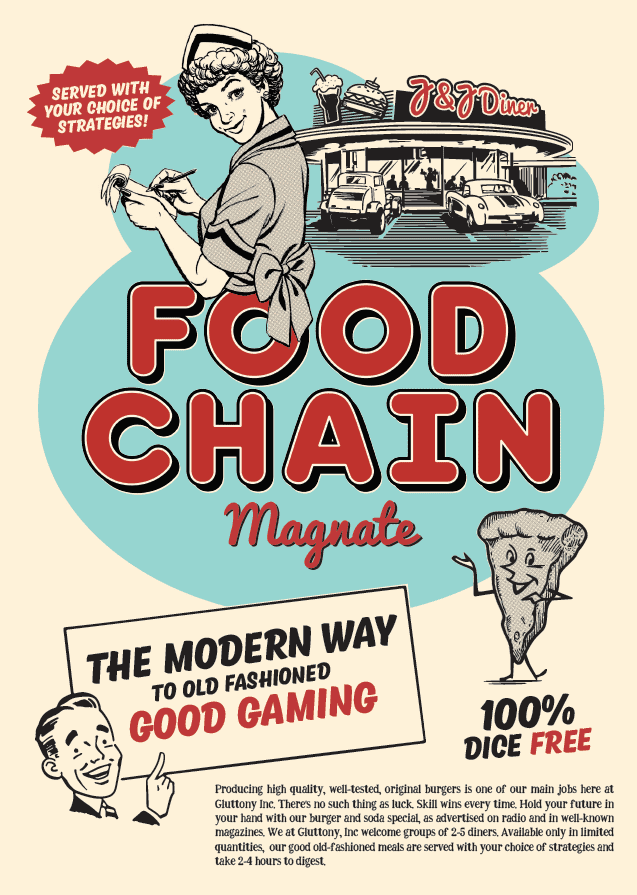
How to Play Food Chain Magnate
Lucky Duck Games, Splotter Spellen, Angry Lion Games · Board game · 2015What do you want to do now
Ask anything about Food Chain Magnate: rules, setup, components, complexity, price, or whether it fits your group.
Video: How to Play
Start here, then follow the written guide
Step by step
1. Objetivo do Jogo
Food Chain Magnate is a heavy strategy game where each player builds a fast‑food chain on a variable city map. You compete by hiring and training staff, running marketing campaigns, and delivering food and drinks to houses. The game ends when the bank runs out of money for the second time. The player with the most cash at that moment wins. If there is a tie, the player earlier in turn order wins.
2. Preparação (Setup)
Follow these steps to set up the game:
- Board and Tiles – Randomly select the number of map tiles shown in the table for the number of players. Rotate each tile randomly and place them in a grid. The grid size is 3x3 for 2 players, 3x4 for 3, 4x4 for 4, and 5x4 for 5.
- Player Menus – Each player chooses one of the five player menus (German or English) and receives a CEO card, three restaurants, and three bank reserve cards.
- Bank – Place $50 × the number of players into the bank pool. Keep the rest of the money in the box.
- Turn Order Track – Shuffle the turn order markers from the chosen restaurant chains and place them on the track in the order drawn.
- Initial Restaurant Placement – Starting with the last player on the track, each player places one of their three restaurants on an empty square that does not contain a road, drink, house, or another restaurant, and whose entrance borders a road. If a player passes, a second round is played in turn order for those who have not yet placed.
- Bank Reserve Cards – Each player chooses one of their three reserve cards, places it face down next to the bank, and discards the other two. These cards determine how much money will be added to the bank when it runs out.
- Employee and Milestone Cards – Lay out the employee cards and milestone cards as shown in the manual. Remove the specified number of cards from each stack according to the table in the manual.
3. Fluxo do Jogo
The game proceeds in a series of phases that repeat each turn. The phases are:
- Phase 1: Restructuring – Players simultaneously choose which of their employees will be at work this turn. These cards are placed face down, then all are revealed together. The revealed cards are placed into a pyramid company structure under the CEO and any managers. Cards that cannot be placed because of insufficient slots go to the beach.
- Phase 2: Order of Business – Players determine their position on the turn order track based on the number of open slots in their company structure (CEO slots plus manager slots). The player with the most open slots chooses first, etc. If tied, the player who was ahead in the previous turn chooses first.
- Phase 3: Working 9:00–5:00 – In turn order, each player performs one action for each card that is at work. Mandatory actions are taken by pricing manager, discount manager, luxury manager, CFO, recruiting manager, HR director, and waitress. Optional actions are taken by all other employees. Actions include recruiting, training, initiating marketing campaigns, producing food, buying food/drinks, placing houses or gardens, and placing or moving restaurants.
- Phase 4: Dinnertime – Houses, in ascending order of their house number, decide where to eat based on available food/drinks, price, distance, and number of waitresses. Income is paid to the chosen chains. If the bank cannot pay all income, the bank breaks (see below).
- Phase 5: Payday – Players may fire any number of employees. Then they pay salaries for all cards that have a salary symbol. Recruitment and HR discounts are applied. If a player cannot pay a busy marketeer, that marketeer must be fired.
- Phase 6: Marketing Campaigns – All active marketing campaigns run in order of their campaign number. Demand tokens are placed on houses according to the campaign type. Campaign tiles are removed when they run out of tokens.
- Phase 7: Clean‑up – Players discard any food or drinks they still own (unless they have the “first to throw away drink/food” milestone). All cards from the company structure and the beach are returned to the hand. Restaurants showing “COMING SOON” are turned over. Milestone cards that were awarded this turn are turned face down and removed from play.
If the bank breaks for the second time, the game ends after Phase 4 and the player with the most cash wins.
4. Ações e Como Jogar
Recruiting
Each CEO automatically performs one free recruitment action. Additional recruitment actions come from recruiting manager (2×), HR director (4×), and recruiting girl (1×). You may hire only cards that have an entry symbol (top left corner). Hired cards go to the beach. If a deck runs out, you cannot hire that type until cards become available again.
Training
For each training action in your structure, you may train one person one step. Only cards on the beach (including newly hired ones) can be trained. Employees that are busy marketeers or currently at work cannot be trained. Training follows the upgrade paths shown on the card. You may not train a card you have just trained further in the same turn, except for coach (two steps), guru (three steps), or if you have the “first to pay $20 in salaries” milestone.
Marketing Campaigns
Each marketeer may place a campaign on the board. The type of campaign depends on the marketeer: marketing trainee → billboard; campaign manager → mailbox or billboard; brand manager → airplane, mailbox, or billboard; brand director → any type. Range is specified on the card; brand managers/directors are not limited by range. Duration is 1–max as printed. After placing a campaign, the marketeer becomes busy and receives a busy chip with the campaign’s duration. Busy marketeers do not occupy a slot in the structure.
Producing Food & Drinks
Kitchen staff and buyers can take food and drinks from the general stock:
- Kitchen trainee – take one burger or pizza.
- Errand boy – take one drink of your choice.
- Burger cook/chef – take the number of burgers printed.
- Pizza cook/chef – take the number of pizzas printed.
- Cart operator – trace a route of range 2 over roads, taking 2 drinks per drink symbol passed.
- Truck driver – same as cart operator but range 3 and 3 drinks per symbol.
- Zeppelin pilot – trace a route of range 4 ignoring roads, taking 2 drinks per symbol.
Milestones such as “first errand boy played” or “first cart operator played” grant extra drinks or increased range.
Placing Houses, Gardens, and Restaurants
With a new business developer, you may place a new house on any empty square connected to a road. A garden must connect over two squares to a house and occupies empty squares. A local manager may place a new restaurant within 3 tiles (by road) from an existing restaurant; the restaurant opens at the end of the turn. A regional manager may place or move a restaurant anywhere with a road entrance; the restaurant opens immediately.
5. Fim de Jogo e Pontuação
The game ends when the bank runs out of money for the second time during Phase 4: Dinnertime. After the second bank break, the game ends at the end of that phase; salaries are not paid for that turn.
Income is calculated as follows:
- For each house that chooses your chain, you receive the unit price of the item sold. The unit price starts at $10 and is modified by active price managers (-$1 each), discount managers (-$3 each), and luxury managers (+$10 each). The “first to lower prices” milestone permanently lowers the unit price by $1.
- If the house has a garden, the income for that item is doubled (2 × unit price). Bonuses from milestones (e.g., “first burger marketed” gives +$5 per burger) are added after the doubling.
- After all houses are processed, each chain receives $3 (or $5 if the “first waitress played” milestone) for each waitress in its structure.
- If a chain has a CFO (or the “first to have $100” milestone), it receives a 50% bonus on all cash earned in that turn, rounded up.
When the bank cannot pay all income, the bank breaks. On the first break, open the reserve cards chosen at the start of the game, add their money to the bank, and set the number of CEO slots for all players to the most common slot number among the reserve cards (highest if tied). On the second break, the game ends immediately after Phase 4.
6. Dicas para Vencer
- Secure early milestones. Milestones such as first to lower prices, first to hire three people in one turn, and first to market a burger/pizza/drink provide lasting benefits that can tip the balance of income or recruitment.
- Use marketing wisely. Place campaigns that reach houses with high demand and consider the distance rule. A well‑placed billboard or airplane can lock in a lucrative market before competitors.
- Balance recruitment and training. Hiring too many low‑level staff can clog your CEO slots, while over‑training can waste valuable training actions. Keep an eye on the number of open slots to maintain flexibility for future hires.
More videos
More rules explanations from the community
In English
-
 Food Chain Magnate Board Game – How to Play (Full Rules) & Setup
-
 How to play Food Chain Magnate
-
 Food Chain Magnate Beginners Guide - Strategies and Tips
-
 How to Play Food Chain Magnate
-
 Food Chain Magnate Setup & Rules
-
 Food Chain Magnate Beginner Strategy Plus Ketchup Updated
-
 Learn to Play Food Chain Magnate
-
 Game Overview: Food Chain Magnate
-
 Food Chain Magnate: How to Play
-
 Food Chain Magnate Beginner Strategy Plus Ketchup
-
 Food Chain Magnate - Teaching Video
Rules manual
Official PDF file
Frequently Asked Questions
Quick answers about the rules
What is the objective of Food Chain Magnate?
How do you set up Food Chain Magnate?
How do you play Food Chain Magnate?
How does Food Chain Magnate end, and how do you score?
What are some tips for winning Food Chain Magnate?
Expansions
Published additional content

Other Games You'll Like
Based on mechanics and theme