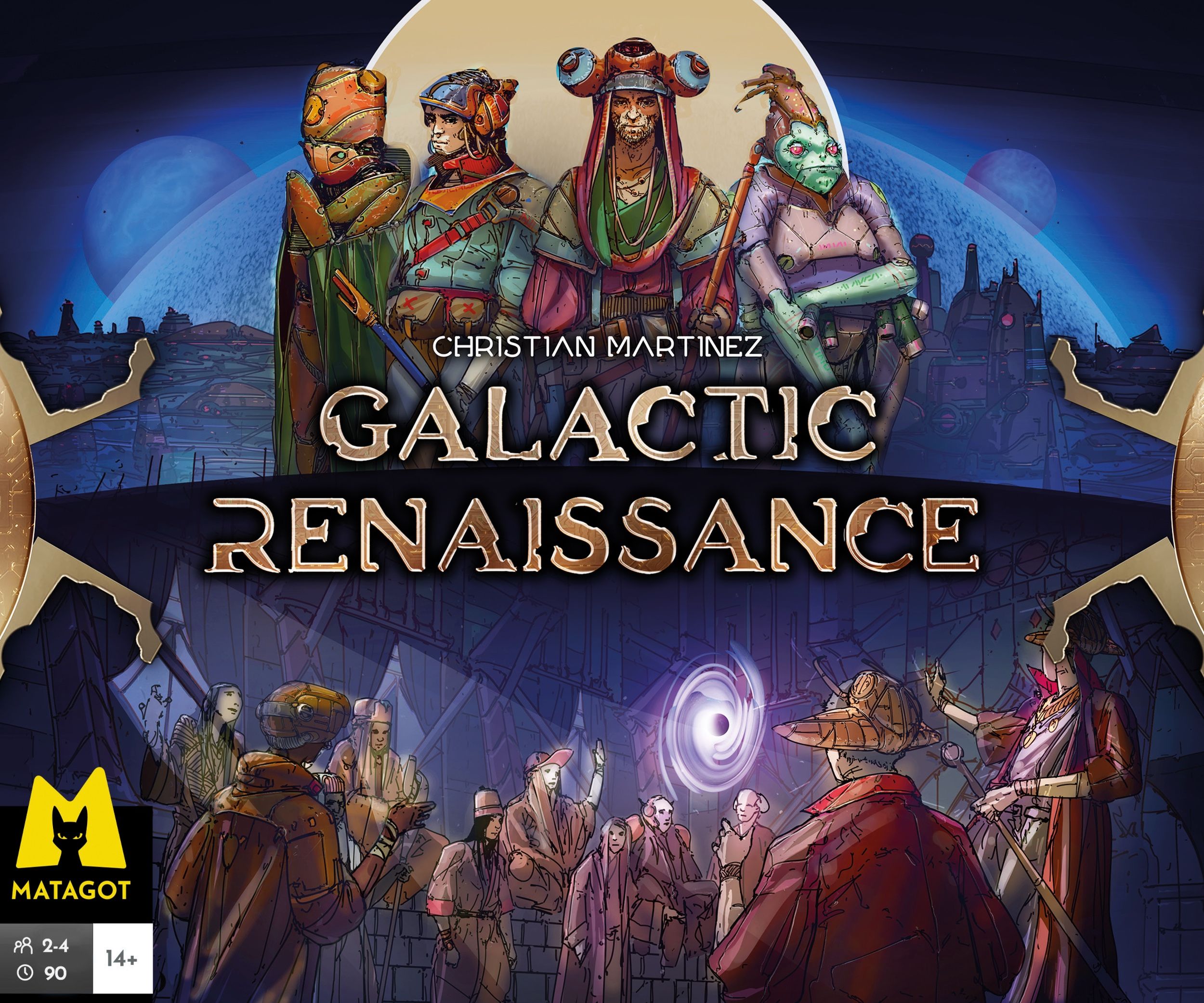
Galactic Renaissance
Matagot, Gen-X Games (GenX), Lavka Games · Board game · 2024
2–4 · best 3
90 min
Weight 2.8/5
Buy · from US$ 45.40
8.1
rating
Ludopedia
7.2
rating
BGG
Our Verdict
RECOMMENDED
If you love interstellar politics and evolving decks, Galactic Renaissance will hook you.
Highlights
- Personal deck building
- Innovative modular board
- Strategic action drafting
- Blend of diplomacy and conquest
Keep in mind
- Can feel slow early on
- Moderate learning curve
- Requires ample table space
Rules manual not indexed yet
Upload the PDF rulebook to ask questions about this game with AI.
About the game
What you do in a play session
Galactic Renaissance continues the success of Inis, completing Christian Martinez and Matagot's "Political Trilogy." Up to four galactic commanders compete to spread their influence across the cosmos. Each player starts with a small core of specialist cards and gradually builds a personal deck, adding unique specialists that grant distinct abilities. These cards let you send emissaries to uncharted planets, uncover lost civilizations, erect embassies, and even sow disorder among rival factions.
The board is modular: hexagonal tiles represent star systems and can be arranged differently each game, ensuring the map never repeats. Area control works via majority/influence – the player with the most presence on a planet earns victory points and resources. Actions are chosen through a draft, so the order you pick cards or tokens can dramatically shift the game’s flow.
Beyond the deck, there is a bag/pool‑building system: completing missions or gaining influence lets you add new cards and tokens to your own pool, making your force increasingly powerful. The ultimate goal is to score more victory points than opponents, whether through discoveries, political sway, or sabotage. With a moderate weight (2.78/5) and a playtime of about 90 minutes, it suits groups that enjoy deep strategy without overwhelming rulebooks. If you love games that blend card management, space diplomacy, and ever‑changing boards, Galactic Renaissance will keep you star‑struck.
The board is modular: hexagonal tiles represent star systems and can be arranged differently each game, ensuring the map never repeats. Area control works via majority/influence – the player with the most presence on a planet earns victory points and resources. Actions are chosen through a draft, so the order you pick cards or tokens can dramatically shift the game’s flow.
Beyond the deck, there is a bag/pool‑building system: completing missions or gaining influence lets you add new cards and tokens to your own pool, making your force increasingly powerful. The ultimate goal is to score more victory points than opponents, whether through discoveries, political sway, or sabotage. With a moderate weight (2.78/5) and a playtime of about 90 minutes, it suits groups that enjoy deep strategy without overwhelming rulebooks. If you love games that blend card management, space diplomacy, and ever‑changing boards, Galactic Renaissance will keep you star‑struck.
Gallery
Box and component photos
Tap any photo to open fullscreen. Photos submitted by the community or publisher.
Rules videos
Learn by watching before you open the box



Best player count
BGG community vote
2
REC
3
BEST
4
REC
Soundtrack
Ambience suggested by Melodice
Loading playlist...
Where to Buy
Prices monitored daily
Finding best prices...
Prices unavailable at this time.
Price history — last 6 months (lowest new offer)
As an Amazon Associate I earn from qualifying purchases. Prices and availability subject to change.
Alert enabled!
Join the BoardGamesBot deals group
Get the best board game deals every day — without message spam.
Join the WhatsApp groupGame details
Mechanics, categories, families and credits
Mechanics
Categories
Families
Publisher
Matagot, Gen-X Games (GenX), Lavka Games, Lord of Boards
Designer
Christian Martinez
Artist
Anthony Questel, Tano Bonfanti
Community
Data from BoardGameGeek
1,552owners
678wishlist
68want to play
Frequently Asked Questions
Quick answers before you buy
How many players can join?
2 to 4 players.
What is the typical playing time?
About 90 minutes.
How complex is the game?
BGG weight 2.78 – moderate strategy, suitable for experienced players who dislike overly heavy rules.
What components are included?
Specialist cards, influence tokens, modular hex board tiles, emissary tokens, victory point markers, and a rulebook.
Who is the game best for?
Fans of political games, deck‑building, and space exploration who enjoy strategic choices and player interaction.
Other Games You'll Like
Based on mechanics and theme