
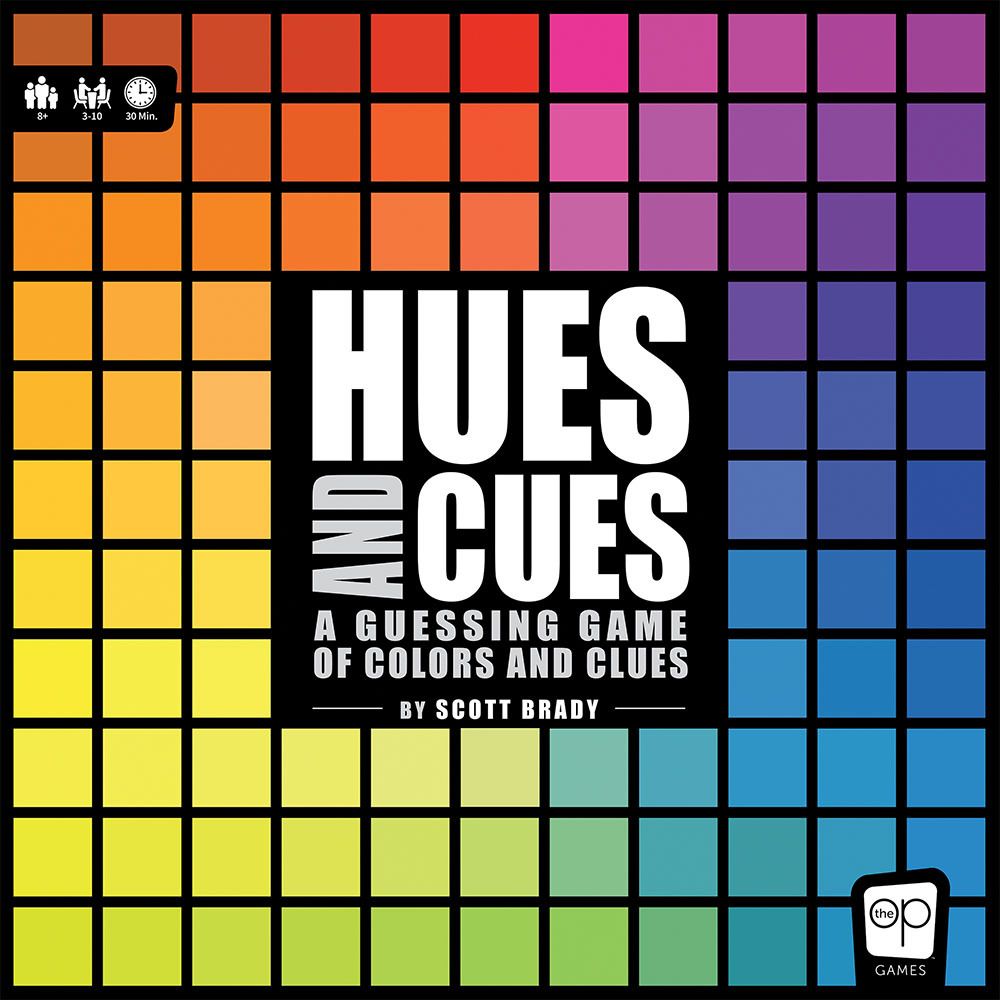
How to Play Hues and Cues
The Op Games, CMON Global Limited, Grok Games · Board game · 2020What do you want to do now
Ask anything about Hues and Cues: rules, setup, components, complexity, price, or whether it fits your group.
Video: How to Play
Start here, then follow the written guide
Step by step
Game Objective
In Hues and Cues, the objective is to accurately describe and guess colors. Players take turns giving one- and two-word clues for others to guess a specific color on the board. Players score points based on the proximity of their guesses to the correct color, and the clue-giver scores points based on the accuracy of their clues. The winner is the player with the highest total score at the end of the game.
Setup
- Place the game board in the center of the playing area.
- Give each player three player markers of the same color. One marker should be placed to the left of the scoring track, and the player keeps the other two.
- Shuffle the Color Cards to form a face-down pile.
- Place the scoring track to the side.
- Assemble the scoring frame by snapping pieces A and B over C and D with sides 1 facing out and sides 2 facing in.
The player wearing the most colorful clothing will be the clue-giver for the first round.
Gameplay Flow
The game progresses in rounds, where one player takes on the role of "clue-giver" and the other players make their guesses. A round consists of the following phases:
- Draw a Card: The clue-giver draws the top card from the deck and looks at it, without other players seeing it. They choose one of the colors on the card to try and describe with clues.
- One-Word Clue: The clue-giver states a single word to describe the chosen color.
- First Guess: Clockwise, all players take turns guessing the color based on the clue provided, placing one of their markers on the square they think matches the clue. Each color can only be guessed once.
- Two-Word Clue: After all players have placed their first marker, the initial player gives a two-word clue. They may, if they prefer, not give the two-word clue or give another one-word suggestion.
- Second Guess: This time, counter-clockwise, players make a second guess, placing their remaining marker on any unoccupied space on the board.
- Scoring: After all guesses, scoring is calculated.
- Starting a New Round: All guessing markers are returned to the players. The next player clockwise becomes the clue-giver and draws a new card from the deck.
Actions and How to Play
Giving Clues
The clue-giver chooses a color from a Color Card and attempts to describe it. Clues can be one or two words and must follow these guidelines:
- Cannot be a common color name (orange, blue, green, yellow, etc.), but can be an abstract color name (brick, sky blue, khaki, etc.).
- Cannot refer to the color's position on the board or to letters and numbers.
- Cannot refer to any object, clothing, or other item in the room.
The clue-giver can strategically choose not to give their second clue after the first round of piece placement if they are satisfied with their score. In this case, scoring happens immediately.
Making Guesses
Guessing players place their markers on the board to indicate the color they believe matches the clue. Each color can only be guessed once. Players make a first guess after the one-word clue and a second guess after the two-word clue.
Variant for Younger Players
For younger players, it is recommended to allow them to select any color from the board to give clues. Before giving the first clue, the player must write down the letter and number of the chosen color's location, keeping it secret. This helps players who may have difficulty creating clues for specific colors on the cards.
End of Game and Scoring
The game ends when each player has given a clue a specific number of times:
- For games with 4 to 6 players, the game continues until each player has given a clue twice.
- If playing with 7 or more players, each person will give a clue once.
After all players have had their turn to give a clue, the person with the highest total score is the winner. In case of a tie, the player who gave the most recent clue wins.
Detailed Scoring
After all players have made their second guess, the initial player reveals the color by placing the scoring frame on the board so that the chosen color on the card is in the center, using the letter and number coordinates from the card for alignment. Points are awarded as follows:
- The clue-giver receives one point for each marker that is within the scoring frame. The maximum the clue-giver can earn is nine points.
- Players who made the guesses receive points based on how close they are to the correct color:
- If a player guesses the exact color, they receive three points.
- Every other marker within the scoring frame, but not on the exact color, receives 2 points.
- Each piece in a space adjacent to the outside of the scoring frame (including diagonally) is worth one point.
A guessing player can earn a maximum of five points (three for a correct answer and two for the other piece being within the frame).
Track points by moving each player's marker the appropriate number of spaces on the scoring track.
Tips for Winning
- Be strategic with the second clue: If you, as the clue-giver, are satisfied with the accuracy of the first guesses (i.e., many markers are already close to the color), you can choose not to give the second clue. This prevents other players from placing their second piece and potentially improving their scores, ensuring that scoring occurs immediately based on existing guesses.
- Consider the color's location: If a color is chosen on the edge of the board, scoring happens in the same way, but with fewer possible areas to score. This can influence the difficulty of giving and receiving clues.
More videos
More rules explanations from the community
In English
-
 How to Play Hues and Cues | Learn to play in 3 1/2 Minutes | Family Friendly Board Game Tutorial
-
 Hues and Cues - In Focus
-
 Board Game Bakes: Hues and Cues Game Board Cake
-
 How to play Hues and Cues - Triple S Games
-
 Hues and Cues - How to Play | The Op Games
-
 How to Play HUES & CUES - Junior Gizmo
-
 How to Play Hues and Cues | Board Game Rules & Instructions
-
 Hues and Cues Overview - Cat and Mouse Games
-
 Hues and Cues Review - AnnexedDinnerTable
-
 How To Play Hues and Cues - Adventure Away
-
 How to Play Hues and Cues
Rules manual
Official PDF file
Frequently Asked Questions
Quick answers about the rules
