How to Play Imperium: Horizons
Osprey Games, Devir, Giant Roc · Board game · 2024What do you want to do now
Ask anything about Imperium: Horizons: rules, setup, components, complexity, price, or whether it fits your group.
Video: How to Play
Start here, then follow the written guide
Step by step
1. Objective of the Game
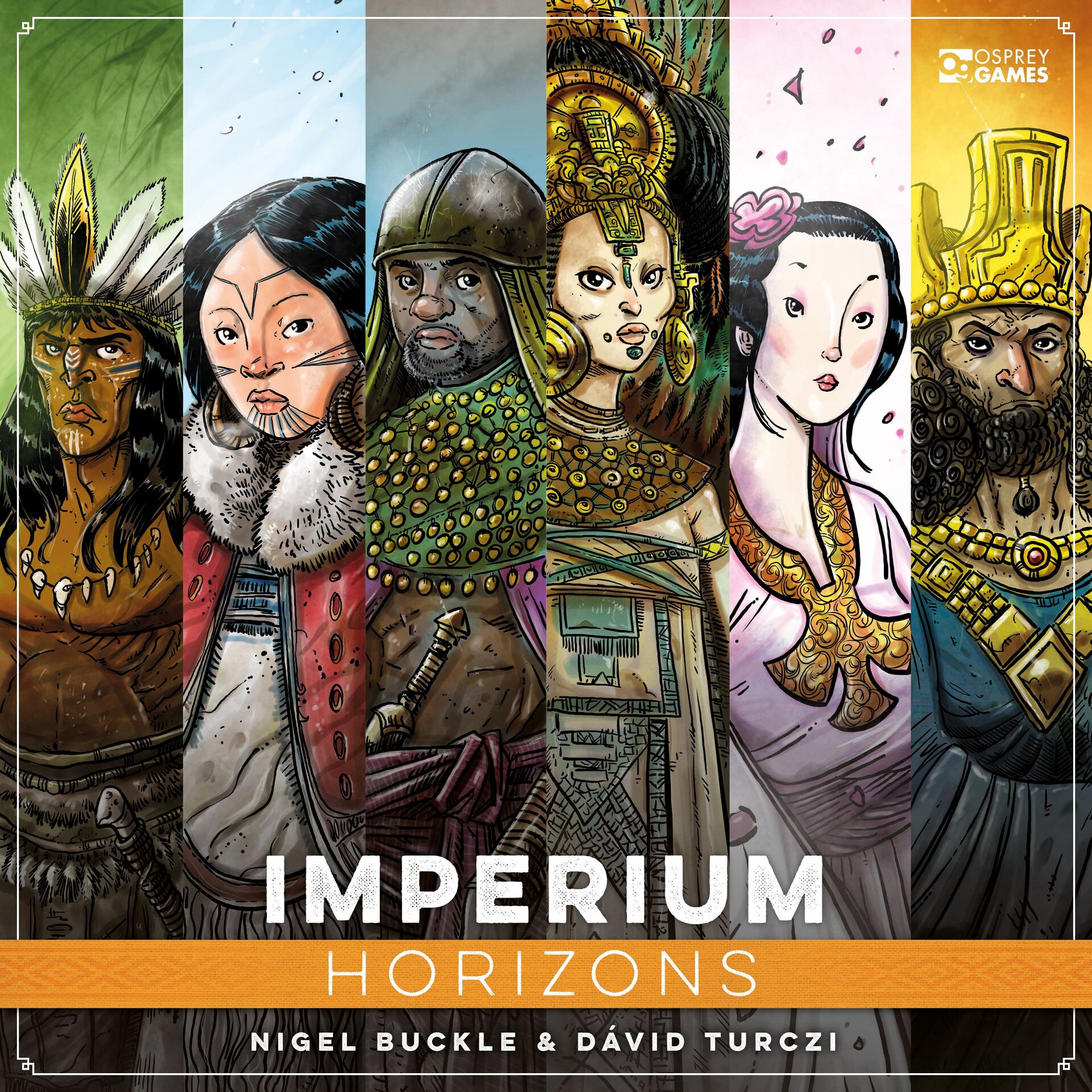
In Imperium: Horizons, you are the ruler of one of the ancient peoples of the world, from 3000 BCE to 1000 CE. Your goal is to become a cultural force by exploring new lands, advancing science and culture, and outmaneuvering rival nations. The game ends when either Scoring or Collapse is triggered (see section 5). At that point, points are tallied from Fame cards, Victory Point icons on cards, and other scoring criteria. The player with the highest total wins; if a player triggers Collapse, that player loses immediately.
2. Preparation (Setup)
- Player Setup (page 10):
- Choose a nation and take all its cards (color‑coded). If you are not playing with Trade Routes, avoid nations with the Trade Routes icon.
- Assemble the Player organiser and place it in front of you.
- Place your single Power card face‑up under the organiser. If you have extra cards (e.g., Arthurians’ King Arthur’s Court), place them below the Power card.
- Place a State card face‑up under the organiser (or the special side for certain nations). If you have a custom State card (e.g., Cultists, Inuit, Polynesians, Taino), use the appropriate side.
- Take 3 Action tokens and 5 Exhaust tokens (or the nation‑specific amount). Place them on your State card. If playing with Trade Routes, give each player an additional token.
- If playing with Trade Routes, take a Merchants card and place it face‑up below the State card.
- Place all your Development cards face‑up above the organiser (or Quest cards for Arthurians). For nations without a Development area, skip this step.
- Place your Accession card face‑up above the organiser (if you have one).
- Shuffle the remaining cards of your nation (excluding the ones already placed) into a face‑down Nation deck and place it perpendicular across the top of the card.
- Take a King of Kings token, 3 Materials, 2 Population, and 1 Progress token. Place them in your Resource pool. If you are a Martian, add the extra 20 or 25 Goods as indicated on your Power card. If playing with Trade Routes, give each player 1 Goods instead of the 1.
- Set aside any cards that will be used in the Commons setup (step 6 of Commons Setup). Return cards that are not needed for the current player count to the box.
- Shuffle the remaining cards (those without a nation corner) into a face‑down Draw deck and place it below the organiser.
- If you are a Cultist, place all Chaos cards below your Draw deck to form the Chaos pile.
- Leave space next to your Draw deck for a face‑up Discard pile and a larger area to the right for your Play area.
- Draw five cards from your Draw deck to form your starting hand.
- Commons Setup (page 13):
- Place the remaining Materials, Population, Progress, Goods, King of Kings, Solstice, Cultist, Exhaustion, Action, and Slot markers tokens on the table.
- Place the Market board in the middle of the table. For a normal game, show the side without icons; with Trade Routes, show the side with the icon.
- Select a set of Commons cards (all cards without a nation color). If playing with Trade Routes, keep only the cards with the Trade Routes icon.
- Sort all Commons cards by banner color (the suit icon). Replace any card that shares a name with a player’s nation with a random card from a different set of Commons cards.
- If playing with three players, remove all 4 Commons cards. If playing with two players, remove all 3 and 4 Commons cards.
- Place all Commons cards face‑up below the icon on the Market board. This is the Unrest pile. Leave space to the right for the Exile pile.
- Place the King of Kings card face‑up above the icon on the Market board.
- Shuffle the remaining Fame cards into a face‑down deck and place it on top of the King of Kings card, perpendicular to it. This is the Fame deck. If playing with Trade Routes, shuffle the Welcoming card into the Fame deck.
- Remove cards from the top of the Fame deck until the deck has the indicated number of face‑down cards for the player count (2 players – 6 cards, 3 players – 7 cards, 4 players – 8 cards). If playing with Trade Routes, increase the final deck size by 1.
- Shuffle the cards and place the appropriate number of cards in a face‑down Small deck above the icon on the Market board. This is the Region deck. Set aside the other cards.
- Shuffle the cards and place the appropriate number of cards in a face‑down Small deck above the icon on the Market board. This is the Uncivilised deck. Set aside the other cards.
- Shuffle the cards and place the appropriate number of cards in a face‑down Small deck above the icon on the Market board. This is the Civilised deck. Set aside the other cards.
- Shuffle the cards and place one card face‑up on the bottom of each of the Small decks (Region, Uncivilised, Civilised). If playing with 3 players, remove one of the remaining cards (without looking at it) from the game; if playing with 2 players, remove two.
- Shuffle all remaining Unrest, Materials, Population, Progress, and all the cards to form the Main deck. Place the Main deck face‑down to the left of the Civilised deck, above the King of Kings on the Market board.
- Draw one card from each of the Region, Uncivilised, and Civilised decks and place each card face‑up below the Market board opposite its respective deck. Draw two cards from the Main deck and place them face‑up side‑by‑side below the Market board opposite the deck. These five cards form the Market.
- Place a card from the Unrest pile underneath each card in the Market that is not a Fame card.
- Add a token on each card in the Market with a white banner.
- Decide which player will go first. Play passes to the left. Place the Solstice token as if it were a player between the last player and the first. The position of the Solstice token acts as a reminder that everyone simultaneously resolves their Solstice effects after the last player’s turn, but before the first player begins a new round.
3. Flow of the Game
The game proceeds over an indeterminate number of rounds. Each round starts with the player to the left of the Solstice token taking the first turn. Turn order proceeds to the left. Play continues until either Scoring or Collapse is triggered, which signals the end of the game (see section 5).
In each turn, you will declare what type of turn you are taking: Activate, Innovate, or Revolt. Once you have finished resolving one of the above turns, you will Clean‑up (see next page). After you have cleaned up, the player to your left takes their turn. If the Solstice token is between you and the player to your left, all players resolve all their Solstice effects before beginning the next round. Solstice is always the last thing to happen each round (see page 16).
Activate Turn – You may take Actions and use Exhaust abilities in any order and in any combination. When you cannot or no longer want to take Actions or use Exhaust abilities, you will move on to Clean‑up.
Innovate Turn – You may Break through for a card, at the expense of not doing anything else. During an Innovate turn you take no Actions and may not use any Exhaust abilities. Instead, you place all cards in your hand into your Discard pile, then Break through for a Region, Uncivilised, or Civilised card.
Revolt Turn – You may permanently remove a number of cards from your deck without spending Resources, at the expense of not doing anything else. During a Revolt turn you may take no Actions and use no Exhaust abilities. Instead, you Return any number of cards from your hand to their proper pile(s) (normally the Unrest pile).
Clean‑up – At the end of your turn, complete the Clean‑up steps in order (see section 4). Once you have completed step 1, the next player can start their turn while you complete the rest of your Clean‑up.
4. Actions and How to Play
To take an Action, first set aside an Action token from your State card. If you have no tokens on your State card, you may not take an Action. The most common type of Action is to play a card from your hand into your Play area and resolve its effects according to the card text. Any other effect that costs an Action will be explicitly noted.
If a card has a State symbol such as Barbarian or Empire, you can only play it from your hand if your State card shows the same symbol. A few cards in the Cultists’ deck show two State symbols; your State card needs to show one of them to be allowed to play such a card.
Cards that have Exhaust, Passive, or Solstice in the first line of text have no immediate effects when played; they are Cards. When a card is played, resolve all effects as much as possible, including resolving any responding triggered effects such as Passive abilities or deck reshuffling (see “Reshuffling Your Draw Deck” on page 16). Afterwards, place the card in your Discard pile unless the card indicates that it should be placed elsewhere. If a card has a Power icon, it remains in your Play area after you play it. However, it is NOT a card, and is not affected by things which specify “cards”.
To use an Exhaust ability, choose a card with the Exhaust keyword that does not have a token on it. Move a token from your State card onto that card. If you have no tokens on your State card, you may not use an Exhaust ability. If a card already has a token on it, you may not use the Exhaust ability shown on that card. Once you have placed your token, fully resolve the effect indicated after the Exhaust keyword. Some Exhaust abilities specify a cost; if you cannot Pay the specified cost, you may not use that Exhaust ability.
During an Innovate turn, you place all cards in your hand into your Discard pile and then Break through for a Region, Uncivilised, or Civilised card. During a Revolt turn, you Return any number of cards from your hand to their proper pile(s) (normally the Unrest pile).
5. End of Game and Scoring
The game ends when either Scoring or Collapse is triggered. Scoring is triggered when the King of Kings card is drawn from the Fame deck; Collapse is triggered when the Chaos pile is empty and a Collapse event occurs (see the Cultist rules).
When the game ends, each player counts points from the following sources:
- Victory Point (VP) icons on cards in play, in the Discard pile, and in History (if the card has a VP icon).
- Fame cards in your Fame area. Each Fame card has a VP value shown on the card.
- Any other scoring criteria specified on cards (for example, “1 VP per 3 Guptas” or “1 VP per 7 cards”).
After all points are tallied, the player with the highest total wins. If a player triggers Collapse, that player loses immediately, regardless of their score.
6. Tips for Winning
- Manage your Action and Exhaust tokens wisely. Each turn you can only take a limited number of Actions and Exhaust abilities. Plan your turn to use the most valuable actions first, and keep tokens available for critical Exhaust abilities that can turn the tide.
- Use the Solstice token strategically. Solstice effects are resolved simultaneously after the last player’s turn. Timing your Activate turns so that you can benefit from Solstice effects before your opponents can react can give you a decisive advantage.
- Pay attention to the Unrest pile. Unrest cards clog your deck and can trigger Collapse if the Chaos pile is empty. Returning Unrest cards to the pile during a Revolt turn can help you avoid Collapse and keep your deck clean.
More videos
More rules explanations from the community


Rules manual
Official PDF file
Frequently Asked Questions
Quick answers about the rules
What is the objective of Imperium: Horizons?
How do you set up Imperium: Horizons?
How do you play Imperium: Horizons?
How does Imperium: Horizons end, and how do you score?
What are some tips for winning Imperium: Horizons?
Other Games You'll Like
Based on mechanics and theme