
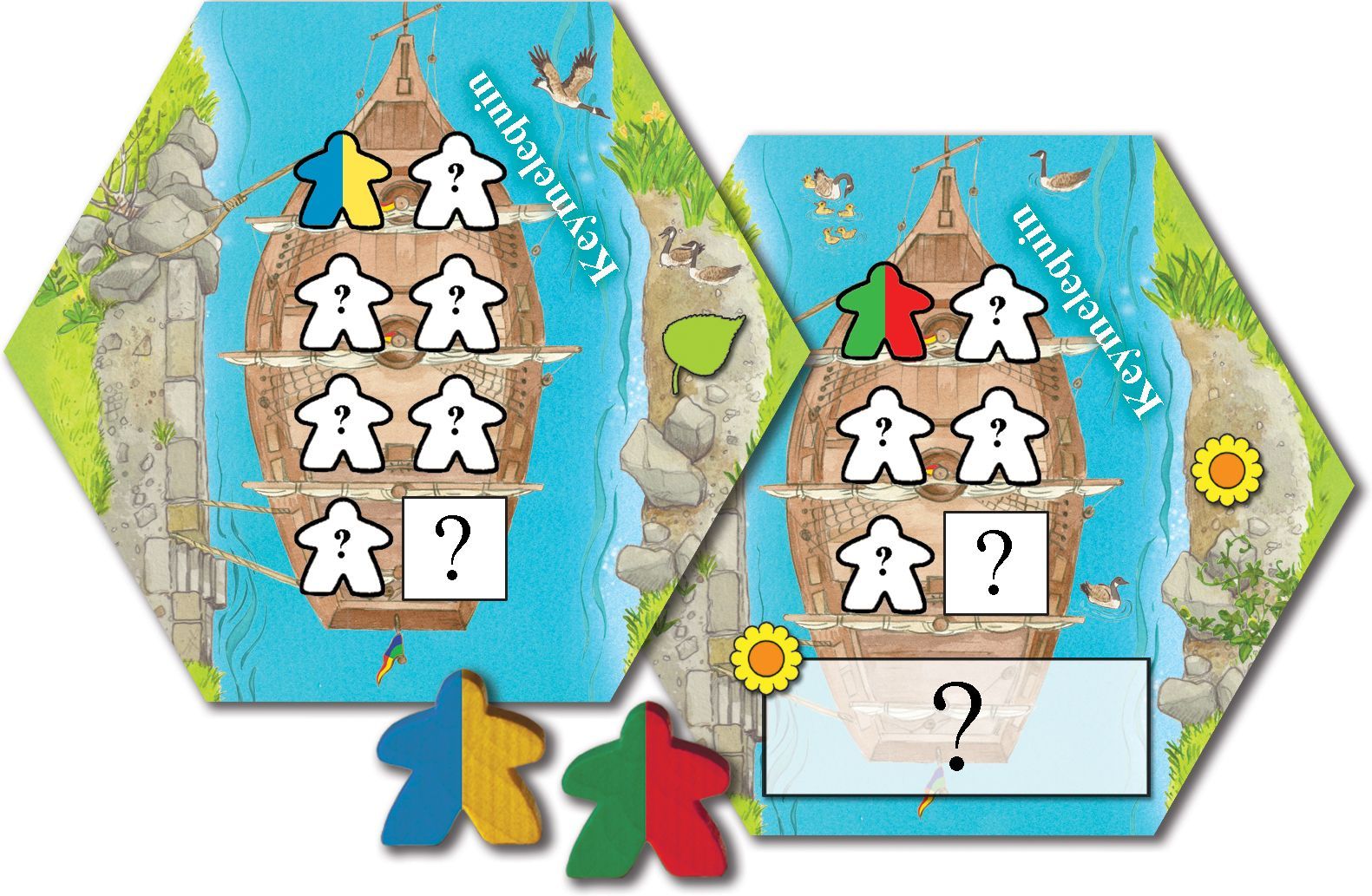
How to Play Keyflower: Keymelequin
R&D Games, Game Salute, Hutter Trade GmbH + Co KG · Board game · 2016What do you want to do now
Ask anything about Keyflower: Keymelequin: rules, setup, components, complexity, price, or whether it fits your group.
Step by step
Objective of the Game
The Keymelequin mini-expansion introduces two new characters, Paulo and Sven, to the world of Keyflower. These special keyples facilitate teamwork and cooperation between their respective factions, leading to powerful and interesting results. The goal is to integrate these new abilities into your strategy to gain an advantage in bidding, production, and scoring, ultimately aiming for the most victory points at the end of the game.
Preparation (Setup)
- Replace a boat tile of your choice with the Keymelequin boat tile.
- This Keymelequin boat tile should be loaded as usual according to the icons on it.
- In the spring season, Sven will be on board the Keymelequin boat tile.
- In the summer season, the Keymelequin boat tile will be flipped, and Paulo will be on board.
Flow of the Game
The Keymelequin mini-expansion integrates into the existing Keyflower game flow. The new characters, Paulo and Sven, arrive with the Keymelequin boat tile at specific times:
- Sven disembarks from the Keymelequin at the end of spring.
- Paulo arrives on the Keymelequin at the end of summer.
- At the end of summer, the player who wins the Keymelequin boat must choose a different boat tile, which is not already in the game, to replace the Keymelequin boat for the autumn season. This allows the player to influence the number of keyples brought into the game in autumn and the boat scoring possibilities in winter.
Actions and How to Play
Using Sven and Paulo
Sven can be used in the same way as an ordinary keyple. Sven counts as either a single blue or a single yellow keyple. However, yellow keyples who are with Sven can be treated as being blue and blue keyples as being yellow. Keyples count as being with Sven if:
- They are part of the same bid as Sven.
- They have been placed (by any player) onto the same tile as Sven.
- They have been allocated to the same tile or contract as Sven for scoring purposes at the end of the game.
Where only Sven (and the keyples with Sven) set the keyple color associated with a tile, the tile can be either a blue tile or a yellow tile. Subsequent keyple placements by a player may determine which of these two colors it becomes.
Paulo acts in the same way except Paulo’s colors are green and red.
Bidding Example
- Player A has bid for a tile using one blue keyple.
- Player B has counterbid with two blue keyples.
- Player A can add Sven and a yellow keyple to his bid.
- Player C cannot overbid with his four yellow keyples, because the color identity of the tile is currently set as blue by Player B.
- Player B moves his two blue keyples to a different tile. The color identity of the tile is now either yellow or blue.
- Player C bids four yellow keyples.
Production Example
- Player A has used a tile with a red keyple.
- Player B uses the same tile with Paulo and a green keyple. (This is allowed even if the tile has a red extension.)
- Player A now uses the tile with two red keyples and a green keyple.
End of Game and Scoring
Consulte o manual para detalhes sobre esta seção.
Scoring Examples
- Craftsman’s guild: 9 points.
- Key market: 10 points.
- Village hall: 5 points.
- Village hall: 7 points.
- Emporium (promotional tile): 6 points.
- Contract (Keyflower the Merchants): 7 points.
- Contract (Keyflower the Merchants): 7 points.
Tips for Winning
- Utilize Sven and Paulo's color-shifting abilities to make flexible bids and production actions. Their presence can allow you to use keyples of a different color than what is currently set for a tile, or even change the tile's color identity.
- Pay attention to the Keymelequin boat tile at the end of summer. Winning this boat allows you to choose a replacement boat tile for autumn, influencing the number of keyples entering the game and potential winter scoring. This can be a powerful strategic move.
Rules manual
Official PDF file
Frequently Asked Questions
Quick answers about the rules
