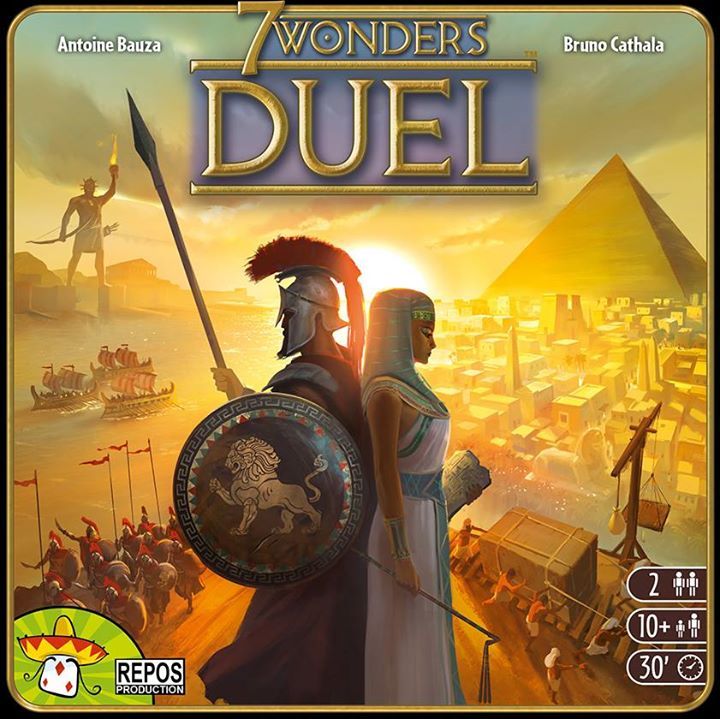
How to Play Leaders (fan expansion for 7 Wonders Duel)
(Web published) · Board game · 2019What do you want to do now
Ask anything about Leaders (fan expansion for 7 Wonders Duel): rules, setup, components, complexity, price, or whether it fits your group.
Video: How to Play
Start here, then follow the written guide
Step by step
Objective of the Game
7 Wonders Duel: Leaders is a fan expansion that brings the mechanics and personalities from 7 Wonders: Leaders into the world of 7 Wonders Duel. Players aim to enhance their gameplay and specialize their strategies by recruiting powerful Leader cards. The expansion also introduces two new Wonders, Rome and Abu Simbel, which offer unique ways to interact with Leaders. The ultimate goal remains to achieve victory through military supremacy, scientific supremacy, or by having the most victory points at the end of the game, leveraging your chosen Leaders to gain an edge.
Preparation (Setup)
- Each player takes 3 additional coins from the bank, for a total of 10 coins.
- Leader Phase: Before the Wonder Selection Phase, perform the following steps:
- Choose a first player (this step is skipped in the Wonder Selection Phase).
- Shuffle the leader cards.
- Place 4 random leaders, face up, between the two players.
- The second player chooses 1 leader.
- The first player chooses 2 leaders.
- The second player takes the remaining leader.
- Place 4 more leaders and repeat the selection process. This time, start with the first player.
- Once this step is complete, each player will have 4 leaders. The chosen leaders should be kept face up and available for both players to examine. The only moment when leaders are not available for inspection is when players are deciding which leader to use for that age.
- Wonder Selection Phase Changes:
- Skip the "Choose a first player" step, as you already chose a first player in the Leader Phase.
- During the "Shuffle the 12 Wonders tiles" step, shuffle the new Wonders Rome and Abu Simbel with the others.
Flow of the Game
The game progresses through ages, with a new Recruitment Phase added before preparing the structure for each age.
Recruitment Phase
For each age, before preparing the structure for that age, each player will have the opportunity to build a leader during the Recruitment Phase.
- Each player takes the leaders that they have not recruited yet into their hand.
- Each player chooses one face down.
- Players turn their selected leader face up simultaneously.
- Each player simultaneously declares if they are recruiting their leader, or discarding it for money.
- For each leader that a player discards for money, they return the leader card to the box and gain 2 coins (This amount is not increased by yellow cards in a player’s city).
- For each leader that a player recruits, they pay the leader’s cost in coins to the bank, place it in their play area and resolve its ability, if applicable.
- Each player returns their unplayed leaders to the board, face up, until the next Recruitment Phase of the next age.
Players will receive money for their discarded leaders prior to the resolution of their opponent’s leaders. It is recommended that players place a chit or marker on leaders that they have recruited to eliminate any possible confusion. If it matters which player’s leader resolves first, the player who is playing first or who has the choice for who plays first in the coming age resolves their leader first. If a military or scientific victory is achieved at this point, the game ends.
Once this phase is finished, the Age is played normally by the normal 7 Wonders Duel rules.
Actions and How to Play
The core actions of 7 Wonders Duel remain, but the Recruitment Phase adds new strategic choices. Players can either recruit a Leader by paying its cost or discard a Leader for 2 coins. Each Leader has a unique ability that can significantly impact gameplay.
Leader Abilities (Examples)
- Alexander: Gives bonus victory points at the end of the game based on military conquests removed from the opponent's side of the military track (2 VP for one token, 5 VP for two).
- Amytis: Worth 2 victory points for each wonder you have built.
- Archimedes: Provides listed linking symbols, allowing a card with these symbols in its cost to be built for free.
- Aristotle: Worth three victory points for each progress token you have.
- Aspasia: Cancels the movement of the conflict pawn the next time it would be moved. You cannot decline to cancel the movement.
- Berenice: Counts as a yellow card in your city when determining how many coins you receive when you discard a card.
- Bilkis: Each time you build a card, you may buy one resource from the bank for 2 coins. This cost is not increased by opposing brown or grey cards.
- Caesar: Provides two shields, similar to constructing a Military card. If Caesar forces the conflict pawn to enter a zone for the first time, your opponent will lose coins accordingly.
- Caligula: Whenever your opponent loses coins due to your military conquests, they lose twice as many coins.
- Cleopatra: Worth 5 victory points.
- Croesus: After building a structure, take the three cards of the current Age returned to the box during setup. Choose and construct one for free, returning the other two to the box.
- Darius: Your opponent loses two coins. Darius does not cost any coins to recruit.
- Diocletian: Your opponent loses four coins.
- Da Vinci: Provides listed linking symbols, allowing a card with these symbols in its cost to be built for free.
- Euclid: Once per game, when you get a card that would give you a pair of science symbols, you may put one of them under Euclid. The card provides all its normal benefits, but instead of any other science symbol, it provides a Law symbol.
- Hammurabi: Provides listed linking symbols, allowing a card with these symbols in its cost to be built for free.
- Hannibal: Provides one shield, similar to constructing a Military card.
- Hatshepsut: Whenever your opponent buys resources from the bank, you get 1 coin for each resource they buy.
- Hiram: Worth 2 victory points for each guild card you have in your city.
- Hypatia: Worth 1 victory point for each green card you have in your city.
- Imhotep: You may build your 4th Wonder, even if your opponent has built their 4 Wonders.
- Justinian: Worth three victory points for each set of a blue, green, and red card you have in your city.
- Leonidas: Provides listed linking symbols, allowing a card with these symbols in its cost to be built for free.
- Maecenas: Look at two random leader cards not used this game. You may recruit one of them without paying their cost.
- Midas: Worth 1 victory point for every three coins you have.
- Nebuchadnezzar: Worth 1 victory point for each blue card you have in your city.
- Nefertiti: Worth 4 victory points.
- Nero: Whenever your opponent loses coins due to your military conquests, you receive the coins instead of the bank.
- Pericles: Worth 1 victory point for each red card you have in your city.
- Phidias: Worth 1 victory point for each brown card you have in your city.
- Plato: Worth 7 victory points for each set of brown, gray, blue, yellow, green, red, and purple cards you have built.
- Praxiteles: Worth 2 victory points for each grey card you have in your city.
- Ptolemy: Once per game, in the 2nd or 3rd age, when building a green card you may choose to have that card’s science symbol become a copy of the symbol on a green card you have already built instead of its printed symbol.
- Pythagoras: Once per game, on your turn you may place the card you choose under Pythagoras instead of using it for any other purpose. You gain no benefit from this card, but you may play a second turn.
- Ramses: After the structure for Age 3 is created, you may look at two random guild cards that were not used as part of the structure. You may build one for free.
- Sappho: Worth 2 victory points.
- Semiramis: Each time your opponent completes a military conquest, you receive a shield.
- Solomon: When you recruit Solomon you may choose a card in the discard pile and add it to your city for free.
- Tomyris: Any time you would lose coins from your opponent’s military conquests, they lose that many coins also.
- Varro: Worth 1 victory point for each yellow card in your city.
- Vitruvius: Worth two victory points for every pair of cards you have in your city that share linking symbols.
- Xenophon: Provides listed linking symbols, allowing a card with these symbols in its cost to be built for free.
- Zenobia: Worth 3 victory points.
New Wonders
- Abu Simbel: Bury a leader you have already recruited by placing them under this wonder. Buried leaders have no abilities, but they are worth victory points equal to twice their cost. Immediately play a second turn.
- Rome: Draw two leader cards randomly from those not used in this game and add them to your available leader cards. You may immediately recruit a leader card from your available leader cards for free. This Wonder is worth 2 victory points.
When playing with 7 Wonders Duel: Leaders, do not return your 4th wonder to the box if your opponent has built their 4th wonder. Instead, keep it in front of you, but turn it face down. You are unable to build that wonder if your opponent has built all 4 of their wonders.
End of Game and Pontuation
The game ends immediately if one of the following conditions is met:
- Military Supremacy: If the conflict pawn reaches the last space on the opponent's side of the military track.
- Scientific Supremacy: If a player collects 6 different science symbols.
If neither of these conditions is met by the end of Age 3, the game ends, and players calculate their victory points. The player with the most victory points wins. In case of a tie, the player with the most coins wins.
Victory Point scoring includes points from:
- Leader cards (e.g., Alexander, Amytis, Aristotle, Cleopatra, Hiram, Hypatia, Justinian, Midas, Nebuchadnezzar, Nefertiti, Pericles, Phidias, Plato, Praxiteles, Sappho, Varro, Vitruvius, Zenobia).
- Wonders (e.g., Rome is worth 2 victory points, Abu Simbel provides points for buried leaders).
- Other scoring criteria from the base 7 Wonders Duel game (e.g., blue cards, guild cards, progress tokens, coins).
Dicas para Vencer
- Carefully consider your Leader draft at the beginning of the game. Your chosen Leaders will shape your strategy for all three ages, so pick ones that complement your preferred playstyle or offer flexibility.
- Pay close attention to your opponent's Leaders. Since they are face up, you can anticipate their potential moves and plan your own Recruitment Phase decisions accordingly, especially when deciding to recruit a Leader or discard for coins.
Rules manual
Official PDF file
Frequently Asked Questions
Quick answers about the rules
What is the objective of Leaders (fan expansion for 7 Wonders Duel)?
How do you set up Leaders (fan expansion for 7 Wonders Duel)?
How do you play Leaders (fan expansion for 7 Wonders Duel)?
How does Leaders (fan expansion for 7 Wonders Duel) end, and how do you score?
What are some tips for winning Leaders (fan expansion for 7 Wonders Duel)?
Expansion for
Published additional content