

How to Play Mindbug: First Contact
Nerdlab Games, Devir, GaGa Games · Board game · 2022What do you want to do now
Ask anything about Mindbug: First Contact: rules, setup, components, complexity, price, or whether it fits your group.
Video: How to Play
Start here, then follow the written guide
Step by step
Game Objective
In Mindbug: First Contact, you take command of hybrid creatures to battle against your opponent's creatures. The main objective is to outsmart your opponent in a tactical duel, where the right moment to play your cards is crucial. A player wins the game the moment their opponent's life points are reduced to zero.
Preparation (Setup)
Let's prepare the battlefield for your creatures:
- Distribute Mindbugs: Each player receives 2 Mindbug cards and places them face up in front of them.
- Shuffle and deal decks: The 48 creature cards are shuffled. Then, each player receives 10 face-down cards, which will form their personal decks. Leave a space next to each deck for the discard pile.
- Fill starting hand: Each player draws 5 cards from their personal deck. These will be each player's starting hand.
- Set initial life points: Each player starts the game with 3 life points. To count them, each player receives a life point counter and positions it on the number 3.
Game Flow
The game proceeds in alternating turns between players. To determine the starting player, each player reveals a random card from the unused deck (the remaining 28 creature cards). The player with the highest power value on the card is the starting player. In case of a tie, the process is repeated until there is a tiebreaker.
During your turn, you must perform one of the following actions. If you cannot perform any, you lose the game:
- Play any card
- Attack with a creature
Whenever you discard a card from your hand (either by playing or discarding), you must immediately draw cards from your deck until you have 5 cards in hand. This happens before any other effects (such as the opponent using a Mindbug or the card's own effect activating). If your personal deck runs out of cards, you cannot draw more. There is no limit to the number of cards you can have in your hand.
Actions and How to Play
Here are the actions you can perform on your turn:
Play a card
Choose a card from your hand and place it face up on the table. Your opponent has two options:
- Option 1: The opponent refuses to use a Mindbug
If your opponent has no more Mindbugs or does not want to use one, the played creature card is placed in your play area and its play effects (if any) are resolved. Your turn ends and it becomes your opponent's turn.
- Option 2: The opponent decides to use a Mindbug
If your opponent decides to use a Mindbug, they take your creature card and play it instead of you, losing a Mindbug. The player flips the Mindbug face down to indicate it has been used and places the creature card in their own play area. The opponent resolves any play effects of the creature as if they had played it from their hand. Your turn ends and you immediately get another turn (in which you can play another card or attack with a creature).
Note: If a card enters play in a way other than being played from your hand (for example, by using a card's effect), there is no option to use a Mindbug to take control of it. You cannot spend a Mindbug to take control of a card already in play, nor use a Mindbug on a creature where your opponent has already used one.
Attack with a creature
Choose a single creature from your play area (an allied creature) to attack. Your opponent can then choose a creature from their play area (an enemy creature) to block the attack. If they choose not to block the attack, they lose one life point. If they decide to block the attack, the two creatures clash. To do this, compare their power. The creature with the lower power number is defeated and sent to that player's discard pile. If the creatures have the same power, both are defeated.
Creature Cards
Each creature card has a Name, a Power value, and may have one or more Keywords and an Ability.
Effect Resolution
When resolving an effect, always resolve as much of the effect as you can and ignore any part that cannot be resolved. If more than one effect occurs at the same time, the active player decides the order of effect resolution.
Keywords
Keywords are shortcuts for specific rules:
- Hunt: When attacking with a creature with Hunt, you can choose, instead of your opponent, which enemy creature will block. Using Hunt is optional, but if you do, you cannot use it to attack the opponent directly.
- Stealth: This creature can only be blocked by creatures with Stealth. A creature with Stealth can block enemy creatures normally.
- Frenzy: After a creature with Frenzy makes a first attack during your turn, it can, if still in play, attack a second time that turn.
- Resistance: If a creature with Resistance is defeated and is not exhausted, exhaust it instead of defeating it. Exhausting means rotating the card 90º. Being exhausted does not affect what a creature can do.
- Poison: In addition to normal combat resolution, this creature always defeats the enemy creature, even if its power is lower. If the enemy creature's power is equal to or greater, the creature with Poison is also defeated.
Abilities
Most creatures have a special ability activated at a specific time:
- Attack: This effect occurs when a creature with this trigger word attacks, but before the opponent decides whether to block it.
- Defeat: This effect occurs when the creature is defeated (moved from the play area to the discard pile). The effect is not activated if your opponent takes control of the creature, returns it to your hand, or sends it directly from your hand to the discard pile.
- Permanent abilities: If a card has ability text without an associated trigger word (Play, Attack, or Defeat), it is a permanent ability, always active as long as the card is in play and all conditions are met.
- Play: This effect occurs when the card enters play. If your opponent spends a Mindbug to take control of a card you played, the "Play" effect applies to them and not to you.
Glossary of Terms
- Take control of a creature: Place it in your play area. It remains in its current state (e.g., exhausted) and does not activate any "Play" effects.
- Allied creature / Enemy creature: Cards in your play area are allied creatures. Cards in the opponent's play area are enemy creatures.
- Discard: Move a card from your hand to your discard pile.
- Exhaust: Rotate the card 90º to indicate that its ability has been activated once.
- Steal: Take a card from your opponent's hand and place it in your hand.
End of Game and Scoring
The game ends and a player wins the game the moment their opponent's life points are reduced to zero. Each player starts the game with 3 life points. When you lose life points, you reduce the corresponding number on the life point counter. When you gain life points, you increase the corresponding number. There is no limit to the number of life points a player can have.
Tips for Winning
- Manage your Mindbugs wisely: Having the best cards and playing them at the wrong time can be fatal. The strategic use of your Mindbugs to steal powerful creatures from your opponent or to force them to spend theirs is crucial.
- Take advantage of "Play" effects: Remember that if your opponent uses a Mindbug to take control of a creature you played, that creature's "Play" effect applies to them, not to you. Use this to your advantage to deny positive effects to your opponent or to force them to activate effects that harm them.
- Understand Keywords and Abilities: Knowing Keywords like Hunt, Stealth, Frenzy, Resistance, and Poison, and Abilities like Attack, Defeat, and Permanent, allows you to create combos and react effectively to your opponent's moves.
More videos
More rules explanations from the community
In English
-
 Mindbug - Tutorial & Playthrough with the designer!
-
 Mindbug - How To Play (Using Mindbug: Battlefruit Kingdom)
-
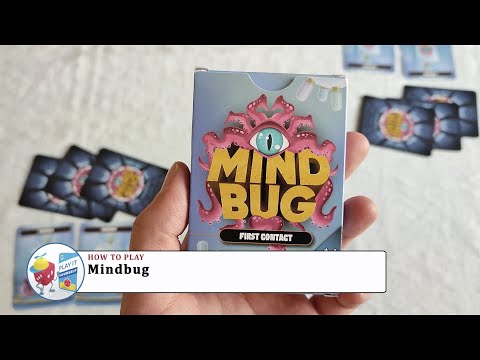 How to Play: Mindbug (Play It Yourself)
-
 Mindbug - Battlefruit Kingdom - Playthrough
-
 MindBug - How to Play in 5 minutes - BoardgameNinja
-
 Mindbug Beyond Evolution??- Richard Garfield's card battle game
Rules manual
Official PDF file
Frequently Asked Questions
Quick answers about the rules
