How to Play Ming Mang
(Public Domain), Geoludie, L. P. Septímio · Board gameWhat do you want to do now
Ask anything about Ming Mang: rules, setup, components, complexity, price, or whether it fits your group.
Step by step
Objective of the Game
Ming-Mang is an ancient abstract strategy game for two players, originating from Tibet. The goal is to capture all of your opponent's chips or create a situation on the board where your opponent cannot make a valid move. The game combines elements of territory control, chip transformation, and strategic positioning.
Preparation (Setup)
To set up Ming-Mang, follow these steps:
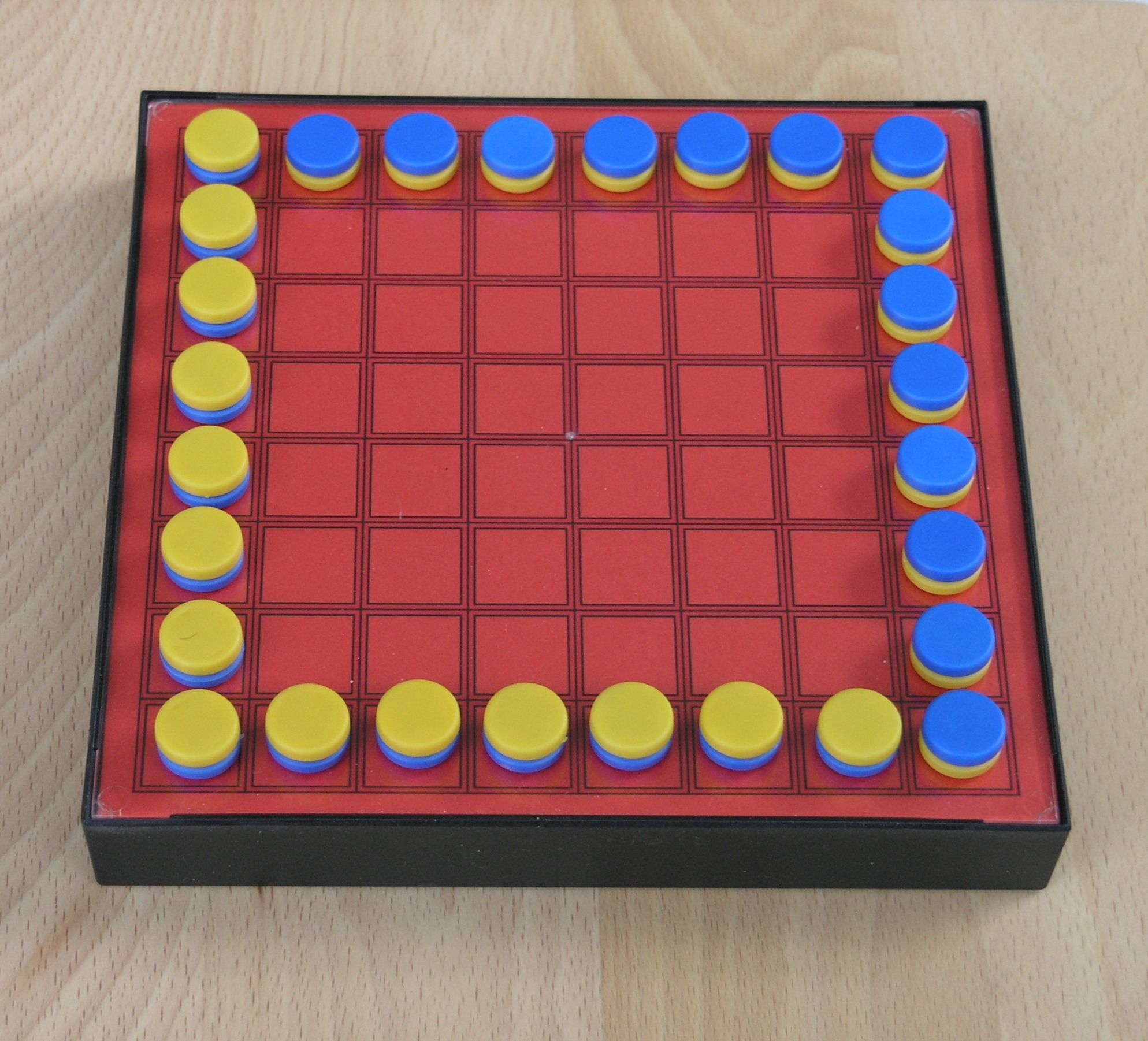
- Use an 8x8 chessboard or other board sizes like 7x7, 9x9, 10x10, 13x13, or 17x17, depending on preference.
- Each player receives 28 chips of one color (e.g., 14 on the board and 14 in reserve). Alternatively, some versions use 8 chips per player.
- Chips can be placed either on the intersections of lines or within the cells of the board, depending on the ruleset.
- Players decide who will use which color and who will make the first move.
- Refer to diagrams R.1.1-R.2.7 for initial chip placements, which vary slightly but do not affect the overall gameplay.
Flow of the Game
The game proceeds in turns, with players alternating moves. Each turn consists of moving a chip orthogonally (horizontally or vertically) to capture or transform opponent chips. The game continues until one player cannot make a valid move.
Actions and How to Play
Players can perform the following actions during their turn:
- Move a chip: Chips move orthogonally (like a rook in chess) any number of free spaces forward or backward. Players cannot jump over their own or their opponent's chips.
- Capture a chip: To capture an opponent's chip, surround it horizontally or vertically with two of your chips. The captured chip is replaced with one of your reserve chips, and the opponent's chip is returned to their reserve.
- Capture multiple chips: Groups of adjacent opponent chips can be captured if they form a continuous line without breaks.
- Transform chips: Captured chips are transformed into your color, potentially triggering a domino effect of further captures and transformations.
Players cannot create repeating positions by moving a chip back to its previous location in the same turn.
End of Game and Scoring
The game ends when one player cannot make a valid move due to one of the following conditions:
- The player has no chips left on the board.
- The player's chips are locked by the opponent's chips and cannot move without creating a repeating position.
The player who fulfills the victory condition wins the game.
Tips for Winning
Here are some strategies to improve your chances of winning:
- Control the center: Positioning your chips in the center of the board gives you more flexibility to capture opponent chips.
- Plan ahead: Anticipate your opponent's moves and set up traps to capture multiple chips in a single turn.
- Use transformations wisely: Transforming opponent chips can create chain reactions, so plan your captures to maximize their impact.
Consulte o manual para detalhes sobre esta seção.
Rules manual
Official PDF file
Frequently Asked Questions
Quick answers about the rules
What is the objective of Ming Mang?
How do you set up Ming Mang?
How do you play Ming Mang?
How does Ming Mang end, and how do you score?
What are some tips for winning Ming Mang?
Other Games You'll Like
Based on mechanics and theme