Scarabya — Prices
Blue Orange (EU), Blue Orange Games, 2 Pionki · Board game · 2018
1–4 · best 4
Solo
15–20 min
Weight 1.4/5
Buy · from US$ 10.70
7.4
rating
Ludopedia
6.5
rating
BGG
Our Verdict
FOR GENRE FANS
Perfect for puzzle lovers who want to test their spatial awareness with friends.
Highlights
- Fast and dynamic gameplay
- Simple and intuitive rules
- Satisfying mental challenge
- Great for solo play
Keep in mind
- Low direct player interaction
- Game length might feel too short
Rules manual not indexed yet
Upload the PDF rulebook to ask questions about this game with AI.
About the game
What you do in a play session
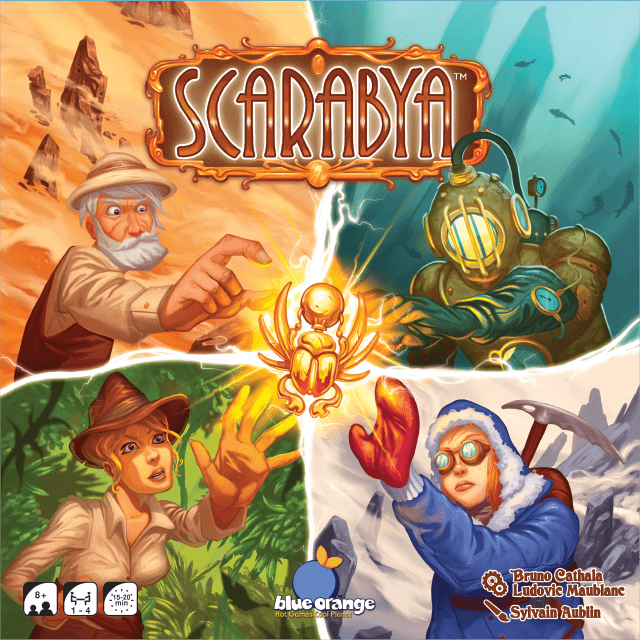
Pack your bags and grab your explorer's hat, because you've just been appointed head of an international archaeological team! Your goal in Scarabya is simple yet challenging: establish strategic camps around the globe to uncover the legendary golden scarabs. But this isn't just any excavation; the secret here lies in geometry.
The game functions as a competitive and simultaneous puzzle. All players receive the same tiles, which are revealed one by one. Each turn, you must decide where to place the current tile on your individual board. The trick to scoring is creating 'enclosed zones' (areas surrounded by tiles) that contain scarabs. The larger the enclosed area (up to a limit of 4 squares), the more points that scarab is worth. It's the kind of game that makes you think: 'If I place it here now, I'll close this area, but will I block my space for the next piece?'
With only 12 tiles to be placed or discarded, the match is fast and intense, lasting about 20 minutes. Since everyone plays with the same tiles simultaneously, the fun lies in seeing who can achieve the best spatial efficiency while the clock is ticking. It's a light game, but it requires sharp logical reasoning to maximize every inch of the board. If you enjoy fitting games and want something that doesn't take up your entire afternoon, Scarabya is the perfect choice to test your brain while hunting for Egyptian treasures.
The game functions as a competitive and simultaneous puzzle. All players receive the same tiles, which are revealed one by one. Each turn, you must decide where to place the current tile on your individual board. The trick to scoring is creating 'enclosed zones' (areas surrounded by tiles) that contain scarabs. The larger the enclosed area (up to a limit of 4 squares), the more points that scarab is worth. It's the kind of game that makes you think: 'If I place it here now, I'll close this area, but will I block my space for the next piece?'
With only 12 tiles to be placed or discarded, the match is fast and intense, lasting about 20 minutes. Since everyone plays with the same tiles simultaneously, the fun lies in seeing who can achieve the best spatial efficiency while the clock is ticking. It's a light game, but it requires sharp logical reasoning to maximize every inch of the board. If you enjoy fitting games and want something that doesn't take up your entire afternoon, Scarabya is the perfect choice to test your brain while hunting for Egyptian treasures.
Gallery
Box and component photos
Tap any photo to open fullscreen. Photos submitted by the community or publisher.
Rules videos
Learn by watching before you open the box


Best player count
BGG community vote
1
REC
2
BEST
3
REC
4
BEST
Soundtrack
Ambience suggested by Melodice
Loading playlist...
Where to Buy
Prices monitored daily
Finding best prices...
Prices unavailable at this time.
Price history — last 6 months (lowest new offer)
Alert enabled!
Join the BoardGamesBot deals group
Get the best board game deals every day — without message spam.
Join the WhatsApp groupGame details
Mechanics, categories, families and credits
Mechanics
Categories
Families
Publisher
Blue Orange (EU), Blue Orange Games, 2 Pionki, Arclight Games, Korea Boardgames, One Moment Games, Portal Games
Designer
Bruno Cathala, Ludovic Maublanc
Artist
Sylvain Aublin
Community
Data from BoardGameGeek
2,606owners
378wishlist
30want to play
Frequently Asked Questions
Quick answers before you buy
Is the game hard to learn?
Not at all! The rules are super simple and intuitive; you can explain it in 5 minutes and start playing.
Can I play it solo?
Yes! It has solo rules, making it great for those who want to exercise their brain without needing company.
How long does a game last?
It's very quick, between 15 and 20 minutes. Ideal as a 'filler' between larger games.
Is it suitable for children?
Definitely. Since it's a fitting puzzle, it's great for developing children's spatial perception.
Do players interact with each other?
Interaction is indirect. You all use the same tiles, but each player focuses on their own board.
What is the game's complexity?
It's a light game (weight 1.37), focusing more on fitting logic than complex strategies.
Other Games You'll Like
Based on mechanics and theme