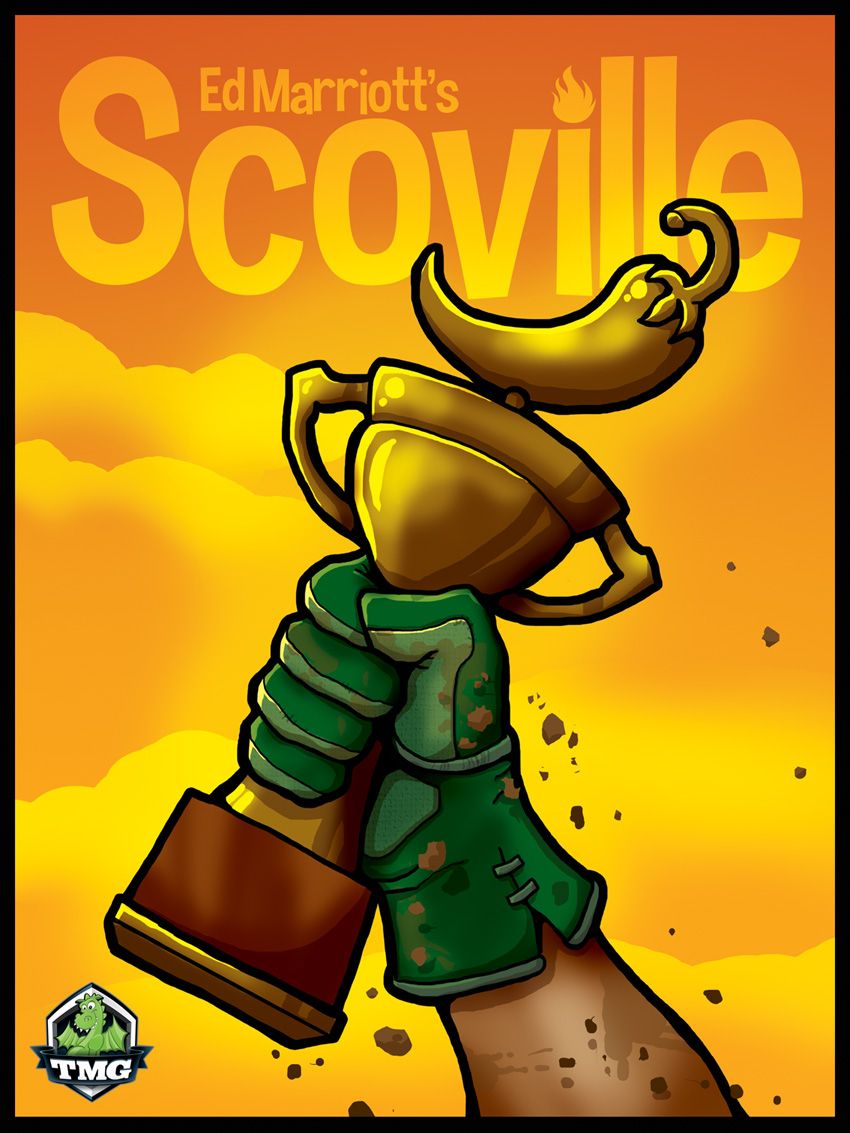
How to Play Scoville: 2nd Edition
Trick or Treat Studios, Arclight Games, Grail Games · Board game · 2025- Players
- 1–6 · best 4
- Players
- Solo
- Play Time
- 60–90 min
- Weight
- Weight 2.9/5
- Year
- Year 2025
- Minimum age
- Minimum age —
What do you want to do now
Ask anything about Scoville: 2nd Edition: rules, setup, components, complexity, price, or whether it fits your group.
Step by step
Game Objective
In Scoville: 2nd Edition, players are chili pepper enthusiasts in the town of Scoville, founded in honor of Wilbur Scoville, the inventor of the chili pepper heat scale. The town annually hosts the Scoville Chili Festival, where growers compete to create the spiciest peppers.
The objective of the game is to become the spiciest grower at the festival by accumulating the most Points by the end of the game. Players do this by planting, harvesting, and cross-breeding peppers, selling them at the Farmers Market, completing Recipes in the Chili Contest, and managing their Coins and Bonus Action Tokens.
Setup
- General: Assemble the 5 Game Board pieces like a puzzle. Place stacks of Pepper Tokens of each color (Red, Bronze, Blue, Gray, Orange, Yellow, White, Green, Ghost, Purple) next to the board. Separate and organize the Coins by value to form a bank.
- Players: Each player receives a Shield, a Farmer, and a Disc of their chosen color, one Bonus Action Token of each type, 10 dollars in Coins, and three Peppers: Red, Yellow, and Blue. Players should position their Shields to hide their components during the game.
- Farmers Market: Shuffle the deck of Morning Market Cards. Draw the number of cards indicated on the board (based on the number of players) and place them face-up in each stall of the Market. Return the remaining morning deck to the box. Shuffle the deck of Afternoon Market Cards and place it face-down in the indicated spot on the board (on the back of the truck).
- Chili Contest: Shuffle the deck of Recipe Cards. Draw the number of cards indicated on the board (based on the number of players) and place them face-up next to the board, overlapping them to save space. It is recommended to order them from lowest to highest score. Return the remaining Recipe deck to the box.
- Auction House: Individually shuffle the Morning Auction and Afternoon Auction decks and place them face-down in the Auction House. Draw as many cards from the Morning deck as there are players and place them face-up in the spaces on the board.
- Town Hall: Separate the Reward Plates by pepper color and stack them in the corresponding spaces on the Town Hall roof, ensuring that the higher value Plates are on top of the lower value ones. For 2 or 3 player games, remove 1 Plate (the highest value one) from each stack and return it to the box.
- Pepper Field: Take one red, one yellow, and one blue pepper. Choose two randomly and place them in the Starting Plots of the Pepper Field (marked with green outlines). Return the third pepper to the supply.
- Turn Order: Take each player's Discs and randomly place them in the spaces on the Turn Order track. Do not use the track spaces numbered above the number of players.
- Combination Board: Keep the Combination Boards handy for players to consult.
- Laboratories Expansion (Optional): If using the Laboratories expansion, mix the 12 expansion Market Cards and 12 Recipe Cards into the corresponding decks before setup. Each player receives a Laboratory of their color and an additional "Plant 1 more pepper" Bonus Action Token. For 2 or 3 player games, do not remove the highest value Reward Token from each stack in the Town Hall.
Game Flow
Each game of Scoville takes place over a variable number of rounds. Each round consists of 5 phases, played in the following order:
- AUCTIONS: Players bid to determine turn order and acquire Auction Cards.
- Bid for Turn Order: In the first round, the order is random. In subsequent rounds, players move their Discs to the baskets above the track, maintaining the previous round's order. Each player discreetly selects a number of Coins (or none) and reveals them simultaneously. The player with the highest bid chooses their spot on the Turn Order track, followed by the second highest, and so on. Bids are placed in the bank. In case of a tie (greater than zero), the player who played first in the previous round chooses first. Players with a zero bid choose their spots in the remaining spaces, in the previous round's order.
- Acquire Auction Cards: In the new turn order, each player chooses one of the Auction Cards currently in the Auction House, takes the pepper(s) represented on the card from the supply, and discards the card. After all players have chosen, new cards are drawn from the supply (either Morning or Afternoon, depending on the current game phase) to refill the Auction House.
- PLANTING: All players must, in turn order, plant one pepper.
- Each player chooses a pepper from their reserve and places it on an empty plot in the Pepper Field. The pepper can only be planted on a plot horizontally or vertically adjacent to a plot that already contains a pepper.
- A player can plant an additional pepper using a specific Bonus Action Token.
- Reward Tokens: If a player plants a pepper of a color for which there are still Reward Tokens in the Town Hall, they can take the corresponding highest value token. Tokens with three peppers are collected by planting a purple, orange, or green pepper. A player cannot acquire more than one Reward Token per round.
- With the Laboratories expansion: After planting the pepper in the field, you can plant a pepper from your supply in your Laboratory. The first pepper in the Laboratory can be planted in any container; subsequent ones must be adjacent to an existing pepper (not diagonally). When planting in the Laboratory, you immediately harvest the peppers resulting from the mix between the pepper you just planted and all peppers directly adjacent to it. Prize Tokens are not awarded for peppers planted in the Laboratory.
- HARVESTING: Each player, in reverse turn order, moves their Farmer a maximum of three steps along the paths between plots, gaining a pepper for each step that ends between two planted plots.
- In the first round, the Farmer is positioned on the star. In subsequent rounds, it starts from where it was.
- The Farmer must advance at least one plot and a maximum of three. A step ends between two plots.
- Farmers cannot pass through or stop on another player's Farmer.
- A Farmer can be rotated at the start of the turn and turn during movement, but cannot retrace its steps.
- When a step ends between two planted plots, the player harvests one or two peppers, depending on the Combination Table.
- With the Laboratories expansion: The "Plant 1 More Pepper" Bonus Action Token can be used in your Laboratory, but only if you have already planted a pepper in your Laboratory normally during that turn.
- ACTIONS: In the Actions phase, all players can, in turn order, perform one or more of the actions described below. Each action can only be performed once per round.
- Combinations: When a Farmer is between two peppers after a step, the player can combine the peppers using the Combination Table and collect the corresponding pepper(s) from the supply. The table is used by choosing a pepper in the left column and following the row to the column of the other pepper. The meeting point indicates the result. Some combinations result in one or two peppers; others (involving bronze pepper) result in nothing (X).
- Sell Many Peppers: The player can sell up to five (5) peppers of one color from their reserve to the supply. Each pepper sold yields $1 for each group of two peppers of that color planted in the Pepper Field.
- With the Laboratories expansion: When selling peppers, you can count the peppers from your own Laboratory, in addition to those from the field, to determine the money earned. Only peppers from your personal supply can be sold.
- Visit the Farmers Market: The player can choose an available Market Card, pay the peppers listed in the "demand" section to the supply, and gain the listed reward(s). The Market Card is kept behind the player's shield and will be worth points at the end of the game.
- With the Laboratories expansion: Some new Morning Market Cards grant a Bonus Action as a reward. To use this Bonus Action, the card must be discarded (forfeiting its points).
- Participate in the Chili Contest: The player can choose an available Recipe Card, pay the indicated pepper combination to the supply, and keep the Recipe Card behind the shield. It will be worth points at the end of the game.
- TIME CHECK: This phase determines whether the game continues, changes from Morning to Afternoon, or ends.
- If it is Morning:
- Count the number of Recipe Cards remaining in the Chili Contest. If there are fewer cards than the number of players, Afternoon is skipped, another round is played, and the game ends after that round's Actions phase.
- Count the number of Market Cards remaining in the Farmers Market.
- If there are at least as many cards remaining as the number of players, it is still Morning. Start a new round.
- If there are fewer cards than players, the game advances to Afternoon. Discard all remaining Morning Market Cards, draw Afternoon Market Cards to fill the Farmers Market, and return the Morning Auction deck to the box. Start a new round.
- If it is Afternoon:
- Count the number of Market Cards remaining in the Farmers Market and the number of Recipe Cards remaining in the Chili Contest.
- If there are fewer cards than players in only one of these locations, another round is played, and the game ends after that round's Actions phase.
- If there are fewer cards than players in each location, the game ends immediately, with no further rounds.
- Otherwise, start a new round.
- Count the number of Market Cards remaining in the Farmers Market and the number of Recipe Cards remaining in the Chili Contest.
- If it is Morning:
Actions and How to Play
The main actions are detailed in the "Game Flow" section under the Actions phase. Additionally, players can use Bonus Action Tokens:
- Plant a second pepper: Play this token during the Planting phase to plant a second pepper of your choice, following the usual rules. If the first pepper already yielded a Reward Token, this second pepper cannot yield another. It is possible to refuse a Token from the first pepper to acquire one from the second.
- Advance one more step: Play this token during the Harvesting phase to advance one more step, if you have already reached the three-step limit. Normal movement and crossing rules apply to this fourth step.
- Retrace steps: Play this token during the Harvesting phase. This ability allows your Farmer to turn once, moving along a path it has already traveled this turn. This does not add steps, but allows you to go around a plot and end up in the same place you started, respecting the rule of not going back the same way.
Each player receives 3 Bonus Action Tokens at the start of the game. They are kept behind the shields and discarded face-up after use. A player can use multiple tokens in one turn. Unused tokens are worth 4 Points at the end of the game.
End of Game and Scoring
The game ends according to the conditions of the Time Check phase, either after the Actions phase of a final round or immediately.
At the end of the game, each player tallies their total Points in 5 different categories:
- Points on Market Cards: Each collected Market Card has an indicated point value.
- Points on Recipe Cards: Each collected Recipe Card has an indicated point value.
- Points on Reward Plates: Each collected Reward Token has an indicated point value.
- Points on the back of unplayed Bonus Action Tokens: Each unused Bonus Action Token is worth 4 Points.
- Coins: 1 Point for every $3 (ignore remaining dollars).
The player with the most Points wins the game!
In case of a tie, the tied player with the most Coins is the winner.
Tips for Winning
- Manage your bids in the Auction phase: Higher bids ensure a better position in the Turn Order, which can be crucial for choosing the best Auction Cards or for the reverse order in the Harvesting phase. However, spending too many Coins can impact your final score.
- Optimize Harvesting and Cross-breeding: Plan your Farmer's movements to end between peppers that result in the most valuable combinations, especially those that produce rarer or multiple peppers. Consult the Combination Table frequently.
- Balance actions: Don't
Rules manual
Official PDF file
Frequently Asked Questions
Quick answers about the rules
What is the objective of Scoville: 2nd Edition?
How do you set up Scoville: 2nd Edition?
How do you play Scoville: 2nd Edition?
How does Scoville: 2nd Edition end, and how do you score?
What are some tips for winning Scoville: 2nd Edition?
Other Games You'll Like
Based on mechanics and theme