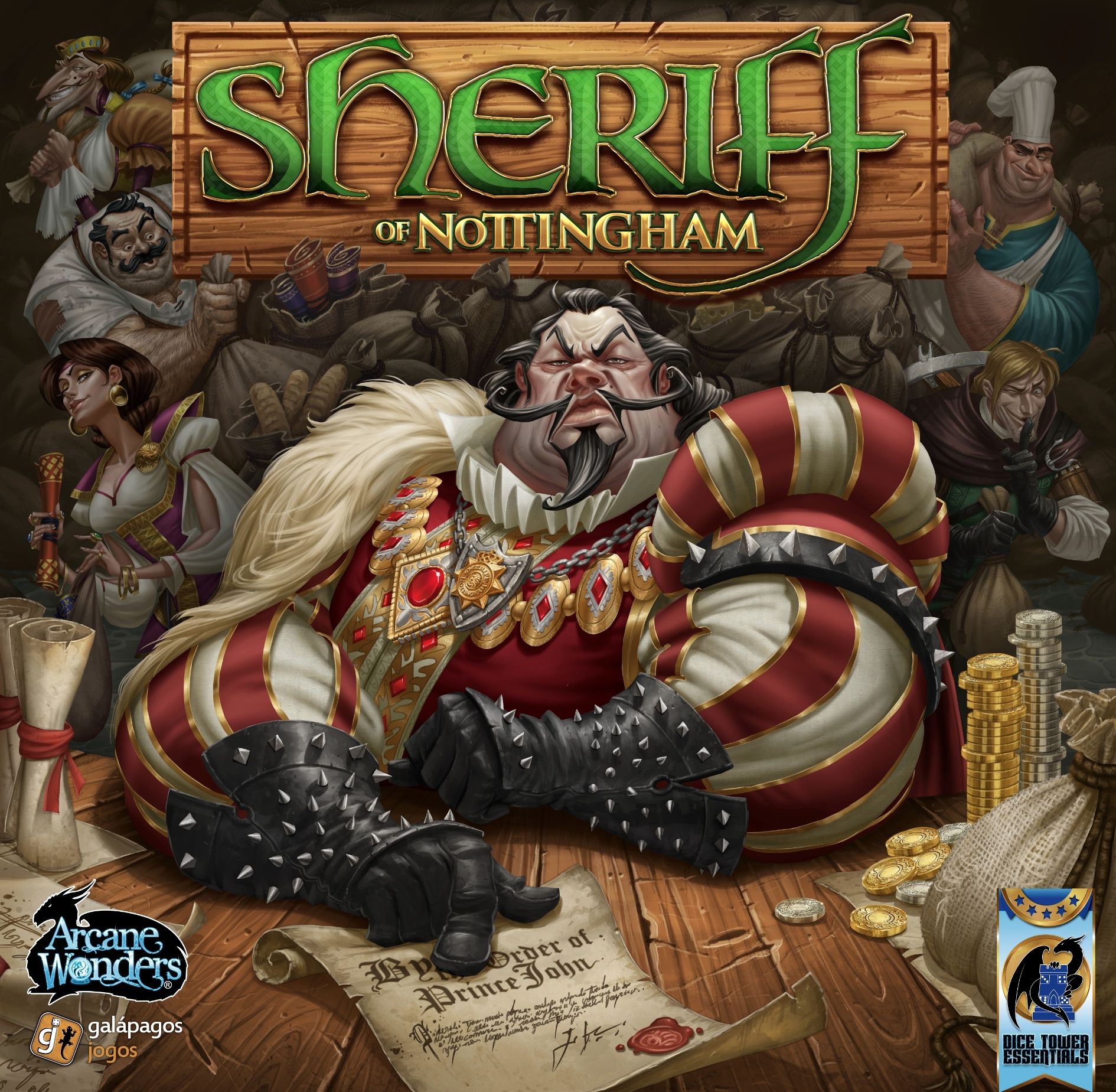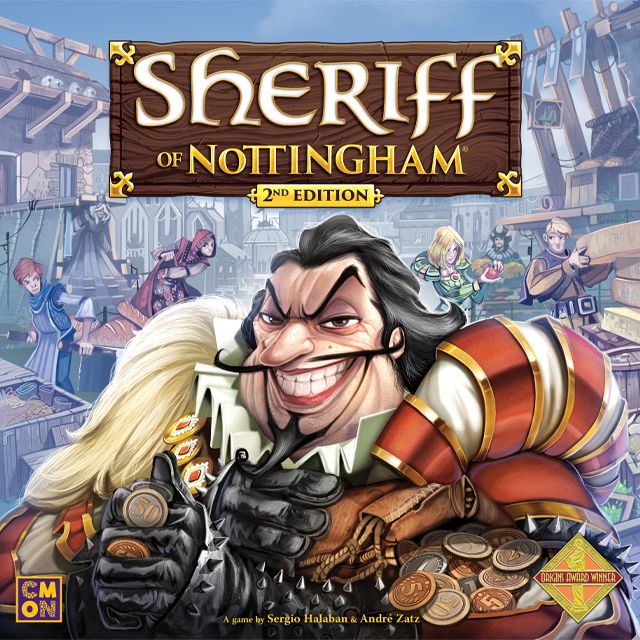
How to Play Sheriff of Nottingham: 2nd Edition
CMON Global Limited, BoardM Factory, Broadway Toys LTD · Board game · 2020What do you want to do now
Ask anything about Sheriff of Nottingham: 2nd Edition: rules, setup, components, complexity, price, or whether it fits your group.
Video: How to Play
Start here, then follow the written guide
Step by step
Game Objective
In Sheriff of Nottingham 2nd Edition, you are a merchant trying to deliver your Goods to the city market. Prince John has imposed abusive taxes and summoned the greedy Sheriff of Nottingham to inspect everyone passing through the main gate, looking for Contraband (valuable goods he tries to confiscate for his own benefit).
Players take turns in the role of the Sheriff, who decides which merchants to inspect and which to let pass. As a Merchant, your goal is to convince the Sheriff to let you in, whether by bluffing, bribing him, or even telling the truth.
At the end of the game, the richest Merchant wins.
Setup
- Each player takes a Merchant Stall and a Merchant Bag of the same color and places them in front of them.
- Choose 1 player to be the Banker. The Banker distributes 50 Gold coins to each player (including themselves) and keeps the remaining Gold within reach for change. The Banker cannot mix their own money with the bank's funds.
- A basic game is played without the Royal Goods cards. It is recommended to use only the basic rules for the first few games.
- Shuffle all Goods cards, deal 6 cards to each player, and place the deck face down in a draw pile.
- The player with the most money will be the first Sheriff. Give them the Sheriff Token.
3-Player Game
Before shuffling the Goods cards, remove all cards displaying the "4+" icon and return them to the box. This includes:
- 36 Breads, 4 Peppers, 5 Meads, and 3 Silks.
- If using Royal Goods, the following cards must also be removed: 1 Golden Apple, 1 Gorgonzola Cheese, 2 Whole Wheat Breads, 1 Rye Bread, and 1 Royal Rooster.
6-Player Game
Refer to the manual for details on this section.
Game Flow
The game unfolds in a series of rounds. In each round, one player is the Sheriff and the others are Merchants.
Each round is divided into five phases, which must occur in this order:
- Transaction
- Loading
- Declaration
- Inspection
- End of Round
At the end of each round, the current Sheriff passes the Sheriff Token to the player to their left. This person will be the new Sheriff during the next round.
- In a three-player game, this repeats until each player has been the Sheriff three times.
- In a four or five-player game, this repeats until each player has been the Sheriff twice.
- In a six-player game, refer to the additional rules for 6 players on page 13 of the manual.
Phase 1 - Transaction
In this phase, Merchants can discard unwanted cards and draw new cards, hoping to get a good set of Goods to take to the Market.
The Sheriff determines who acts first. Then, clockwise from the chosen player, each Merchant takes a turn. On your turn, you can play up to 5 cards from your hand (face up) and then draw cards from the Goods deck until you have 6 cards in your hand again. After all players have taken their turns, the Sheriff takes all played cards and forms a face-up discard pile next to the Goods deck.
The Sheriff does not act during this phase and cannot exchange their own Goods cards.
Phase 2 - Loading
In this phase, Merchants place the Goods cards they want to take to the market into their Bags. All Merchants place Goods cards into their bags simultaneously. Each must place 1 to 5 Goods cards. Merchants must be careful not to let the Sheriff or other Merchants see which cards they have chosen! When you are satisfied with the Goods in your bag, place it closed on the table in front of you. Once you close the bag, you can no longer change your mind about the Goods you want to take to the market!
Phase 3 - Declaration
In this phase, Merchants declare to the Sheriff which Goods they are taking to the Market. Lying about the contents of the bag is an option.
Starting with the player to the Sheriff's left and proceeding clockwise, each Merchant will look the Sheriff in the eye, declare which Goods they are taking to the market, and hand their Merchant Bag to them.
The bag cannot be opened during this phase. It is mandatory to declare the exact quantity of Goods in your Merchant Bag, and you can only announce 1 type of Legal Good, which may or may not be in your bag. You cannot declare Contraband or more than one type of Legal Good. Other than that, you can declare whatever you want.
Phase 4 - Inspection
Now the Sheriff can choose whether to inspect the Merchant Bags! The Sheriff can inspect any number of Merchant Bags during this phase, from none to all of them, and in any order they wish. If the Sheriff inspects a bag and discovers that the owner lied about its contents, they collect a fine. But a Merchant can apply a Penalty to the Sheriff if they are telling the truth.
As Sheriff, you can threaten Merchants with an inspection. As a Merchant, you can try to bribe the Sheriff to avoid inspection or convince them to inspect someone else's bag. The Sheriff can refuse the bribe and inspect your bag anyway, or allow you to pass without the bribe. Everyone can participate in all negotiations simultaneously during this phase, but it is the Sheriff who decides when to end negotiations.
If the Sheriff accepts the bribe, they return the Merchant Bag without opening it. If they decide to inspect the bag regardless of what was offered, they open the bag and reveal the contents to all players.
Examples of what can be offered as a bribe:
- Gold
- Legal Goods from your Merchant Stall
- Contraband from your Merchant Stall
- Goods from your Merchant Bag
- Promises of future favors
You cannot offer cards from your hand or more Gold than you possess as part of a bribe. Only the Sheriff can handle the Merchant Bags until they inspect them or return them to their owners. The Sheriff needs to inspect or reject each Merchant Bag, one at a time, in any order they wish. From the moment the Sheriff returns or opens a bag, all negotiations related to it are concluded. Once the Sheriff makes a choice, they cannot change their mind! If the Sheriff returns the bag without opening it, the last bribe offered (if any) must be paid. If the Sheriff accepts the bribe, they cannot inspect the bag. If you receive a bribe as Sheriff, add any Goods received as part of the bribe to your Merchant Stall (whether they came from the Merchant Stall or another player's bag). Any Gold paid is added to your supply.
If the Sheriff Lets You Pass
All Legal Goods are placed face up in the corresponding spaces of your Merchant Stall. The Legal Goods in your Merchant Stall can be inspected by any player at any time. All Contraband is kept secret! You must reveal the quantity of Contraband cards you brought to Nottingham, but not the type. Keep your Contraband face down on top of your Merchant Stall.
If the Sheriff Inspects Your Bag
There are 2 possible outcomes:
- If you told the truth: If your bag has exactly what you declared, the Sheriff must pay you an amount of Gold equal to the Penalty of each Legal Good in your Bag. Then, your Legal Goods are added to your Merchant Stall.
- If you lied: If your bag does not have exactly what you declared, 3 things can happen:
- Any Goods you declared correctly can enter the Market. Place them face up on your Merchant Stall, as usual.
- Any Goods you did not declare honestly are confiscated: whether they are Legal Goods or Contraband! The Sheriff takes all these Goods and places them in the discard pile.
- You must pay a fine to the Sheriff for all confiscated Goods. The fine is equal to the Penalty displayed on each card.
Running Out of Gold
If you cannot pay any Penalty you owe, you must hand over Legal Goods from your Merchant Stall that total a Value at least equal to the amount you owe. This may cause you to hand over a greater value than you owe, as you will not receive any change for the excess. If you do not have enough Legal Goods, you must reveal and hand over your Contraband to make up the difference. The player receiving the Goods must add them to their Merchant Stall. If all Goods and Contraband from your Merchant Stall are gone, any remaining debt is considered settled.
Honor Among Thieves
Normally, all agreements must be honored, but promises of future favors, which take effect after the current round, are not binding. You can offer Goods from your bag or Merchant Stall as a bribe to the Sheriff. If the Sheriff lets you pass, upon revealing the Goods from your bag, you only need to hand over the Goods you promised if they actually exist! If you promised something to the Sheriff that is not in your bag or Merchant Stall, you do not need to pay for the Goods (but you need to prove you don't have them by showing the cards from the bag and stall to the Sheriff). An agreement is made when an offer is made by a Merchant or the Sheriff and the other player accepts it. Until then, the agreement is considered to be in negotiation. Generally, it is obvious when an agreement is accepted, but if there is any confusion, use the words "Deal Closed" to show that you agree to the terms.
Phase 5 - End of Round
If each player has been the Sheriff 3 times (in a three-player game) or twice (in a four or five-player game), the game ends immediately! Otherwise, the player who is the Sheriff passes the Sheriff Token to the player to their left. This will be the new Sheriff during the next round. Now, all players draw cards from the deck until they have 6 cards in hand again before the next round begins. The Sheriff will already have 6 cards in hand from the previous round.
Reshuffling Cards
If you run out of cards during the game, shuffle all Goods cards from the discard pile to form a new deck.
End of Game and Scoring
The game ends when the end-game trigger is met in Phase 5 - End of Round (each player has been Sheriff 3 times in 3-player games, or 2 times in 4 or 5-player games). For 6-player games, refer to the manual.
At the end of the last round, all players discard any cards they have in hand. These cards are not worth Points!
Then, reveal your Contraband cards and count your score. You earn Points in this way:
- The Value of all Goods you have in your Merchant Stall (Legal or Contraband).
- Any Gold Coins you have.
- King and Queen Bonuses.
King and Queen Bonuses
The player who has delivered the most of each type of Legal Good is declared King of that good, and the second-place player is declared Queen of that Good. They receive Bonus Points in this way:
- Apple: King Bonus 20, Queen Bonus 10
- Cheese: King Bonus 15, Queen Bonus 10
- Bread: King Bonus 15, Queen Bonus 10
- Chicken: King Bonus 10, Queen Bonus
More videos
More rules explanations from the community



Rules manual
Official PDF file
Frequently Asked Questions
Quick answers about the rules
What is the objective of Sheriff of Nottingham: 2nd Edition?
How do you set up Sheriff of Nottingham: 2nd Edition?
How do you play Sheriff of Nottingham: 2nd Edition?
How does Sheriff of Nottingham: 2nd Edition end, and how do you score?
Other Games You'll Like
Based on mechanics and theme