Taluva
Ferti, Hans im Glück, Cranio Creations · Board game · 2006
2–4 · best 2
45 min
Weight 2.3/5
Buy · from US$ 19.99
7.6
rating
Ludopedia
7.1
rating
BGG
Our Verdict
RECOMMENDED
Perfect for those who love abstract strategy with a stunning 3D look and high interaction.
Highlights
- Dynamic and organic 3D board
- Direct and aggressive interaction
- Elegant and deep rules
- Fast and intense matches
Keep in mind
- Initial learning curve
- Can be frustrating to be buried
Rules manual not indexed yet
Upload the PDF rulebook to ask questions about this game with AI.
About the game
What you do in a play session
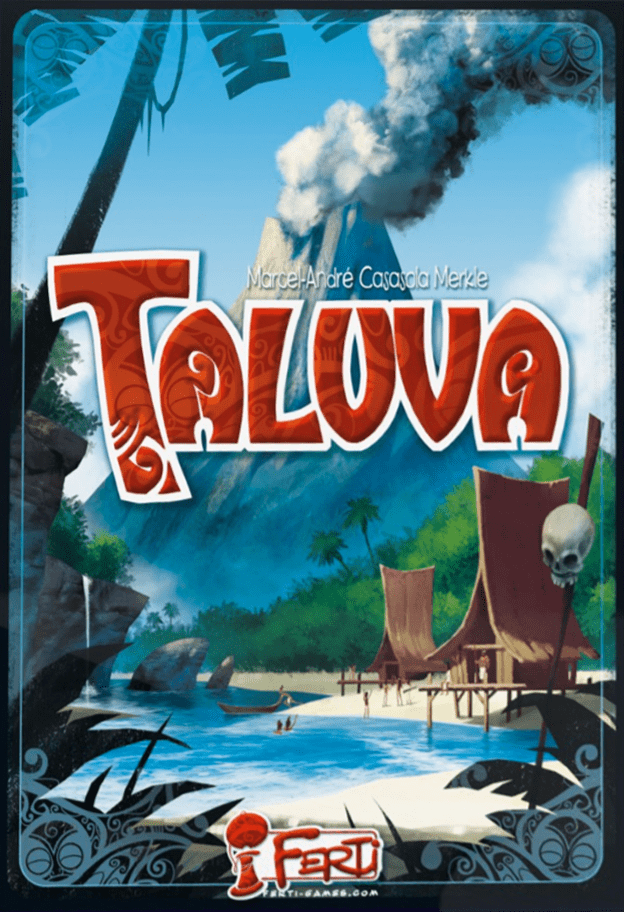
Imagine trying to settle an island that is literally emerging from the ocean as volcanoes erupt. That's exactly what happens in Taluva! The dynamic here is fascinating: each turn, you decide whether to expand the island outwards by placing a new tile on the coast or to trigger an existing volcano's eruption, stacking tiles upwards. This creates an organic 3D board that evolves with every move.
But it's not just about shaping the land; you need to colonize it. You start by placing simple huts at the lowest level. From there, you can expand your settlement across the same terrain types or move up in height to build temples and towers. The catch is that the geology is treacherous: a new eruption can bury your opponents' buildings, though it never fully wipes out a settlement. This creates a cat-and-mouse game where you can use a single hut to block a volcano's eruption and protect your base, or cause geological chaos to split an opponent's village in two, forcing them to restart.
Victory goes to the player who places the most temples once the tiles run out. However, keep an eye out for the 'ultimate victory'. If you manage to place all your buildings of two different types, the game ends instantly and you win. Conversely, if you find yourself unable to legally play any buildings during your turn, it's an immediate defeat. It's a duel of pure strategy, area control, and timing, where the terrain is both your greatest ally and your worst enemy.
But it's not just about shaping the land; you need to colonize it. You start by placing simple huts at the lowest level. From there, you can expand your settlement across the same terrain types or move up in height to build temples and towers. The catch is that the geology is treacherous: a new eruption can bury your opponents' buildings, though it never fully wipes out a settlement. This creates a cat-and-mouse game where you can use a single hut to block a volcano's eruption and protect your base, or cause geological chaos to split an opponent's village in two, forcing them to restart.
Victory goes to the player who places the most temples once the tiles run out. However, keep an eye out for the 'ultimate victory'. If you manage to place all your buildings of two different types, the game ends instantly and you win. Conversely, if you find yourself unable to legally play any buildings during your turn, it's an immediate defeat. It's a duel of pure strategy, area control, and timing, where the terrain is both your greatest ally and your worst enemy.
Gallery
Box and component photos
Tap any photo to open fullscreen. Photos submitted by the community or publisher.
Rules videos
Learn by watching before you open the box
In English


Best player count
BGG community vote
2
BEST
3
REC
4
REC
Soundtrack
Ambience suggested by Melodice
Loading playlist...
Where to Buy
Prices monitored daily
Finding best prices...
Prices unavailable at this time.
Price history — last 6 months (lowest new offer)
As an Amazon Associate I earn from qualifying purchases. Prices and availability subject to change.
Alert enabled!
Join the BoardGamesBot deals group
Get the best board game deals every day — without message spam.
Join the WhatsApp groupGame details
Mechanics, categories, families and credits
Mechanics
Categories
Families
Publisher
Ferti, Hans im Glück, Cranio Creations, Gameland 游戏大陆, Rio Grande Games, Schmidt Spiele
Designer
Marcel-André Casasola Merkle
Artist
Julien Le Faucheur, Manuel Casasola Merkle, Marcel-André Casasola Merkle, Xavier Gueniffey Durin, 杨静雯 (Yang Jingwen), 谢有鑫 (Xie Youxin), 郭紫颖 (Guo Ziying), 陈杰 (Chen Jie)
Community
Data from BoardGameGeek
9,301owners
2,319wishlist
507want to play
Frequently Asked Questions
Quick answers before you buy
Is the game too complex?
It has a medium weight (2.2 on BGG). The rules are elegant, but the strategy of where to place each tile to block opponents requires focus.
How long does a game take?
It's quite fast! Usually around 45 minutes, depending on how aggressive the players are.
Does it work well with 2 players?
Yes, it works great, turning into a very tight tactical duel.
Do I need a lot of table space?
Yes, the island grows both outwards and upwards, so reserve a decent amount of space for the map's expansion.
Is it suitable for beginners?
For those who already play some board games, yes. For absolute beginners, it might be a big jump, but it's a great 'gateway' to expert games.
Other Games You'll Like
Based on mechanics and theme