10.0
rating
Ludopedia
5.1
rating
BGG
Our Verdict
RECOMMENDED
A classic strategy gem that turns simple Tic Tac Toe into a high-level mental duel.
Highlights
- Deep strategy in minutes
- Brilliant sending mechanic
- Fast and intense play
- Perfect two-player duel
Keep in mind
- Visual simplicity might be polarizing
- Requires constant intense focus
Rules manual not indexed yet
Upload the PDF rulebook to ask questions about this game with AI.
About the game
What you do in a play session
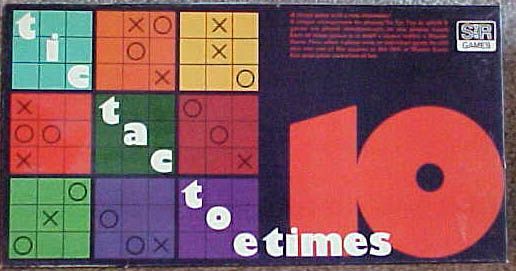
You know that Tic Tac Toe you used to play on scraps of paper in class? Forget everything you know about it, because Tic Tac Toe Times 10 is a massive upgrade! Imagine a giant board that is actually composed of nine smaller Tic Tac Toe mini-games. The ultimate goal isn't just to win a single mini-game, but to conquer three of those smaller cells in a row on the 'Master Board' to claim victory.
But hold on, things get interesting and a bit chaotic here. The real game-changer is the 'sending' mechanic. To start, the first player picks any of the 81 spaces (9 mini-games x 9 cells each). From there, the game turns into a high-stakes game of cat and mouse: your move dictates where your opponent must play! If you place a piece in a specific spot within a mini-game, your opponent is forced to make their next move in that exact same relative position within the mini-game corresponding to that Master Board cell.
This adds an incredible layer of strategy, because you aren't just trying to complete your own line; you're trying to 'push' your opponent into a mini-game where they are at a disadvantage or where the outcome is already decided. There are also escape rules: if your opponent sends you to a cell that has already been won or is a tie (full), you earn a 'free move' and can choose any spot on the board to reposition yourself. It's a game of pure anticipation, where every micro-level move has a massive macro-level impact. If you love pure strategy games that are fast-paced and fry your brain in just a few minutes, this 1977 classic is a must-play!
But hold on, things get interesting and a bit chaotic here. The real game-changer is the 'sending' mechanic. To start, the first player picks any of the 81 spaces (9 mini-games x 9 cells each). From there, the game turns into a high-stakes game of cat and mouse: your move dictates where your opponent must play! If you place a piece in a specific spot within a mini-game, your opponent is forced to make their next move in that exact same relative position within the mini-game corresponding to that Master Board cell.
This adds an incredible layer of strategy, because you aren't just trying to complete your own line; you're trying to 'push' your opponent into a mini-game where they are at a disadvantage or where the outcome is already decided. There are also escape rules: if your opponent sends you to a cell that has already been won or is a tie (full), you earn a 'free move' and can choose any spot on the board to reposition yourself. It's a game of pure anticipation, where every micro-level move has a massive macro-level impact. If you love pure strategy games that are fast-paced and fry your brain in just a few minutes, this 1977 classic is a must-play!
Gallery
Box and component photos
Tap any photo to open fullscreen. Photos submitted by the community or publisher.
Best player count
BGG community vote
2
BEST
Soundtrack
Ambience suggested by Melodice
Loading playlist...
Where to Buy
Prices monitored daily
Finding best prices...
Prices unavailable at this time.
Price history — last 6 months (lowest new offer)
As an Amazon Associate I earn from qualifying purchases. Prices and availability subject to change.
Alert enabled!
Join the BoardGamesBot deals group
Get the best board game deals every day — without message spam.
Join the WhatsApp groupGame details
Mechanics, categories, families and credits
Mechanics
Categories
Families
Publisher
Selchow & Righter
Designer
(Uncredited)
Community
Data from BoardGameGeek
26owners
4wishlist
1want to play
Frequently Asked Questions
Quick answers before you buy
How long does a game last?
Super quick! Usually between 20 minutes.
How many players can play?
It is a game designed exclusively for 2 players.
Is the game very hard?
The rules are easy to learn, but the strategy is deep. Easy to pick up, hard to master!
Do I need to know English?
No, the game is purely abstract and visual, with no language dependency.
Who do you recommend it to?
For those who love fast strategy games like Chess or Go, but want something more dynamic and short.
What's in the box?
The board, X and O pieces (small and large), and instructions.
Other Games You'll Like
Based on mechanics and theme