7.4
rating
Ludopedia
6.0
rating
BGG
Our Verdict
FOR GENRE FANS
Perfect for those who love logical puzzles and tactical racing games with zero luck.
Highlights
- Intelligent asymmetric movement
- Dynamic chain jumping
- Simple and elegant rules
- Mensa quality seal
Keep in mind
- Pace may feel slow to some
- Lack of theme might be boring
Rules manual not indexed yet
Upload the PDF rulebook to ask questions about this game with AI.
About the game
What you do in a play session
If you enjoy pure mental challenges where luck is non-existent and everything depends on your game vision, Traverse is the right choice. Imagine a square grid board where the goal is simple, yet the execution requires strategy: you must move all eight of your pieces from your starting row to the row of the opponent sitting opposite you. Sounds easy? Wait until you see the movement rules.
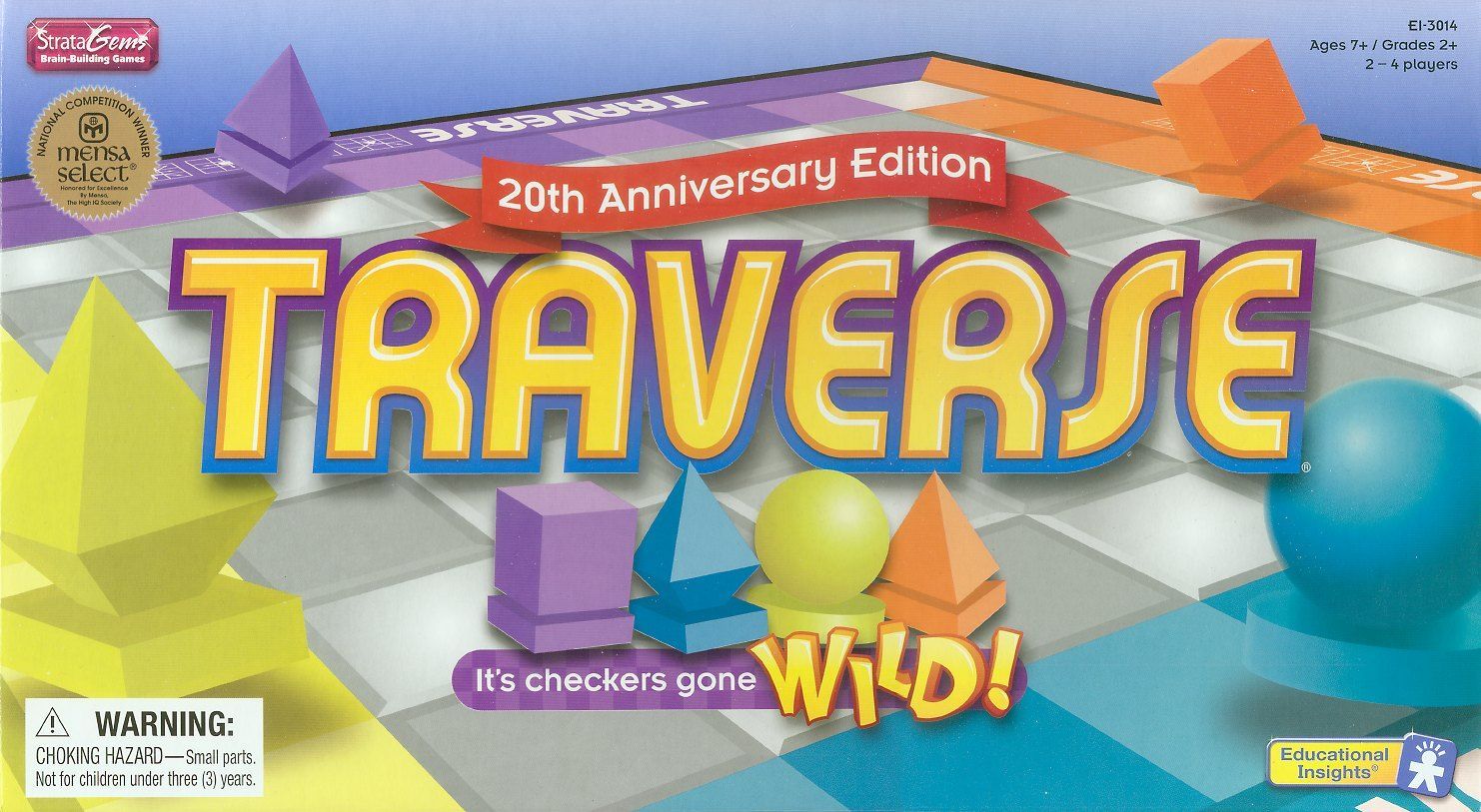
Each player controls pieces with different geometric shapes, and each shape dictates how it moves. Squares are the horizontal and vertical workers; diamonds are the diagonal specialists; triangles are curious, as they move forward diagonally but retreat in a straight line; and circles are the 'wildcards', capable of moving in any direction. This asymmetry creates a dynamic puzzle where you must plan each piece's route to avoid blocking your own path.
The highlight of Traverse is the jumping mechanism. Similar to Checkers or Chinese Checkers, you can jump over pieces (whether they are yours or your opponent's) to cross the board faster. Even better: if you can chain valid jumps together, you can make several moves in a single turn, creating explosive plays that completely shift the game's momentum. There is no capturing, so the total focus is on the race and positioning.
It's a duel of efficiency and logic, where the player who best manages their piece flow wins. With the Mensa Select endorsement, the game proves that simple rules can hide surprising tactical depth, making every match an exercise in geometry and anticipation. It's a perfect blend of a race game and an abstract puzzle, challenging you to optimize every single move to reach the finish line first.
Each player controls pieces with different geometric shapes, and each shape dictates how it moves. Squares are the horizontal and vertical workers; diamonds are the diagonal specialists; triangles are curious, as they move forward diagonally but retreat in a straight line; and circles are the 'wildcards', capable of moving in any direction. This asymmetry creates a dynamic puzzle where you must plan each piece's route to avoid blocking your own path.
The highlight of Traverse is the jumping mechanism. Similar to Checkers or Chinese Checkers, you can jump over pieces (whether they are yours or your opponent's) to cross the board faster. Even better: if you can chain valid jumps together, you can make several moves in a single turn, creating explosive plays that completely shift the game's momentum. There is no capturing, so the total focus is on the race and positioning.
It's a duel of efficiency and logic, where the player who best manages their piece flow wins. With the Mensa Select endorsement, the game proves that simple rules can hide surprising tactical depth, making every match an exercise in geometry and anticipation. It's a perfect blend of a race game and an abstract puzzle, challenging you to optimize every single move to reach the finish line first.
Gallery
Box and component photos
Tap any photo to open fullscreen. Photos submitted by the community or publisher.
Rules videos
Learn by watching before you open the box
In English

Best player count
BGG community vote
2
REC
3
OK
4
BEST
Soundtrack
Ambience suggested by Melodice
Loading playlist...
Where to Buy
Prices monitored daily
Finding best prices...
Prices unavailable at this time.
Price history — last 6 months (lowest new offer)
As an Amazon Associate I earn from qualifying purchases. Prices and availability subject to change.
Alert enabled!
Join the BoardGamesBot deals group
Get the best board game deals every day — without message spam.
Join the WhatsApp groupGame details
Mechanics, categories, families and credits
Mechanics
Categories
Families
Publisher
Alga, Brio AB, Competo / Marektoy, Educa Korea, Educational Insights, Glacier, Mitra, N.W. Damm & Søn (Damm)
Designer
John Miller, Michael Kuby
Community
Data from BoardGameGeek
Frequently Asked Questions
Quick answers before you buy
Is the game hard to learn?
Not at all! The rules are quite simple. The challenge isn't in learning how to play, but in mastering the movement strategy for each geometric shape.
How many people can play?
The game supports 2 to 4 players.
How long does a game last?
Around 30 minutes on average, depending on how strategic (or stalled) the match becomes.
Is there any luck involved?
None. There are no dice or cards; victory depends entirely on your skill and planning.
Are pieces captured?
No. You jump over pieces to move faster, but no one is removed from the board.
Is it suitable for children?
Yes, from age 7 up, as it helps develop spatial reasoning and logic.
Other Games You'll Like
Based on mechanics and theme