
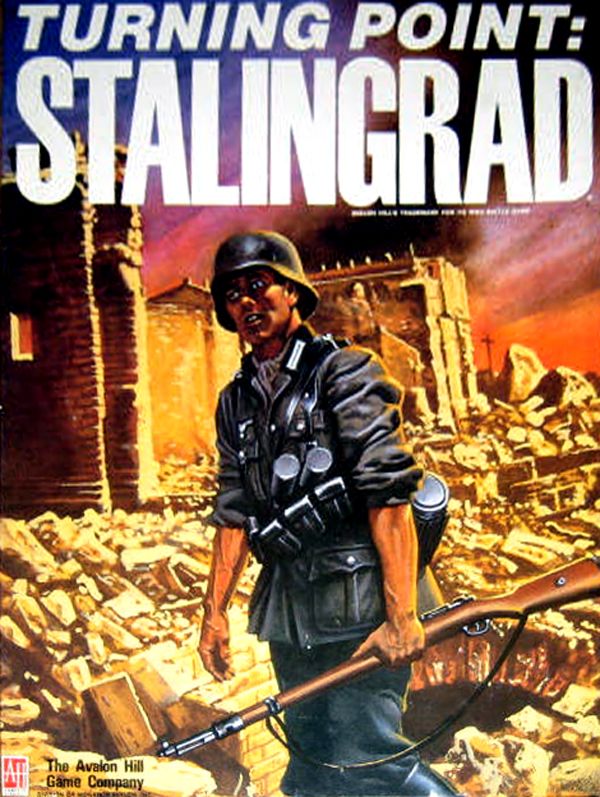
Turning Point: Stalingrad
The Avalon Hill Game Co · Board game · 1989
1–2 · best 2
Solo
120–1800 min
Weight 3.3/5
—
rating
Ludopedia
7.3
rating
BGG
—
rating
Ludopedia
7.3
rating
BGG
Our Verdict
A tense and strategic historical wargame for those wanting to command the fate of Stalingrad.
Highlights
- Precise historical simulation
- Dynamic impulse system
- Detailed urban combat
- Classic impulse mechanics
Keep in mind
- Requires intense focus
- Strictly 2-player focus
FOR GENRE FANS
Rules manual not indexed yet
Upload the PDF rulebook to ask questions about this game with AI.
If you want to feel the historical weight of one of the most brutal moments of World War II, Turning Point: Stalingrad is your destination. Here, the atmosphere is one of absolute tension as the German 6th Army desperately tries to dislodge the Soviet 62nd Army from the ruins of Stalingrad. The German goal is clear: capture the city before Operation Uranus begins, allowing their troops to redeploy and reinforce the Italian and Romanian formations struggling on the Volga flanks. If the chaos is averted, the historical fiasco might just be prevented.
The game operates at an operational level, focusing on urban combat and large-scale unit movements. Forget generic battles; here you manage battalions and armored units (at platoon and company strength) on a highly detailed map. The setting is divided into 74 areas with varying terrain that directly influences defense and attack. The turn system is quite dynamic, simulating a full day through a series of impulses that can be daylight or nighttime, adding a strategic layer to action timing.
Victory is a race against time and your opponent. The German player must capture a specific number of objectives per week to win. If they succeed, victory is secured. If they fail to meet the requirement, the Soviet player wins. If the result is a tie regarding the objective, the game doesn't end there; it extends into a subsequent week with even heavier requirements. It's a game of pure strategy, utilizing the classic 'Area-Impulse' system that Avalon Hill fans love, perfect for those seeking a medium-complexity wargame that truly puts you in command of Stalingrad's fate.
The game operates at an operational level, focusing on urban combat and large-scale unit movements. Forget generic battles; here you manage battalions and armored units (at platoon and company strength) on a highly detailed map. The setting is divided into 74 areas with varying terrain that directly influences defense and attack. The turn system is quite dynamic, simulating a full day through a series of impulses that can be daylight or nighttime, adding a strategic layer to action timing.
Victory is a race against time and your opponent. The German player must capture a specific number of objectives per week to win. If they succeed, victory is secured. If they fail to meet the requirement, the Soviet player wins. If the result is a tie regarding the objective, the game doesn't end there; it extends into a subsequent week with even heavier requirements. It's a game of pure strategy, utilizing the classic 'Area-Impulse' system that Avalon Hill fans love, perfect for those seeking a medium-complexity wargame that truly puts you in command of Stalingrad's fate.
GALLERY
11 photos · from the community
Tap any photo to open fullscreen. Photos submitted by the community or publisher.
1
REC
2
BEST
Loading playlist...
Finding best prices...
Prices unavailable at this time.
Price history — last 6 months (lowest new offer)
Mechanics
Categories
Families
Publisher
The Avalon Hill Game Co
Designer
Don Greenwood
Artist
Charles Kibler, George I. Parrish, Jr.
1,983
owners
0
wishlist
0
played
1,983
interactions
What is the complexity level of the game?
It is considered medium complexity, ideal for those with a wargame background who don't want something extremely heavy.
How many players is the game intended for?
The game is focused on direct confrontation between 1 or 2 players.
How long does a typical game last?
It can vary depending on strategy, but expect around 2 to 3 hours of intense action.
Is it too difficult for beginners?
If you understand wargame basics, you'll be fine. If you're a total newbie, the urban scale might require a bit more study.
What does the 'Area-Impulse' system do?
It allows you to execute actions based on regions on the map, creating a much more dynamic pace than traditional turns.

