
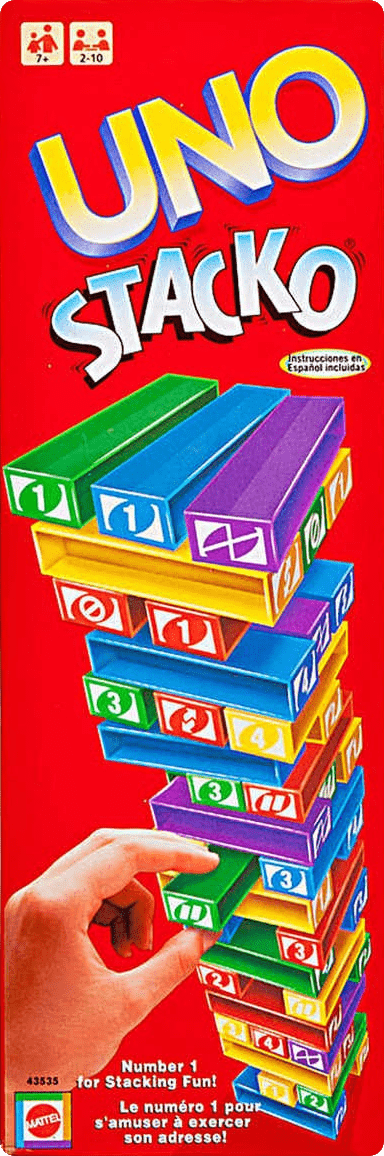
UNO Stacko
(Unknown), Mattel, Inc. · Board game · 1994
2–10 · best 4, 5
20 min
Weight 1.1/5
7.2
rating
Ludopedia
5.6
rating
BGG
7.2
rating
Ludopedia
5.6
rating
BGG
Our Verdict
If you love a fast, laugh‑filled game with a dash of physical tension, UNO Stacko is the ticket.
Highlights
- Mixes action and luck
- Super simple rules
- Great party filler
Keep in mind
- Towers can topple quickly
- Some action symbols may confuse newbies
RECOMMENDED
Rules manual not indexed yet
Upload the PDF rulebook to ask questions about this game with AI.
UNO Stacko blends the tension of Jenga with the colorful strategy of UNO. Each block carries a number and a color, and players must pull a block that matches either the color or the number of the previously taken block. Early editions (1994‑1996) used a special die – the Uno Cube – to dictate whether the next move should match color or number, and also to trigger classic UNO actions like Reverse and Draw Two. From 1999 onward the die was dropped and those actions appear as symbols printed on certain blocks, streamlining play. The goal is straightforward: keep the tower standing while trying to make your opponents cause it to fall. As the tower grows taller, the challenge increases, and action blocks can reverse turn order or force the next player to draw two blocks. The game supports 2‑10 players, runs about 20 minutes, and features lightweight rules perfect for parties, family gatherings, or a quick break. Components are sturdy, colorful plastic blocks, easy to handle, and the dice‑rolling mechanic in older versions adds a splash of luck. While the game is easy to pick up, the constant need to watch the tower’s balance can frustrate the more impatient players when it crashes. Overall, UNO Stacko offers chaotic fun, guaranteed laughs, and a physical challenge that appeals to kids and adults who enjoy fast, interactive games.
GALLERY
11 photos · from the community
Tap any photo to open fullscreen. Photos submitted by the community or publisher.
In English


2
REC
3
REC
4
BEST
5
BEST
6
REC
7
REC
8
OK
9
OK
10
OK
Loading playlist...
Finding best prices...
Prices unavailable at this time.
Price history — last 6 months (lowest new offer)
Mechanics
Categories
Families
Publisher
(Unknown), Mattel, Inc.
Designer
Jim Keifer
Artist
Kinetic
How many players can join?
From 2 up to 10 players, making it great for large groups.
How long does a game take?
About 20 minutes, depending on player count and tower height.
Do I need to know UNO rules?
No, only the action symbols (Reverse, Draw Two, Skip) are used and are explained in the game.
What components are included?
Colored plastic blocks with numbers, some bearing action symbols, and in early editions a special die.
Who is the game suitable for?
Kids 6+, teens and adults looking for a casual, interactive party game.
Is there a variant for more experienced players?
The dice‑based editions add an extra layer of randomness, making the game less predictable.
Do I need a special playing surface?
A flat, stable surface is enough; avoid very slippery tables.

