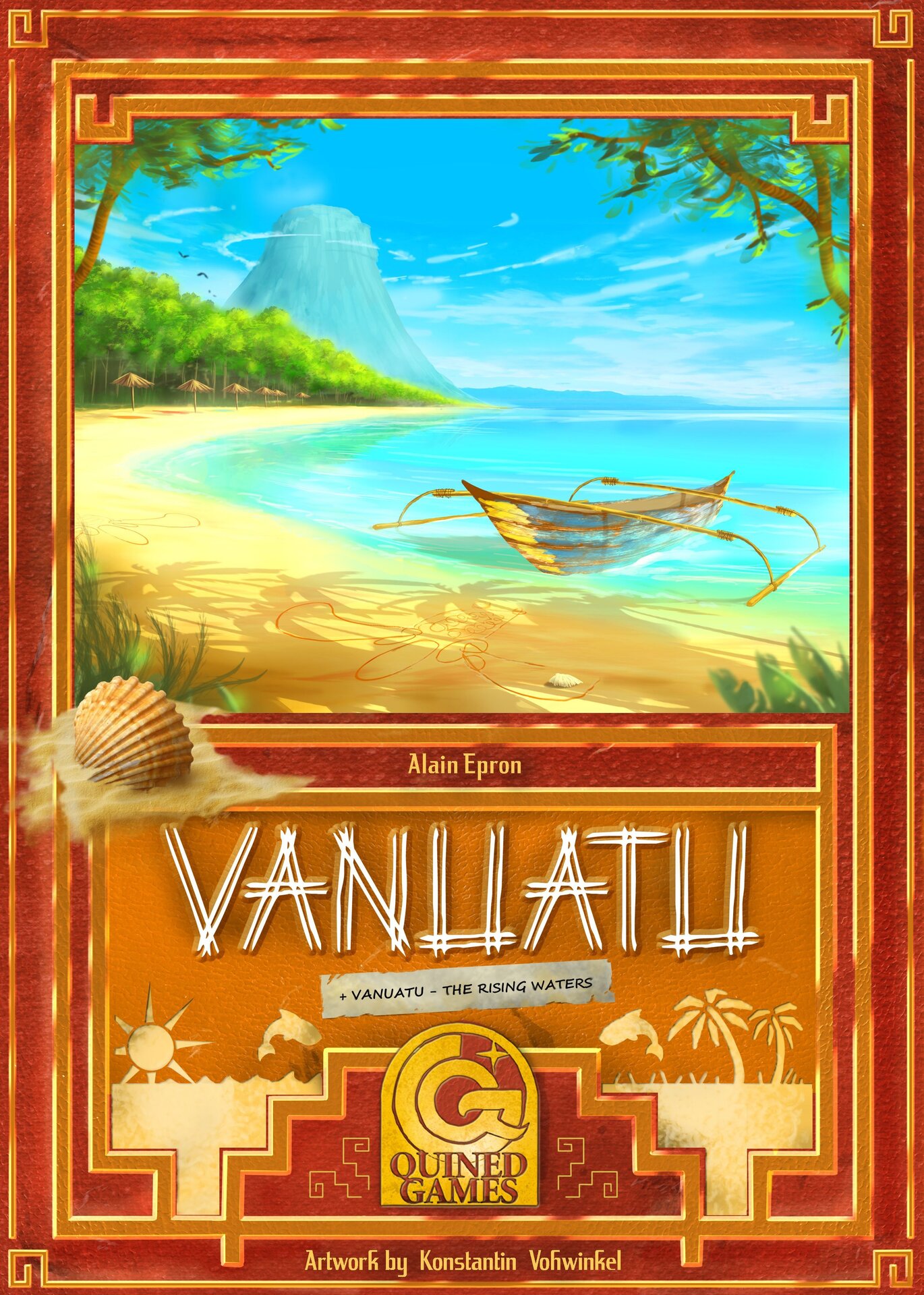
How to Play Vanuatu (Second Edition)
Quined Games · Board game · 2016What do you want to do now
Ask anything about Vanuatu (Second Edition): rules, setup, components, complexity, price, or whether it fits your group.
Video: How to Play
Start here, then follow the written guide
Step by step
Game Objective
In Vanuatu, each player attempts to prosper in the archipelago. To do so, you will fish and sell Fish, recover sunken Treasures, create Sand Drawings, build market Huts, transport Tourists, buy and export native Goods, and donate wealth to gain as many Prosperity Points as possible over the eight rounds of the game.
Preparation (Setup)
- Place the Game Board in the center of the table. Place the three Initial Archipelago Tiles randomly on the highlighted locations on the board.
- Make two separate stacks with the 12 standard Archipelago Tiles, each stack containing one random Tile of each letter (A, B, C, D, E, F). Organize each stack in alphabetical order ("A" on top) and then combine them by placing one stack on top of the other. Reveal the top two Tiles and place them on the Volcano.
- Separate the Fish Tokens and Treasure Tokens by value and place them face up in separate piles near the board.
- Shuffle the 10 Demand Tiles and place them face down next to the board. Draw the top three Demand Tiles and place them face up in the Foreign Trade Chamber.
- Depending on the number of players, return one Tourist Tile to the box:
- With 3 players, return the 4-value Tourist Tile.
- With 4 players, return a 2-value Tourist Tile.
- With 5 players, return the 0-value Tourist Tile.
- Place the 4 Rest Tokens in a face-down pile on the Vanuatu stamp sign.
- Place the 11 Character Tiles face up next to the Game Board in any order.
- Place the Sand Drawing Tokens and the 50 Prosperity Point Markers next to the game board.
- Place the Fish Price Marker on the first space of the Fish Market (value 3). Place the Game Round Marker on the first space of the Game Round Track.
- Place 1 Goods Cube of each color on the Starting Island. Allocate 3 Fish Tokens and 2 Treasure Tokens to the Initial Ocean Tiles based on the symbols present on those Tiles. Place as many Tourist Pawns near the face-up Tourist Tile as indicated on the Tile. Place all other pawns, cubes, and discs next to the board to form a reserve.
- Each player chooses a color and takes all corresponding components (1 Sailboat, 8 Huts, 5 Action Markers, and 3 Player Discs).
- Each player places a Player Disc on the first position (0) of the Prosperity Point Track. Each player places a second Disc on position 3 of the Vanuatu Bank Track; this Vatu Marker is adjusted up or down when Vatus are gained or spent.
- Each player places their Sailboat on the blank Archipelago Tile (which contains no Fish or Treasures).
- Finally, randomly determine the First Player and give them the First Player Token.
Game Flow
Vanuatu takes place over 8 game rounds. A game round consists of 5 phases. Each phase is completed by all players, in turn order, before moving to the next. Each phase begins with the First Player and proceeds clockwise around the table.
Phase I: Round Preparation (skipped in the first round)
- Advance the Game Round Marker to the next space on its track.
- Remove any remaining Tourist Pawns on the current Tourist Tile and remove the Tile from the game. Draw the next Tourist Tile and place it in the Vanuatu Tourism Office. Place a number of Tourist Pawns on the Tile equal to the Tile's value.
- If any Demand Tiles are completely filled, discard them (returning the cubes to the reserve) and move all Tiles below them up one space. Draw the next Demand Tile from the stack and place it at the bottom of the Foreign Trade Chamber. Repeat this process for all filled Demand Tiles. If the stack runs out, shuffle the discards into a new draw pile.
- Completely replenish all Island Tiles that do not have Goods Cubes. Place Goods Cubes from the reserve as indicated by the Tiles.
- Reset the Fish Price Marker to indicate a market price of 3 Vatus.
- The First Player places the two visible Archipelago Tiles on the board in any order, following these placement rules:
- Each Tile must be adjacent to 2 already placed Tiles.
- An Island Tile cannot touch another Island Tile.
- An Ocean Tile must touch an Island Tile.
Note: During the last round of the game (8), there will be no Archipelago Tiles to place. The rest of the round proceeds normally.
- Place Fish and Treasure Tokens as indicated on any newly placed Ocean Tiles, and place Goods Cubes as indicated on any newly placed Island Tiles.
- Draw the next 2 Archipelago Tiles from the stack and place them face up on the Volcano.
Phase II: Character Selection
Starting with the First Player, each player chooses a Character Tile from those available and places it in front of them, face up. The player then returns their previous Character Tile to the set of available Characters (except during round one). The game then passes clockwise to the next player.
Note: It is not possible to choose the same Character in two consecutive rounds.
The Character can be used to provide a bonus during that round, typically when the action related to it is performed.
Note: A player is not obliged to plan the action related to their Character Tile, and is never obliged to use their bonus.
Phase III: Action Planning
Each player uses their Action Markers to plan one or more of the nine possible actions for resolution in the next phase.
In turn order, each player places 2 of their 5 Action Markers on 1 or 2 Action Spaces of their choice. Players then play a second similar round, placing 2 more Action Markers on new spaces or on already planned spaces (to strengthen their positions).
Finally, in turn order, each player places their last Action Marker.
Note: A player cannot plan an action that would be impossible to perform. For example, one cannot place a marker on the SELL Action Space if the player has no Fish Tokens and has not yet placed a marker on the Fish action. If a player without Fish Tokens wants to plan the SELL action, they must first plan the Fish action (and possibly even the Sail action if their Sailboat is not in a fishing area).
Phase IV: Performing Actions
In turn order, each player selects an Action Space where they have a "simple majority" of Action Markers. If possible, the player then performs the corresponding action. Then, the player retrieves all their markers from the Action Space, and the game passes clockwise to the next player. Continue until no Action Markers remain on the board. If a player has no Action Markers remaining on the board, their turn is skipped.
To clarify, "simple majority" (i.e., plurality) is held by the player with the most Action Markers of their color in an Action Space. In case of a tie, the tied player who is higher in turn order holds the majority.
A player with Action Markers still on the board cannot pass their turn. If a player holds the majority in an action that is impossible for them to perform, they must still remove those Action Markers. On the other hand, a player must perform their planned actions, if possible. For example, a player who selects the SAIL action must move at least one space if they can afford it. If a player does not hold the majority on their turn, they retrieve all their markers from any Action Space without performing the action. Finally, a player who holds the majority in multiple Action Spaces chooses which of those spaces to resolve.
A player who does not hold a simple majority in an Action Space cannot perform the corresponding action until they do.
Phase V: Resolve Rest Token bonuses
Players who collected a Rest Token during the round reveal it and collect the associated bonus. They then return the token to the board, face down.
Actions and How to Play
To perform an action on a specific Island Tile, the player's Sailboat must be ADJACENT to that Island Tile. To perform an action on an Ocean Tile, the player's Sailboat must be ON THAT Ocean Tile. Board spaces without Archipelago Tiles are not accessible.
1) SAIL (Ocean)
To sail, the player pays 1 to 3 Vatus and moves their Sailboat an equal number of Ocean Tiles in any direction. The Sailboat cannot move to an Island Tile.
2) BUILD (Island)
To build a Hut, the player's Sailboat must be adjacent to an Island with an available Hut location. The player pays 3 Vatus and places 1 Hut on the Island location. Huts allow the player to perform certain other actions on the Island and can yield Prosperity Points at the end of the game.
Note: A player can have multiple Huts on the same Island.
3) EXPLORE (Ocean)
To explore a shipwreck, the player's Sailboat must be on an Ocean Tile with one or more Treasure Tokens. The player takes a Treasure Token of value corresponding to the number of Treasure Tokens on the Ocean Tile and then returns one of the tokens to the reserve. If kept until the end of the game, the Treasure Token will be worth Prosperity Points. Alternatively, the player can sell the Token for Vatus at any time (no action is required). If sold, the Token is removed from the game and the player gains Vatus equal to the Token's value.
Note: A player is never obliged to sell Treasure Tokens.
4) FISH (Ocean)
To fish, the player's Sailboat must be on an Ocean Tile with one or more Fish Tokens. The player takes a Fish Token of value corresponding to the number of Fish Tokens on the Ocean Tile and then returns one of the tokens to the reserve. Fish Tokens can be sold later for Vatus through the "SELL FISH" action.
5) SELL FISH (Island)
To sell fish, the player's Sailboat must be adjacent to an Island Tile that has a Hut of their color built on it.
The player chooses one or more Fish Tokens in front of them to be sold. For each Token, the player gains Vatus equal to the Token's value multiplied by the price indicated on the Fish Market.
After all sales are made, the Fish Price Marker is moved to the next lower space (but never below 1). The sold Fish Tokens are removed from the game.
6) BUY AND EXPORT GOODS (Island)
To buy and export native Goods, the player's Sailboat must be adjacent to an Island with a Goods Cube. The player takes 1 Goods Cube from the Island and pays the corresponding price in Vatus (1 for kava, 2 for copra, 3 for beef).
The player then places the cube on the topmost Demand Tile with unmet demand for that Good, scoring Prosperity Points based on the type of Good (1 for kava, 3 for copra, 5 for beef), plus a bonus (+2) if this was the last Good needed on the Demand Tile.
Note: If the player buys a Good for which there is no current demand, the Good is immediately lost and no points are scored. Return the cube to the reserve.
7) DRAW (Island)
To draw in the sand, the player's Sailboat must be adjacent to an Island with an incomplete Drawing Location.
More videos
More rules explanations from the community


Rules manual
Official PDF file
Frequently Asked Questions
Quick answers about the rules
What is the objective of Vanuatu (Second Edition)?
How do you set up Vanuatu (Second Edition)?
How do you play Vanuatu (Second Edition)?
Other Games You'll Like
Based on mechanics and theme