
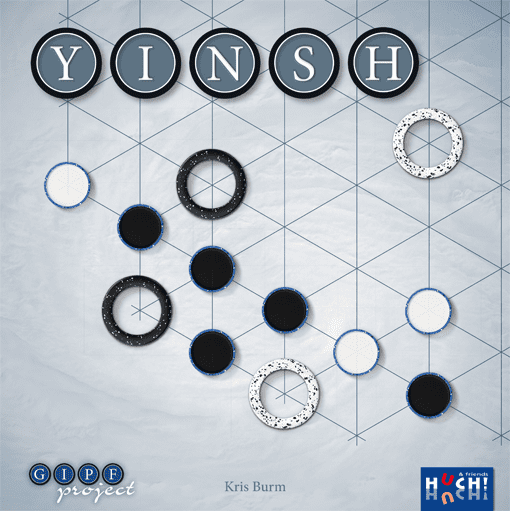
How to Play YINSH
Don & Co., DiceTree Games, HUCH! · Board game · 2003What do you want to do now
Ask anything about YINSH: rules, setup, components, complexity, price, or whether it fits your group.
Video: How to Play
Start here, then follow the written guide
Step by step
Game Objective: Find Order in Chaos!
Welcome to the intriguing world of YINSH, the sixth game in the GIPF project! Prepare for a duel of minds where the fine line between chaos and strategy is constantly challenged. Your main objective is simple, but the journey to achieve it is full of twists: you need to be the first player to remove 3 of your own rings from the board.
How do you do that? Each time you manage to form a line of 5 markers of your color, you remove one of your rings. So, for the final victory, you will have to form three of these lines of 5 markers!
Master Tip: If you enjoy faster and more dynamic games, try the Blitz Version (see the End Game and Scoring section). It's perfect for learning and having fun without commitment!
Preparation (Setup): Setting Up the Board
Let's set up the table for the battle of YINSH. It's super easy!
- Position the Board: Place the game board between the players so that the lines marked with letters run from one player to the other. Each player should have 3 discard spaces for rings on their side of the board.
- Choose Colors and First Player: Decide who starts (it can be by coin toss, or however you prefer!). The starting player will be "White" and takes the 5 white rings. The other player takes the 5 black rings.
- Prepare the Marker Reserve: Place the 51 markers (which are white on one side and black on the other) next to the board, in an easily accessible location for both. This is your stock.
- Initial Ring Placement: The board starts empty. Players, alternately, place one of their rings at a time on any free intersection on the board (including the edges) until each has placed their 5 rings. Once all 10 rings are on the board, the initial position is set and the game can truly begin!
The Game Turn: Moving Rings and Flipping Markers
In YINSH, each turn is a strategic dance of movement and transformation. Here's how it works:
- Take a Marker: Every turn begins by taking one marker from the stock.
- Choose a Ring and Place the Marker: Decide which of your rings you want to move. Place the marker you just took inside that ring, with your color facing up, occupying the same space as the ring. Remember: you only move the ring, not the marker!
- Move the Ring: Now, move the ring (with the marker inside) following these crucial rules:
- The marker you just placed remains in place.
- The ring must always move in a straight line to an empty space.
- It can move over one or more empty spaces.
- It can jump over one or more markers (of any color), as long as they are aligned without interruption. If you jump, the ring must stop in the first empty space immediately behind the jumped markers.
- You can first move over empty spaces and then jump markers. However, once the ring jumps markers, it cannot move over empty spaces anymore.
- A ring can only jump over markers, never over other rings.
- Flipping Markers (if applicable):
- If you moved the ring only over empty spaces, your turn ends when you place it in the new location.
- If you jumped over one or more markers, you must flip all jumped markers. This includes both your markers and your opponent's! White markers turn black and black markers turn white. Important: Do not flip the markers while moving the ring; first move the ring and then flip the markers. The marker you placed in the ring at the beginning of the turn is not flipped, as it was not jumped.
- Forming a Line and Removing a Ring:
- If, after your movement and marker flipping, you have formed a line of 5 markers of your color (adjacent and in a straight line, rings do not count), you must:
- Remove the 5 markers from the line from the board and return them to the stock.
- Remove one of your rings from the board and place it in one of the 3 discard spaces next to you. This indicates that you have formed a line.
- Lines Larger than 5: If you form a line with more than 5 markers, you can choose which 5 consecutive markers to remove.
- Multiple Lines in One Turn:
- If you form two (or more) lines that do not intersect, you remove both lines and 2 of your rings.
- If the lines intersect, you choose which line to remove. The other line will remain incomplete and its remaining markers stay on the board. You remove only 1 ring.
- Forming a Line for the Opponent: If you, unintentionally, form a line of 5 markers of your opponent's color, they must remove that line and one of their rings (they choose which one) before making their own move.
- Lines for Both: If you form a line for yourself and one for the opponent in the same turn, you deal with your line first, and then the opponent deals with theirs.
- If, after your movement and marker flipping, you have formed a line of 5 markers of your color (adjacent and in a straight line, rings do not count), you must:
End Game and Scoring: The Final Victory
The game of YINSH can end in a few ways:
- Victory by Rings Removed: The game ends as soon as a player removes their third ring from the board. That player is the winner, as they managed to form 3 lines of 5 markers of their color!
- Simultaneous Victory: If your move results in the formation of your third line and, at the same time, your opponent's third line, you win! This is because you remove your third ring first.
- Out of Markers: If all markers are placed on the board before any player manages to remove 3 rings, the game ends. The player who has removed the most rings wins. In case of a tie in the number of rings removed, the game ends in a draw.
Blitz Version (Optional)
For a super fast game, try the Blitz Version! The rules are the same, but the objective is simplified: the first player to form only one line of 5 markers of their color wins the game. It's that simple!
Tips for Winning: Be Cunning, Be YINSH!
YINSH is a game of deep strategy, where every move can have unexpected consequences. Here are some tips to start mastering the chaos:
- Balance is Key: Forming a line brings you closer to victory, but it also costs you a ring, limiting your future options. Try to find a delicate balance between advancing your own goals and, sometimes, forcing your opponent to remove a ring, restricting their possibilities.
- The Third Line is What Counts: Don't worry too much about having an overwhelming advantage of markers on the board. What really matters is the ability to form the third line. Pay attention to opportunities to create your own lines and to prevent your opponent from completing theirs.
- Beware of Ambiguity: A move that seems brilliant in one situation can be disastrous in another. Always think about the long-term consequences. Flipping markers can create a line for you, but it can also set the stage for an opponent's line in the next turn. Stay vigilant!
More videos
More rules explanations from the community



Rules manual
Official PDF file
